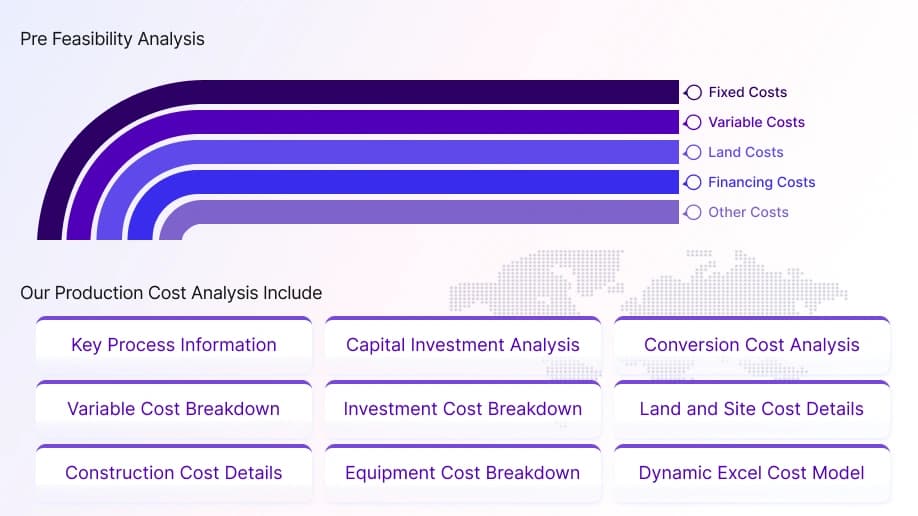
The report provides a detailed analysis essential for establishing a 2,4-Dichlorophenoxy Acetic Acid production plant. It encompasses all critical aspects necessary for 2,4-Dichlorophenoxy Acetic Acid production, including the cost of 2,4-Dichlorophenoxy Acetic Acid production, 2,4-Dichlorophenoxy Acetic Acid plant cost, 2,4-Dichlorophenoxy Acetic Acid production costs, and the overall 2,4-Dichlorophenoxy Acetic Acid production plant cost. Additionally, the study covers specific expenditures associated with setting up and operating a 2,4-Dichlorophenoxy Acetic Acid production plant. These encompass production processes, raw material requirements, utility requirements, infrastructure needs, machinery and technology requirements, manpower requirements, packaging requirements, transportation requirements, and more.
2,4-Dichlorophenoxy Acetic Acid is a systemic herbicide that is widely used in agrochemical and chemical industries. It is a strong acid that is a secondary plant growth regulator utilized in the formulation and production of herbicides that are used to control broadleaf weeds. The herbicides prepared using 2,4-D are utilized to control weeds in forestry for trunk injection and stump treatment. It is used for the selective control of brush in the forests, especially coniferous forests. Also, it is used in the formulation of pesticides that are used to kill and prevent pest attacks in agricultural fields.
The global market for 2,4-Dichlorophenoxy Acetic Acid is mainly driven by its demand observed in the agrochemical and chemical industries. Its utilization in the preparation and production of herbicides and pesticides boosts its demand in the agrochemical sector. Its applications in the formulation of pesticides as a strong acidic compound help in driving its demand in the chemical and agrochemical industry. The advancements in technology improve its formulation and application techniques, making it more in demand among agricultural producers. Also, favorable regulatory support for agrochemical use in various regions contributes to the market's growth. Overall, all these factors contribute to industrial 2,4-Dichlorophenoxy Acetic Acid procurement around the world.
Raw Material for 2,4-Dichlorophenoxy Acetic Acid Production
According to the 2,4-Dichlorophenoxy Acetic Acid production plant project report, the key raw materials used in the production of 2,4-Dichlorophenoxy Acetic Acid include Phenol-Chlorine Gas-Chloroacetic Acid.
Production Process of 2,4-Dichlorophenoxy Acetic Acid
The extensive 2,4-Dichlorophenoxy Acetic Acid production cost report consists of the following major industrial production process:
- From Phenol, Chlorine Gas, and Chloroacetic Acid: The production process of 2,4-Dichlorophenoxy Acetic Acid starts with the chlorination of phenol, forming 2,4-dichlorophenol. This compound is then reacted with chloroacetic acid, forming a mixture of 2,4-dichlorophenoxyacetic acid and other polychlorophenols. Finally, the mixture is filtered to get pure 2,4-dichlorophenoxyacetic acid as the final product.
2,4-Dichlorophenoxy Acetic Acid has a chemical formula of C8H6Cl2O3 and a molecular weight of 221.04 g/mol. It is a white to yellow colored powder with a slight phenolic odor. The compound decomposes on heating, and the melting point is at around 140 °C. It is a water-soluble solid chemical that also dissolves in alcohol. It is highly soluble in ethanol and yields a clear to slightly faint yellow solution. The compound remains stable under a standard temperature of 25 °C. It decomposes on heating at a high temperature while emitting toxic fumes of chlorides. Its reaction with alkali metals and amines gives water-soluble salts. It is a chemical oxidant that is highly toxic in nature and can harm the eyes and skin on direct exposure.