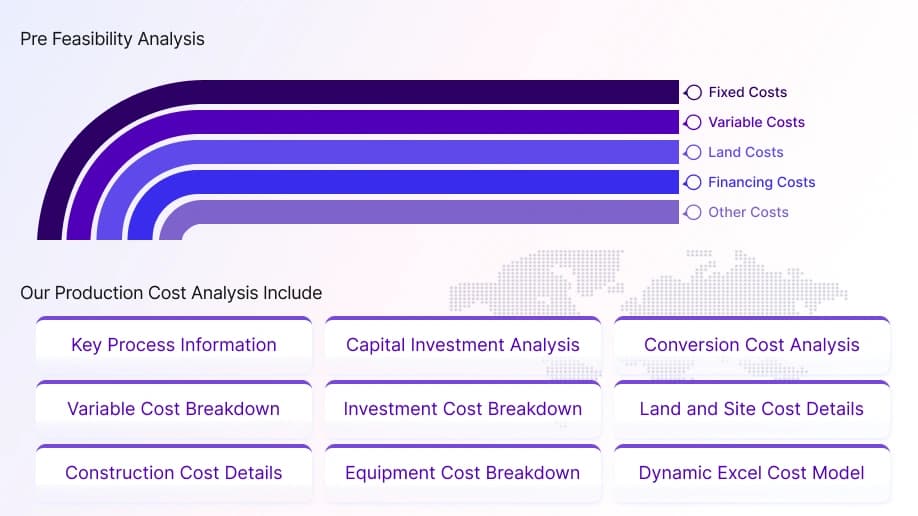
The report provides a detailed analysis essential for establishing an Adipic Acid production plant. It encompasses all critical aspects necessary for Adipic Acid production, including the cost of Adipic Acid production, Adipic Acid plant cost, Adipic Acid production costs, and the overall Adipic Acid production plant cost. Additionally, the study covers specific expenditures associated with setting up and operating an Adipic Acid production plant. These encompass production processes, raw material requirements, utility requirements, infrastructure needs, machinery and technology requirements, manpower requirements, packaging requirements, transportation requirements, and more.
Adipic Acid is an organic compound used in the production of nylon 6,6. Nylon gets processed and turned into fibers for making automobile tire cords, carpeting, and clothing. It is also used for producing plasticizers and lubricant components. Furthermore, it is among the most essential monomers in the polymer industry as it is used to manufacture other polymers like polyurethanes.
In medical end-uses, it is added into drug tablets to help the controlled release of acidic as well as essential drug compounds. In addition, in food-related applications, it is employed as a pH regulator, acidulant, gelling aid, and as leavening and buffering agent. Unlike most food acids, it is a dicarboxylic acid, and those which have the lowest acidity level. It is utilised in numerous functions such as jams, beverages, as well as in baked goods.
The market for Adipic Acid is driven by its usage to manufacture nylon 6,6, which is extensively used in textiles, automotive parts, and engineering plastics. Its utilization as a critical ingredient to produce polyurethanes, which are used in furniture, insulation, automotive components, and footwear amplifies its market value even more. Its incorporation into drug tablets to help the controlled release of acidic as well as essential drug compounds fuels its market in the pharmaceutical and medical industries.
As a pH regulator, an acidulant, a gelling aid and a leavening and buffering agent besides being an additive in functions like jams, beverages and baked products increases its requirement in the food industry. Overall, industrial Adipic Acid procurement is influenced by its application in various industries such as textile, automotive, furniture, plastics, pharmaceutical and medical, and food industries, the availability of its raw materials (cyclohexene, KA oil, and butadiene), the cost of its raw materials, regional market growth, sustainability trends, and technological advancements.
Raw Material for Adipic Acid Production
According to the Adipic Acid production plant project report, the key raw materials used in the production of Adipic Acid include cyclohexene; KA oil; butadiene.
Production Process of Adipic Acid
The extensive Adipic Acid production cost report consists of the following major industrial production processes:
- Production via oxidative cleavage process: The production process of Adipic Acid involves the oxidative cleavage process. In this process, cyclohexene undergoes oxidation using hydrogen peroxide as the oxidizing agent to produce Adipic Acid as the final product and water as the by-product.
- Production via oxidation: The production process of Adipic Acid involves the oxidation of KA oil. In this process, cyclohexanone and cyclohexanol, together called KA oil (ketone-alcohol oil), are oxidized with nitric acid (oxidizing agent and catalyst) at high temperature to produce Adipic Acid as the final product and glutaric acid and succinic acid as the by-products.
- Production via carbonylation: The production process of Adipic Acid involves carbonylation of butadiene. In this process, butadiene, carbon monoxide, and methanol are carbonylated in the presence of cobalt carbonylation catalyst to produce dimethyl adipate, which is then hydrolyzed to Adipic Acid.
Adipic Acid with the chemical with the formula (CH2)4(COOH)2 is an alpha,omega-dicarboxylic acid, which is butane's 1,4-dicarboxy derivative, an alpha,omega-dicarboxylic acid, and a fatty acid. Adipic acid appears to be a white crystalline solid. It is slightly soluble in water and soluble in acetone and alcohol. The organic compound melts at 152 ºC. Its net charge is 0, and its molecular weight is 146.14120 g/mol.