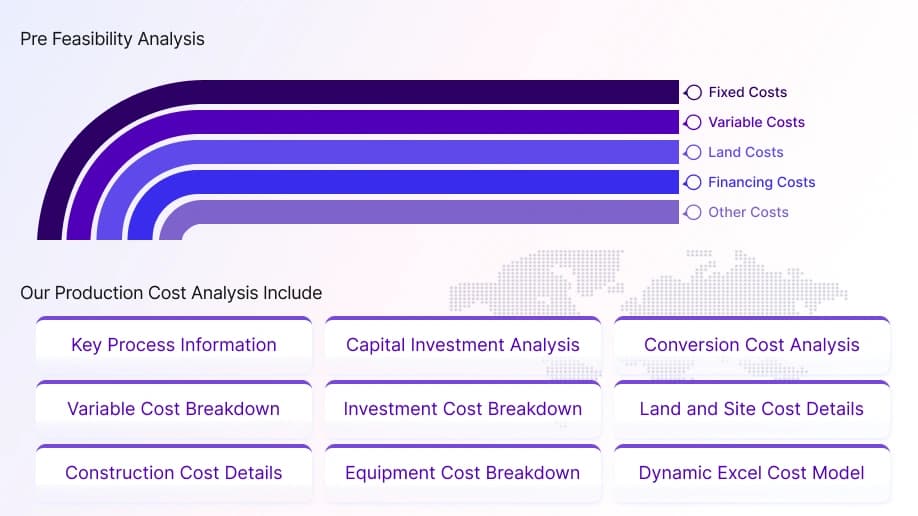
The report provides a detailed analysis essential for establishing an Aripiprazole production plant. It encompasses all critical aspects necessary for Aripiprazole production, including the cost of Aripiprazole production, Aripiprazole plant cost, Aripiprazole production costs, and the overall Aripiprazole production plant cost. Additionally, the study covers specific expenditures associated with setting up and operating an Aripiprazole production plant. These encompass production processes, raw material requirements, utility requirements, infrastructure needs, machinery and technology requirements, manpower requirements, packaging requirements, transportation requirements, and more.
Aripiprazole is used for the treatment of mental illnesses like major depressive disorder, bipolar disorder, autistic spectrum disorder (ASD), and schizophrenia. It is utilized in the management of several symptoms connected to these illnesses, such as sadness, mood swings, irritability, delusions, and hallucinations. Aripiprazole acts as an antagonist of alpha-adrenergic and 5-HT2A receptors and agonist of dopaminergic and 5-HT1A receptors.
The procurement of Aripiprazole is influenced by its application in the pharmaceutical and medical industries as an antipsychotic medication. The escalating prevalence of psychotic disorders has been propelling the market for Aripiprazole, as it stands out as an effective antipsychotic treatment. Additionally, its application in treating acute bipolar I disorder, especially in patients who struggle with pill compliance, further enhances its demand.
The drug’s utility extends to off-label uses, such as aiding in the management of drug use disorders and symptoms of dementia, contributing significantly to its adoption. Moreover, Aripiprazole's ability to mitigate side effects associated with dopamine neurotransmission positions it as a superior choice for patients dissatisfied with other antipsychotics.
This is crucial in settings where patients experience persistent motor and metabolic disturbances. Furthermore, its effectiveness in reducing alcohol cravings and restoring normal sexual function in dependent individuals amplifies its market presence, supported by increased mental health awareness and continuous regulatory approvals. Overall, industrial Aripiprazole procurement is influenced by its application in the pharmaceutical and medical industries, rising cases of antipsychotic cases, fewer side effects, better tolerability, off-label uses, enhanced efficacy, increased mental health awareness, and regulatory approvals.
Raw Material for Aripiprazole Production
According to the Aripiprazole production plant project report, the key raw material used in the production of Aripiprazole includes 7-hydroxy-3,4-dihydroquinolin-2(1H)-one.
Manufacturing Process of Aripiprazole
The extensive Aripiprazole production cost report consists of the following major industrial production process:
- Production from 7-hydroxy-3,4-dihydroquinolin-2(1H)-one: The production process of Aripiprazole starts with refluxing the starting material with 1,4-dibromobutane in the presence of aqueous K2CO3 solution to form an intermediate. The intermediate is reacted with 1-(2,3-dichlorophenyl)piperazine in the presence of acetonitrile and NaI, followed by refluxing the whole solution to produce Aripiprazole.
Aripiprazole, commercially known as Abilify, is a colorless compound having the molecular formula C23H27Cl2N3O2 and a molecular weight of 448.4 g/mol. It has a boiling point in the range of 139.0-139.5 °C and melting point in the range of 137-140 °C. It has a water solubility of 0.00777 mg/mL. The value of its dissociation constant, pKa, is 7.6. It has a log P value of 5.21. It is an antipsychotic medication used to treat various psychotic disorders.