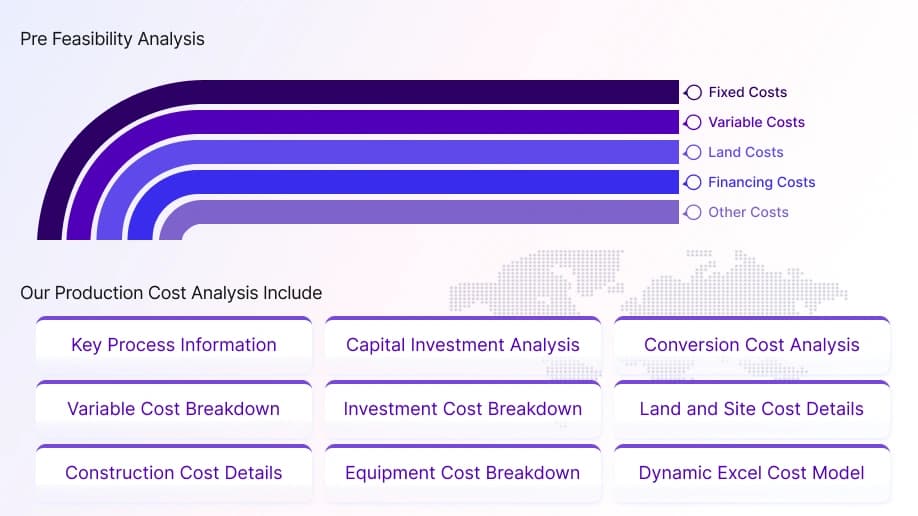
The report provides a detailed production cost analysis for Banana. It encompasses all critical aspects necessary for Banana production, including the cost of Banana production, Banana production cost model, and other extensive details. These encompass production processes, raw material requirements, utility requirements, infrastructure needs, machinery and technology requirements, manpower requirements, packaging requirements, transportation requirements, and more.
Banana is a tropical fruit, which is rich in a variety of nutrients that are quite necessary for maintaining good health. Its fibre is used to print money, make yarn, shoes, abrasive backing papers, carrier bags, tea bags, rope cordage, and more. Banana leaves are utilized as a hygienic alternative to dining plates. It is biodegradable and can be further processed to produce organic manures, which can be used in crop fields which further facilitate vegetation. Flowers developed on banana trees are considered a vegetable variety that is widely consumed across the world. Apart from its fruits, the plant, along with its leaves, is widely utilized for various applications in multiple industries.
The industry uses banana sap, which is regarded as an indelible ink. The plant's fibre is slowly becoming more and more well-known worldwide because of its eco-friendly nature. Its primary usage as a source of fibre to print money, make yarn, carrier bags, tea bags, rope, etc., is what drives the market for this commodity for the food & beverage, textile, paper, printing industry. Due to its flavour, taste and nutrients present in it, the fruit, pulp and its leaves have great demand in the food, vegetable, and the culinary industry, respectively. It is consumed both in its fresh and processed form.
Moreover, the pseudo stem obtained from the inner core of the plant is used as a vegetable and has many therapeutic uses, which eventually amplify its demand in the medical sector. Additionally, industrial banana procurement is governed by various factors which include seasonality, marketing year of banana, quality standards, sustainability practices, regulatory compliance, supply chain management, etc. Bananas are important for the environment and economy because of their versatility from their fruits to their leaves and fibres, which contribute to their economic and environmental significance to a great extent.
Raw Material for Banana Production
According to the Banana production cost report, the major raw materials for Banana production include Rhizome/Corms.
Production Process of Banana
The extensive Banana production cost report consists of this major industrial production process:
- Production by agricultural methods: Banana is a fruit variety that may be cultivated by planting rhizomes or corms. It takes nine to twelve months for the banana to mature and become a fruit-bearing tree. Also, it takes six to seven months for it to reach inflorescence and eventually bear fruit. After planting, the fruits are harvested eleven to sixteen months later. It can be harvested throughout the year. However, the type of plant, cultural practices, and environment all have a significant impact on the crop.
Banana is a fruit with soft and pulpy flesh enclosed in a soft yellow peel. It contains calories, protein, carbohydrates, natural sugar, fibre, and 0.3 grams of fat. It is a rich source of various minerals and can provide great health benefits on regular consumption. Banana is a fruit variety that is grown from a Banana corm or rhizome. It belongs to the Musaceae family and is one of the most crucial fruit varieties in the world. It is mainly grown in tropical regions, and its availability is observed throughout the year. The fruit has great demand in the food market due to its flavor, taste, and nutrients present in it. It is consumed in fresh and processed form. The fruit is incorporated in the preparation of savory as well as sweet delicacies.