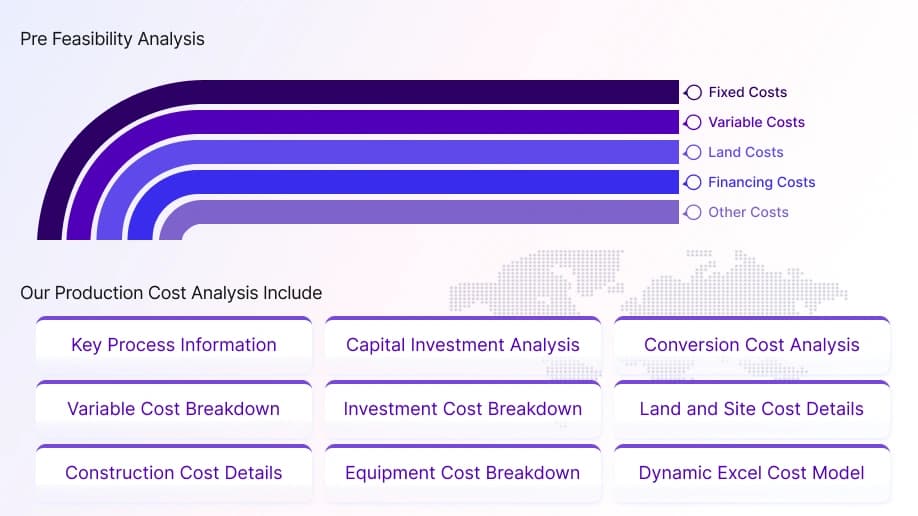
The report provides a detailed analysis essential for establishing a Diammonium Phosphate production plant. It encompasses all critical aspects necessary for Diammonium Phosphate production, including the cost of Diammonium Phosphate production, Diammonium Phosphate plant cost, Diammonium Phosphate production costs, and the overall Diammonium Phosphate production plant cost. Additionally, the study covers specific expenditures associated with setting up and operating a Diammonium Phosphate production plant. These encompass production processes, raw material requirements, utility requirements, infrastructure needs, machinery and technology requirements, manpower requirements, packaging requirements, transportation requirements, and more.
Diammonium Phosphate (DAP) is used as a fertilizer for its high supplement substance and excellent physical characteristics. In crops, it adds high nutritional content, which is required for nurturing crops, as the fertilizer is highly soluble and can easily dissolve in soil, releasing ammonium and phosphorus. In addition, it can also be used as a fire retardant, chemical additive, and corrosion inhibitor. Also, it is employed for several industrial processes, such as in production chemicals and metal finishing, as well as in yeast fermentation during the production of wine.
The market for Diammonium Phosphate is driven by its usage as a fertilizer to enhance crop yields and agricultural productivity, which elevates its demand in the agriculture industry. Its balanced nutrient composition of nitrogen and phosphorus makes it a preferred choice for many crops, which amplifies its market appealhold.. Its other end-uses, such asincluding as a fire retardant, chemical additive, and corrosion inhibitor, to manufacture chemicals, metal finishing, and wine production, boosts its demand even more. Overall, industrial Diammonium Phosphate procurement is influenced by its application in the agriculture industry, its various end-uses, its balanced nutrition and composition, government initiatives, environmental sustainability concerns, and regional growth.
Raw Material for Diammonium Phosphate Production
According to the Diammonium Phosphate production plant project report, the key raw materials used in the production of Diammonium Phosphate include phosphoric acid-ammonia.
Production Process of Diammonium Phosphate
The extensive Diammonium Phosphate production cost report consists of the following major industrial production process:
- Production from phosphoric acid and ammonia through ammonia-granulation process: The production process of Diammonium Phosphate occurs via the ammonia-granulation process with phosphoric acid and ammonia as the starting materials. The process involves the pre-neutralization of phosphoric acid and ammonia to react with each other in a pipe reactor, followed by granulation to produce Diammonium Phosphate.
Diammonium Phosphate (DAP) is a widely used phosphorus fertilizer comprising two common constituents of the fertilizer industry. It is comparatively higher in nutrients with excellent physical properties making it ideal for farming and across other sectors. It is an inorganic phosphate, which is the diammonium salt of phosphoric acid. It is produced by reacting 1 mole of phosphoric acid with 2 moles of ammonia, which forms a slurry that gets solidified into a granular form. It dissolves in soil and delivers temporary alkalization of the pH of the solution of soil. It is soluble in water and available in greyish-white or off-white in color. It is an excellent source of phosphorus in phosphate form and has a higher nitrogen content than MAP.