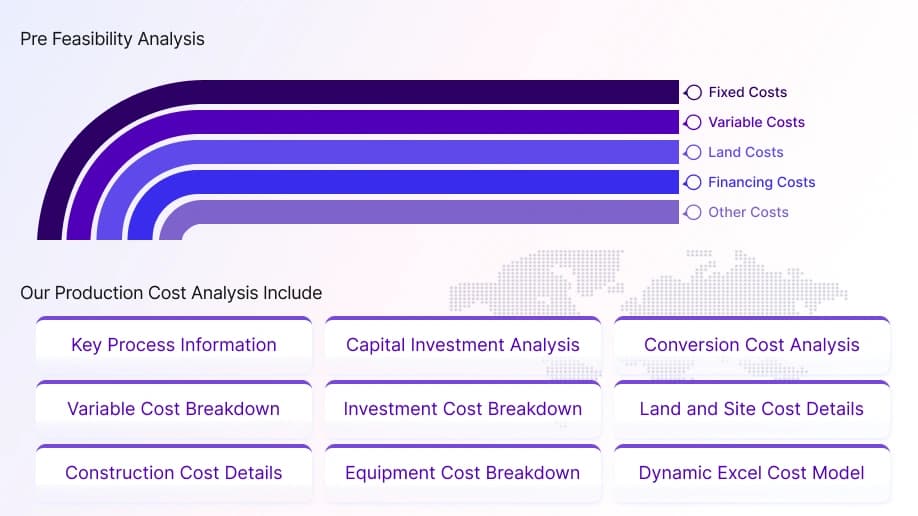
The report provides a detailed analysis essential for establishing a diamond production plant. It encompasses all critical aspects necessary for diamond production, including the cost of diamond production, diamond plant cost, diamond production costs, and the overall diamond production plant cost. Additionally, the study covers specific expenditures associated with setting up and operating a diamond production plant. These encompass production processes, raw material requirements, utility requirements, infrastructure needs, machinery and technology requirements, manpower requirements, packaging requirements, transportation requirements, and more.
Diamond is a hard and shiny hydrocarbon rock obtained by processing and polishing kimberlite rocks. It is majorly associated with the mineral, jewelry, glass, and construction industries. It is primarily used as a precious stone or gem that is embedded in expensive wearable and decorative jewelry pieces. All abrasive surfaces utilize diamonds in cutting blade solutions. It is also used in the construction industry for sawing, cutting, grinding, cutting diaphragm walls, tunneling, and operations. Because of its exceptional hardness, diamond is especially well suited for cutting dimension stones like granite and marble. Moreover, it is used to quickly drill holes and is often included for boring and drilling operations.
The market for diamonds is strongly influenced by the variation in their demand as a strong and expensive stone or gem in the jewelry, construction, and glass industries. Its usage in cutting, polishing, and structuring glass sheets, and its applications in drilling, boring, sawing, grinding, and tunneling operations in the construction sectors, fuels its demand in the global market. Moreover, its prime application as an expensive gem in jewelry design stands as one of the prominent factors that drive its demand for jewelry. Industrial diamond procurement is determined by various factors, including its demand in the market, along with the market prices, logistics, production cost, and supply, etc. Therefore, fluctuations in its demand, especially as a strong and hard precious stone for jewellery, along with for glass and construction purposes, are highly essential to govern its procurement across various regions.
Raw Material for Diamond Production
According to the diamond production plant project report, the key raw material for diamond production includes kimberlite mineral rock.
Production Process of Diamond
The extensive diamond production cost report consists of the major industrial production process:
- By Opencast Mining: Diamond is a hard hydrocarbon rock obtained by mining. It is extracted from the mineral rock and then processed through weathering, crushing, and polishing to obtain the final product.
Diamond is a very hard allotrope of carbon with its carbon atoms organised in a diamond cubic form. It is the hardest and most thermally conductive material found in nature. It has uses in the cutting and polishing industries because of its unique qualities. Natural diamonds come from the earth's mantle, but synthetic diamonds are created using the Chemical Vapour Deposition (CVD) method using high-purity carbon and extreme heat and pressure.
It is a native mineral. It typically varies from yellow, brown, or grey to colourless. The molar mass of a diamond is 12.01 g/mol and its specific gravity is 3.52±0.01. The density of the diamond varies from 3.5–3.53 g/cm3.