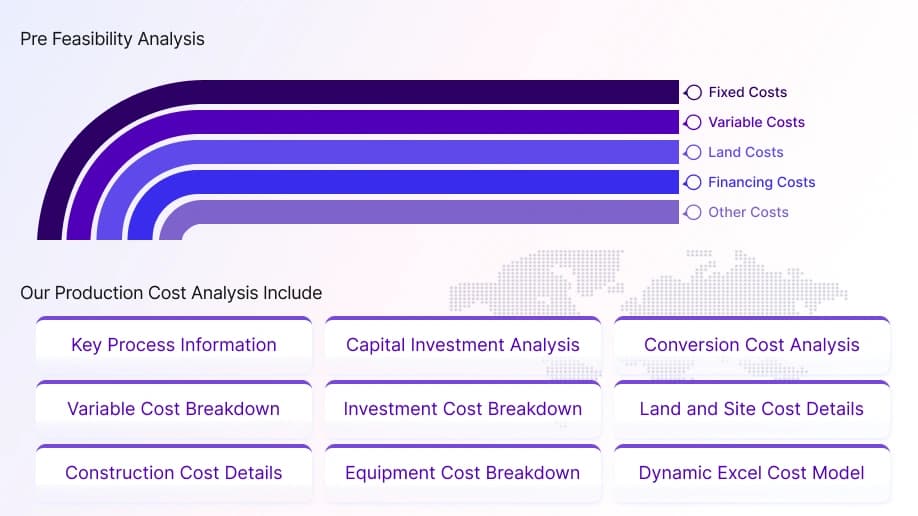
The report provides a detailed analysis essential for establishing a Dioscin production plant. It encompasses all critical aspects necessary for Dioscin production, including the cost of Dioscin production, Dioscin plant cost, Dioscin production costs, and the overall Dioscin production plant cost. Additionally, the study covers specific expenditures associated with setting up and operating a Dioscin production plant. These encompass production processes, raw material requirements, utility requirements, infrastructure needs, machinery and technology requirements, manpower requirements, packaging requirements, transportation requirements, and more.
Dioscin is a naturally occurring steroid saponin, which has various pharmacological effects. It has been reported to have anti-inflammatory and antioxidant properties, making it useful in the treatment of diseases caused by inflammation (such as autoimmune diseases) and oxidative stress respectively. It also exerts anticancer activity and shows antiproliferative activity against various cancer cells. Besides, Dioscin can be used in rising the sensitivity of insulin receptors and the regulation of blood sugar in the metabolic disorder, such as diabetes. It is also noted to possess antibacterial properties and is therefore recommended for use as a natural antibiotic.
The market for Dioscin is driven by its usage as a spirostanol glycoside used for the treatment of autoimmune diseases, cancer, and several hormonal disorders, which significantly promotes its demand in the pharmaceutical and medical industries. The widespread occurrence of hormonal disorders and autoimmune diseases is significantly increasing the demand for Dioscin. Its utilization in Chinese medicine for its health benefits, expanding its usage in herbal care and dietary supplements, further contributes to its growing demand in ayurvedic and nutrition industries.
The drug’s effectiveness in skin health and renewal is utilized in the cosmetic industry, which promotes its adoption in the market. Overall, industrial Dioscin procurement is influenced by its usage in the pharmaceutical and medical industries, its usage in the ayurvedic and nutrition industries, a wide range of pharmacological properties, rising cases of hormonal disorders and autoimmune diseases, and regulatory approvals.
Raw Material for Dioscin Production
According to the Dioscin production plant project report, the key raw material used in the production of Dioscin includes diosgenin.
Production Process of Dioscin
The extensive Dioscin production cost report consists of the following major industrial production process:
- Production from Dioscin: The production process of Dioscin starts with the glycosylation reaction between diosgenin and the perbenzoylated glucopyranosyl N-phenyl trifluoroacetimidate donor, catalyzed by TMSOTf to form the corresponding 3-O-β-glycoside. In the next step, the benzoyl groups are removed, followed by the selective 3′,6′-OPiv protection to give the 2′,4′-diol acceptor. The compound is coupled with peracetylated l-rhamnopyranosyl N-phenyl trifluoroacetimidate to form the desired monodesmosidic trisaccharide derivative, which undergoes deprotection to produce Dioscin as the final product.
Dioscin is a natural steroidal saponin glycoside derived from diosgenin. It is a white crystalline powder having the molecular formula C45H72O16 and a molecular weight of 869.0 g/mol. It has a melting point in the range of 220-222°C. It has a log P value of 2.4. It is soluble in methanol, ethanol, and DMSO. It dissolves to some extent in water. It is stable in standard storage settings, but in acidic or basic environments, it can hydrolyze to create its aglycone, diosgenin. It is a spirostanol glycoside consisting of a steroidal aglycone (diosgenin) linked to a disaccharide chain (two glucose units) at the C-3 position.