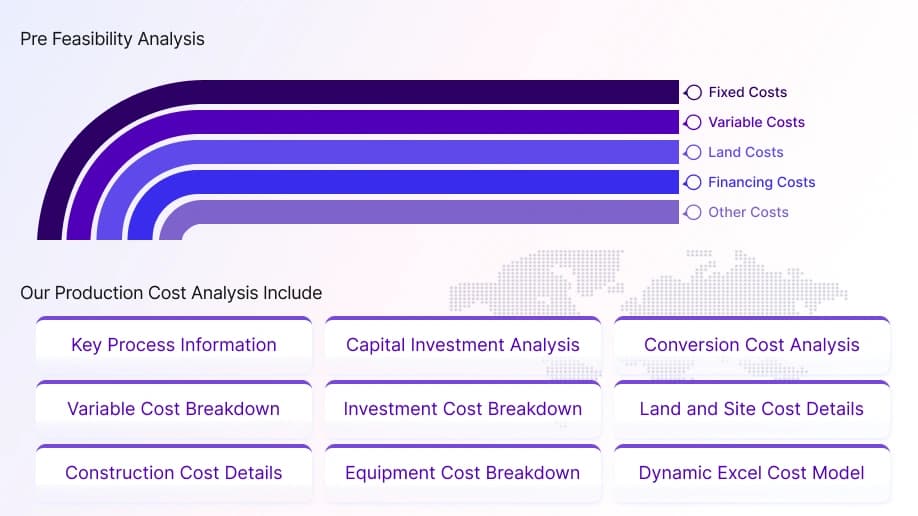
The report provides a detailed analysis essential for establishing a DL Methionine production plant. It encompasses all critical aspects necessary for DL Methionine production, including the cost of DL Methionine production, DL Methionine plant cost, DL Methionine production costs, and the overall DL Methionine production plant cost. Additionally, the study covers specific expenditures associated with setting up and operating a DL Methionine production plant. These encompass production processes, raw material requirements, utility requirements, infrastructure needs, machinery and technology requirements, manpower requirements, packaging requirements, transportation requirements, and more.
DL-Methionine is an essential amino acid and an important ingredient added to commercial pet treats, foods, and products. In pharmaceuticals, it is used to treat liver disorders and as an antioxidant. It is also utilized in the personal care industry for its skin-conditioning properties and as a fragrance component. In agriculture, it is important for animal nutrition to promote healthy growth in livestock and aquaculture. Additionally, DL-Methionine plays a role in chemical production and biomedical research, mainly in cancer treatment strategies.
The market for DL-Methionine is primarily driven by its application as an essential amino acid mainly found in animal-based products, such as meat, eggs, and dairy products. Its utilization as a feed additive in animal nutrition to promote growth and improve the efficiency of feed utilization, elevates its demand in the animal feed and livestock industries.
The global rise in the demand and consumption of meat and other animal-based products boosts its market growth. Its function as an essential nutrient to boost immunity, improve digestion, and prevent fatigue fuels its market value in the healthcare sector. Additionally, its usage as a dietary supplement to treat conditions such as liver disease, anemia, and depression also supports its market expansion. The rising use of amino acids in human dietary supplements, along with the increasing demand for animal feed, further impacts the industrial DL Methionine procurement.
Raw Material for DL Methionine Production
According to the DL Methionine production plant project report, the key raw materials used in the production of DL Methionine include methyl mercaptan-acrolein.
Production Process of DL Methionine
The extensive DL Methionine production cost report consists of the following major industrial production process:
- Production from Acrolein: The production process of DL-Methionine starts with acrolein and methyl mercaptan as the starting materials. It is a multi-step process that involves reactions like mercaptan synthesis, condensation, amination, hydrolysis, and decarboxylation. The first step is the condensation of methyl mercaptan (methanol and hydrogen sulfide are reacted to produce methylmercaptan) with acrolein using a base catalyst.
The resulting methylmercaptopropionaldehyde (MMP) undergoes hydrolysis, amination with ammonia, and decarboxylation at high temperatures. The crude DL-methionine formed is purified by crystallization or ion-exchange chromatography. Sodium hydroxide solution is added to this and heated to give salts of dl-methionine, followed by heating the mixture, cooling the dl-methionine solution, decolorizing, and neutralizing to obtain precipitated dl-methionine, led by the addition of hydrochloric acid to completely precipitate dl-methionine followed by filtering and evaporation of hydrochloric acid to give pure dl-methionine.
Methionine is an amino acid that contains sulfur and butyric acid bearing an amino substituent at position 2 and a methylthio substituent at position 4. It plays the role of an Escherichia coli metabolite, a plant metabolite, a Saccharomyces cerevisiae metabolite, an algal metabolite, and a Daphnia magna metabolite. DL-Methionine is the preparation of methionine, including a mix of D-methionine and L-methionine isomers. It is an essential amino acid which is protein's building block. DL-methionine, with the chemical formula C5H11NO2S and a molecular weight of 149.21 g/mol, is a white crystalline chemical powder. Its density is 1.206 g/cm3. It has a melting point in the range of 270-273 °C. Also, its flash point is 139.4 °C. It is water soluble (solubility of 2.9 g/100 mL (20 °C)).