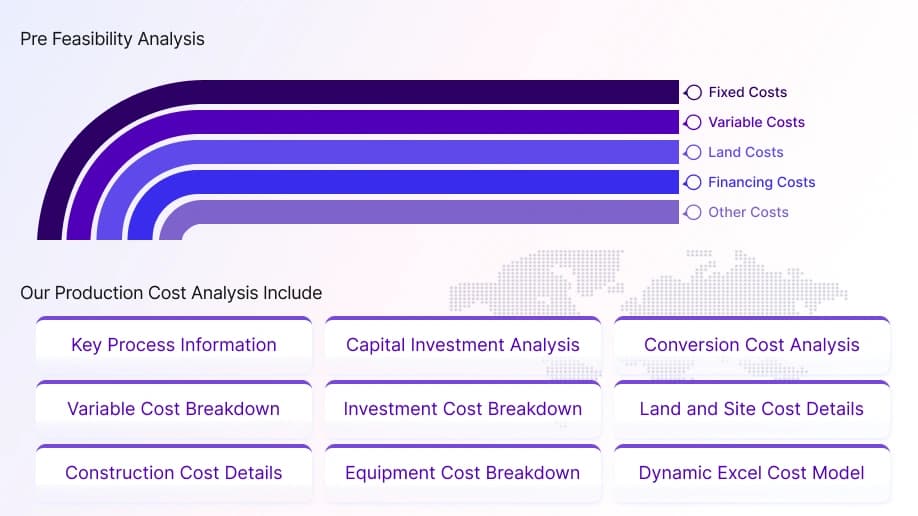
The report provides a detailed analysis essential for establishing an Emetine production plant. It encompasses all critical aspects necessary for Emetine production, including the cost of Emetine production, Emetine plant cost, Emetine production costs, and the overall Emetine production plant cost. Additionally, the study covers specific expenditures associated with setting up and operating an Emetine production plant. These encompass production processes, raw material requirements, utility requirements, infrastructure needs, machinery and technology requirements, manpower requirements, packaging requirements, transportation requirements, and more.
Emetine is a highly effective drug that comes from the ipecac root and has various medical applications. It is used in the treatment of amoebiasis that is caused by Entamoeba histolytica by killing the active trophozoite of the parasite but is less effective on the cyst form. It works by stopping the protein synthesis in the parasite, thus killing it.
Emetine is utilized for its antiviral activity against many viruses, and it acts on both virus-based and host-based targets to stop the replication of viruses. It is used to reduce inflammation in COVID-19 patients by inhibiting. It has some cardiotoxic effects that limit its use at high doses, including tachycardia, EKG abnormalities, and dyspnea. It remains a valuable drug for developing less toxic antiviral and anti-protozoal agents despite its limitations.
The procurement of Emetine is driven by several key factors. Its use in the treatment of amoebiasis contributes to its increasing demand as an anti-protozoal agent. Its activity as an effective antiviral in the treatment for a range of viral diseases makes it in demand. Being a generic drug, its cost is very low compared to other options. Research on its safety and efficacy in other areas of treatment besides anti-infective effects also adds to its demand. Overall, industrial emetine procurement is affected by its effectiveness in treating amoebiasis and various viral diseases, along with its cost-effectiveness, safety and anti-inflammatory effects, and regulatory support for specific uses.
Raw Material for Emetine Production
According to the Emetine production plant project report, the key raw materials used in the production of Emetine include Ipecac Roots-Solvents.
Production Process of Emetine
The detailed Emetine production cost report consists of the following major industrial production process:
- From Ipecac Roots and Solvents: The production process for Emetine has several steps. First, the roots of Cephaelis ipecacuanha are obtained, dried, and ground. After that, the powder is subjected to extraction using solvents to isolate Emetine. After extraction, the crude alkaloid is purified using recrystallization or chromatography to get pure Emetine.
Emetine appears as yellow crystals having a molecular formula of C29H40N2O4. Its molecular weight is around 480.649 g/mol, and it has a melting point range of 235-255 °C. It is soluble in water and alcohol and has a pH value of about 5.6 in aqueous solutions. It is an alkaloid having an isoquinoline and benzoquinolizidine nuclei making it biological activity. It emits toxic fumes, including chlorides and oxides of nitrogen in the presence of heat as well and it is also sensitive to light, which affects its stability. All these physical and chemical properties contribute to its usage in various applications.