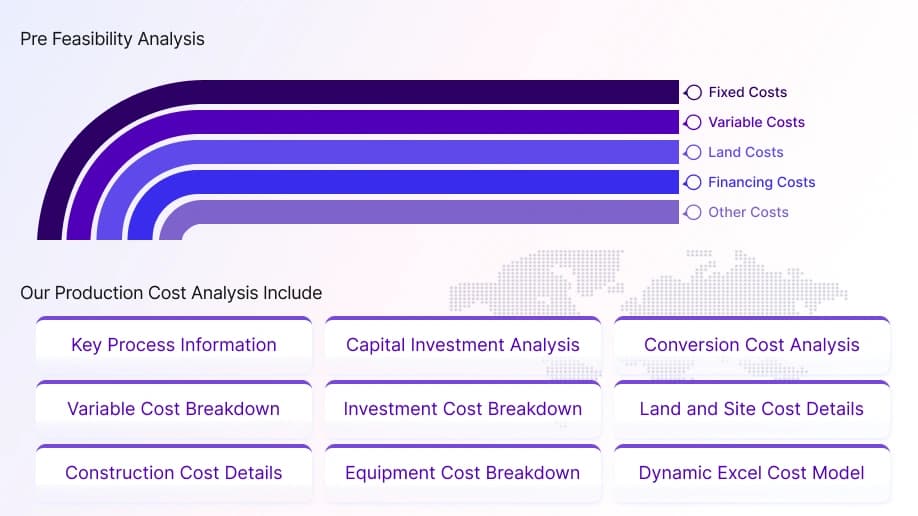
The report provides a detailed analysis essential for establishing an ethylene oxide production plant. It encompasses all critical aspects necessary for ethylene oxide production, including the cost of ethylene oxide production, ethylene oxide plant cost, ethylene oxide production costs, and the overall ethylene oxide production plant cost. Additionally, the study covers specific expenditures associated with setting up and operating an ethylene oxide production plant. These encompass production processes, raw material requirements, utility requirements, infrastructure needs, machinery and technology requirements, manpower requirements, packaging requirements, transportation requirements, and more.
Ethylene oxide is the simplest epoxide, that is majorly associated with chemical, pharmaceutical, agricultural, construction, oil, and gas industries. The ethylene derivative is used as a raw material that is used to produce other chemicals such as ethylene glycol. The compound, along with its derivatives, is utilized in semiconductors and batteries that are further used to power electric vehicles or EVs. It serves as a component in the production of antifreeze chemicals.
Similarly, it can be included to produce certain pesticides and often acts as a sterilizing agent in cleansing products. Moreover, ethylene oxide is included in the production of cosmetics and personal care products. It can also be used in cleansers and detergents that are used for fabrics.
The demand for ethylene oxide is prominently influenced by its wide range of applications covering chemical, cosmetics, agricultural, construction, and pharmaceutical industries. Its usage in the preparation of its derivatives, including ethylene glycol and others, boosts its demand in the chemical industry. Moreover, its usage in the production of various products, including sterilizers, cleansers, pesticides, cosmetics, and personal care products, fuels its demand in the market.
Industrial ethylene oxide procurement is mainly influenced by some factors, such as its demand as an ethylene derivative, in cosmetics, chemical, agricultural, and healthcare sectors. Other factors, including its supply, governmental policies, logistics, production cost, and market prices, impact its procurement across borders. Hence, changes in these factors, especially its demand in chemical, agricultural, cosmetics and healthcare sectors, along with its supply and prices, are highly essential to determine its procurement.
Raw Material for Ethylene Oxide Production
According to the ethylene oxide production plant project report, the key raw material for ethylene oxide production includes ethylene-oxygen.
Production Process of Ethylene Oxide
The extensive ethylene oxide production cost report consists of the major industrial production process:
- From Ethylene and Oxygen: the preparation of ethylene oxide comprises of a chemical reaction between ethylene and oxygen in the presence of a catalyst.
Ethylene Oxide (C2H4O) is a versatile compound primarily used to create other chemicals that are used to form products like fabrics for clothes, carpets, upholstery, and pillows. However, it is a toxic gas, and its exposure can lead to conditions like headaches, stomach sickness, nausea, weakness, trouble breathing, drowsiness, frostbite, eye, and skin burns, as well as reproductive problems.
Ethylene Oxide at room temperature is a combustible gas. It appears to be colourless and has a sweet odour. It has a molecular weight of 44.1 g/mol. It is soluble in water as well as in ether, alcohol, acetone, and benzene. However, it is less dense than water, with vapours heavier than air.