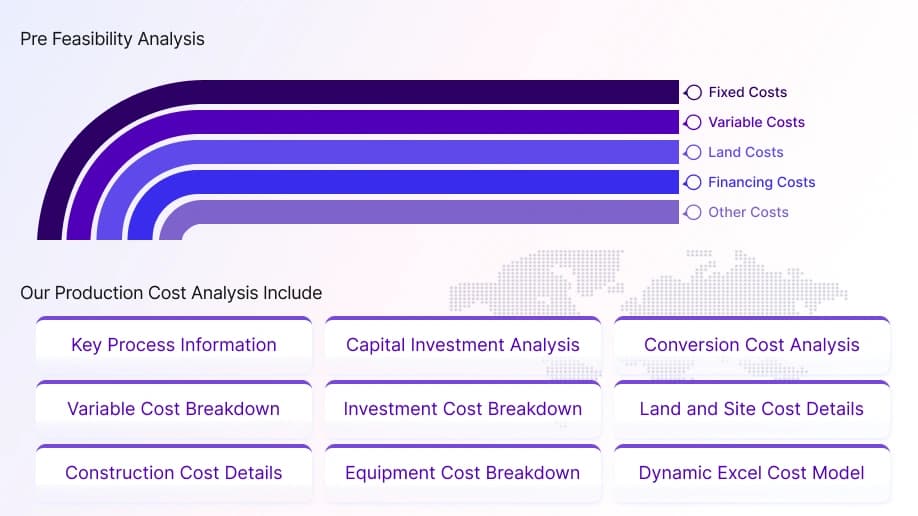
The report provides a detailed analysis essential for establishing a hydrofluoric acid production plant. It encompasses all critical aspects necessary for hydrofluoric acid production, including the cost of hydrofluoric acid production, hydrofluoric acid plant cost, hydrofluoric acid production costs, and the overall hydrofluoric acid production plant cost. Additionally, the study covers specific expenditures associated with setting up and operating a hydrofluoric acid production plant. These encompass production processes, raw material requirements, utility requirements, infrastructure needs, machinery and technology requirements, manpower requirements, packaging requirements, transportation requirements, and more.
Hydrofluoric acid is an acidic solution of hydrogen fluoride in water. It is used for etching glass and metal. It is a precursor to most of the fluorine compounds. It is a constituent element in the manufacture of surface coatings such as PTFE (Teflon), fluoxetine (Prozac), elemental fluorine and pharmaceuticals as well. It finds application in oil refining and producing organofluorines and is also used to dissolve rock samples (typically powdered) before the analysis. Moreover, diluted hydrofluoric acid also works as a cleaning agent for car wash, household rust stain remover, and a reagent that dissolves oxides and silicates.
The market for hydrogen fluoride is primarily driven by its demand in the metal and glass industries due to its unique property of dissolving glass, metals, and many semimetal oxides, which increases its market expansion. It is often utilized as an important constituent in the manufacture of surface coatings such as PTFE (Teflon), elemental fluorine, and pharmaceuticals, which further propels its market growth.
Moreover, due to its ability to dissolve metal oxides and oxides, it is widely used to remove oxide impurities from stainless steel, in semiconductors, in car wash, and household rust stain remover, which amplifies its demand in the metal, semiconductor, automotive, and household industries. Furthermore, it is also employed in the extraction of organic fossils from silicate rocks, and in oil refining, which notably enhances its market growth. Additionally, the availability and cost of production of hydrofluoric acid’s feedstock (Fluorspar, Sulfuric acid), hydrofluoric acid market prices, distribution (including trading and shipping), logistics, etc., are some of the elements that influence an industrial hydrofluoric acid procurement.
Raw Material for Hydrofluoric Acid Production
According to the Hydrofluoric Acid production plant project report, the major raw materials for Hydrofluoric Acid production include Fluorspar-Sulfuric Acid.
Production Process of Hydrofluoric Acid
The extensive Hydrofluoric Acid production cost report consists of this major industrial production process:
- Production from Fluorspar: During this procedure, fluorspar that is high in calcium fluoride is collected from open quarries and separated from the coproducts. Further, fluorspar is reacted with sulfuric acid to produce hydrogen fluoride gas, which is then liquified to obtain hydrofluoric acid.
Hydrofluoric acid (38%, azeotropic mixture with water) is made up of a fluorine atom and a hydrogen atom made when the chemical Hydrogen fluoride comprising fluorine is dissolved in water. The acid comprises a diatomic molecule with strong intermolecular hydrogen bonds. The molecule chains are generally shorter and, on average, exist between five and six molecules.
Hydrofluoric acid is a colourless and corrosive liquid or gas with a strong, irritating odour. It is seen as a vital chemical reagent in wet digestion processes because of the complexing ability of fluoride ions. It is potent in decomposing silicate matrices. It is a weak acid due to its lower dissociation constant in contrast to the strong acids. Still, it can lead to serious health issues because of the fluoride ion’s aggressive, destructive penetration of tissues.
It is easily penetrated the skin and the body’s tissues and can damage the cells causing dysfunction in them. Due to it being extremely corrosive, it is not easy to handle. It has a molar mass of 20.006 g·mol−1 and a density of 1.15 g/mL. Its respective melting and boiling points are −83.6 °C and 19.5 °C. Hydrofluoric acid has applications in the production of various products like herbicides, aluminium, refrigerants, pharmaceuticals, high-octane gasoline, fluorescent light bulbs, plastics and electrical components. The acid is widely known due to its ability to dissolve glass when reacted with SiO2 (silicon dioxide), the main part of the glass, to make silicon tetrafluoride gas and hexafluorosilicic acid.