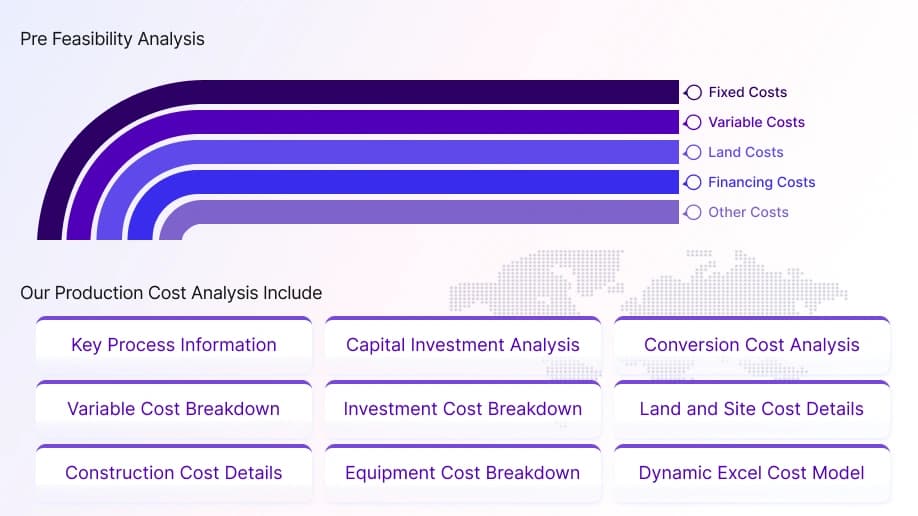
The report provides a detailed analysis essential for establishing an Isoleucine production plant. It encompasses all critical aspects necessary for Isoleucine production, including the cost of Isoleucine production, Isoleucine plant cost, Isoleucine production costs, and the overall Isoleucine production plant cost. Additionally, the study covers specific expenditures associated with setting up and operating an Isoleucine production plant. These encompass production processes, raw material requirements, utility requirements, infrastructure needs, machinery and technology requirements, manpower requirements, packaging requirements, transportation requirements, and more.
Isoleucine is an essential amino acid that is found in many proteins. It is widely utilized as a component in the production of dietary supplements that help to enhance energy levels in the body. Moreover, it also finds its application as a food additive in the manufacture of various protein-fortified foods and beverages to increase its nutritional content. Additionally, it is also employed for parenteral nutrition infusions to support patients with specific nutritional requirements.
The market for Isoleucine is largely driven by its application as a nutrient supplement in various health products, which significantly contributes to its demand in the nutraceutical industry. Moreover, its utilization as an additive in various food products, including protein bars and other functional foods to promote muscle health, further enhances its demand in the food and beverage industry. Its usage in medical nutrition formulations to help fast recovery in patients with muscle disease effectively promotes its demand in the healthcare and wellness industries.
Several factors, such as the cost and availability of raw materials (Corynebacterium glutamicum), source and purity, compliance with healthcare regulations, and maintaining quality standards, significantly influence industrial Isoleucine procurement globally. Furthermore, optimized distribution and logistics, new advances in science or technology, and powerful sustainability practices lead to variations in the requirements for procurement.
Raw Material for Isoleucine Production
According to the Isoleucine production plant project report, the major raw material for Isoleucine production includes Corynebacterium glutamicum.
Production Process of Isoleucine
The extensive Isoleucine production cost report consists of the following industrial production process:
- Production via Fermentation: This method of production constitutes metabolic engineering of the l-isoleucine biosynthesis pathway in Corynebacterium glutamicum to produce isoleucine industrially. The method involves the use of classically derived mutants of C. glutamicum through the process of fermentation that is continuously fed with acetic acid, which results in the formation of isoleucine. The biosynthesis of isoleucine by C. glutamicum involves 11 reaction steps to obtain isoleucine as the final product. One of the 11 steps in the fermentation process is the formation of threonine as an intermediate to synthesize isoleucine.
Isoleucine is an α - amino acid with the chemical formula HO2CCH(NH2)CH(CH3)CH2CH3. It appears as a white to off-white solid and is stored in a refrigerator. The molecular formula of the compound is C6H13NO2, and its molecular mass is 131.17 g/mol. Moreover, the melting point of the compound is >166°C, and its value of dissociation constant is 2.32(at 25?). The compound is slightly soluble in water but does not dissolve in alcohol and ether. There are two possible diastereomers of L-isoleucine and four possible stereoisomers of isoleucine. However, there is only one enantiomeric form of isoleucine found in nature, which is (2S,3S)-2-amino-3-methylpentanoic acid.