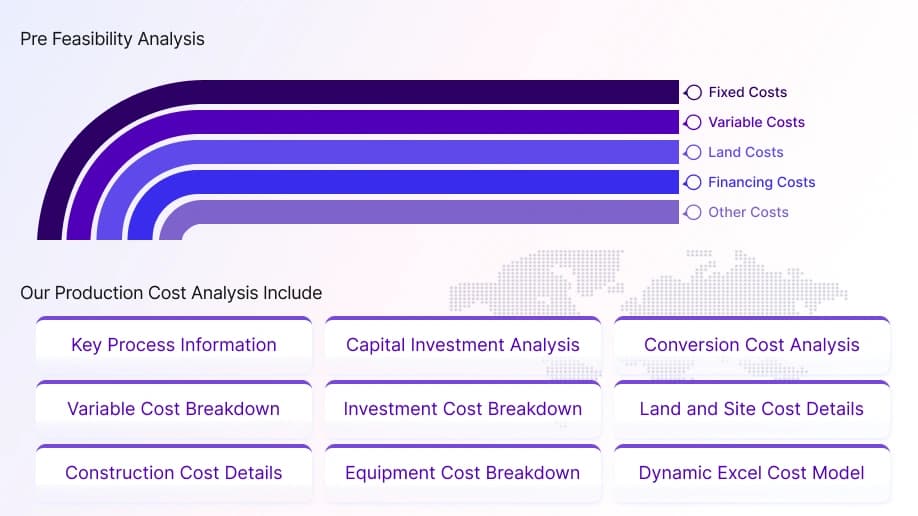
The report provides a detailed analysis essential for establishing a Low-Density Polyethylene (LDPE) production plant. It encompasses all critical aspects necessary for Low-Density Polyethylene (LDPE) production, including the cost of Low-Density Polyethylene (LDPE) production, Low-Density Polyethylene (LDPE) plant cost, Low-Density Polyethylene (LDPE) production costs, and the overall Low-Density Polyethylene (LDPE) production plant cost.
Additionally, the study covers specific expenditures associated with setting up and operating a Low-Density Polyethylene (LDPE) production plant. These encompass production processes, raw material requirements, utility requirements, infrastructure needs, machinery and technology requirements, manpower requirements, packaging requirements, transportation requirements, and more.
Low-Density Polyethylene (LDPE) is a polymer that has several characteristics that make it an excellent polymer material that can be used to manufacture different polymer products. It is a flexible compound with low cost, providing high production efficiency. It exhibits resistance to corrosion and chemicals, which makes it a good thermoplastic material. It is mainly incorporated in plastic and polymer industries.
The compound is utilized to manufacture packaging and storage products on a large scale. It is used to develop packaging films, foils, plastic bags, and more. Moreover, it can be used to produce trays, tubing, wash bottles, cling wraps, juice containers, ice cream lids, laminates, extrusion molding, prosthetics, six-pack rings for soda cans, etc.
The market for Low-Density Polyethylene (LDPE) is driven by its usage for flexible packaging solutions, such as films and bags, which elevates its demand in the food and packaging industries. Its utilization for components like insulation and interior parts due to its lightweight and durable nature amplifies its demand in the automotive industry. Its application in construction materials, such as moisture barriers and insulation films, boosts its demand in the construction industry.
Its function in a wide range of applications beyond packaging, such as textiles, agriculture (e.g., mulch films), and household products (e.g., containers and bags) fuels its demand even more. Overall, industrial Low-Density Polyethylene (LDPE) procurement is influenced by its application in various industries such as food, packaging, automotive, construction, textile, agriculture, and household products industries, the availability of its raw material (ethylene), the cost of its raw material, urbanization, cost-effectiveness, various applications, sustainability trends, and technological advancements.
Raw Material for Low-Density Polyethylene (LDPE) Production
According to the Low-Density Polyethylene (LDPE) production plant project report, the key raw material used in the production of Low-Density Polyethylene (LDPE) includes ethylene.
Production Process of Low-Density Polyethylene (LDPE)
The extensive Low-Density Polyethylene (LDPE) production cost report consists of the following major industrial production processes:
- Production via Polymerization: The production process of Low-Density Polyethylene (LDPE) occurs via the polymerization process. Ethylene is polymerized in the presence of oxide initiators that lead to the formation of a polymer structure, with Low-Density Polyethylene as the final product. The polymerization is carried out under very high pressure of up to 350 megapascals and at a temperature measuring approximately 350 °C.
- Production via the Tubular Process: The production process of Low-Density Polyethylene (LDPE) occurs in a tubular reactor having higher ethylene conversion rates. The reaction is carried out using a free radical initiator that has one or two peroxides with or without oxygen. New operating techniques prevent polymer build-up on the inside wall of the reactor tubes, which decreases downtime and increases reactor efficiency to produce pure and efficient Low-Density Polyethylene (LDPE).
Low-density Polyethylene (LDPE) is a polymer variety that is mainly obtained by polymerization of ethylene in the presence of oxide initiators. The compound is polymerized under very high pressure and temperature that is valued at approximately around 350 megapascals at 350 °C. It results in the formation of a polymer structure with long and short branches that prevent polyethylene molecules from packing closely together and obtaining a hard or rigid structure.
LDPE is a very flexible polymer variety due to its loose crystalline arrangements. Its melting point is measured around 110 °C. It is a non-toxic polymer resin that has no diverse effect on the health of an individual under normal conditions. However, in a melted state, it can cause severe burns when in contact with the skin and eyes. It is a compound with an extremely slow decomposition rate. It gradually decomposes in the presence of UV radiation and is highly insoluble in water. It is a combustible polymer but is highly flammable in nature. It emits toxic fumes and irritating substances in combustion, such as carbon monoxide. It can be charged electrostatically.