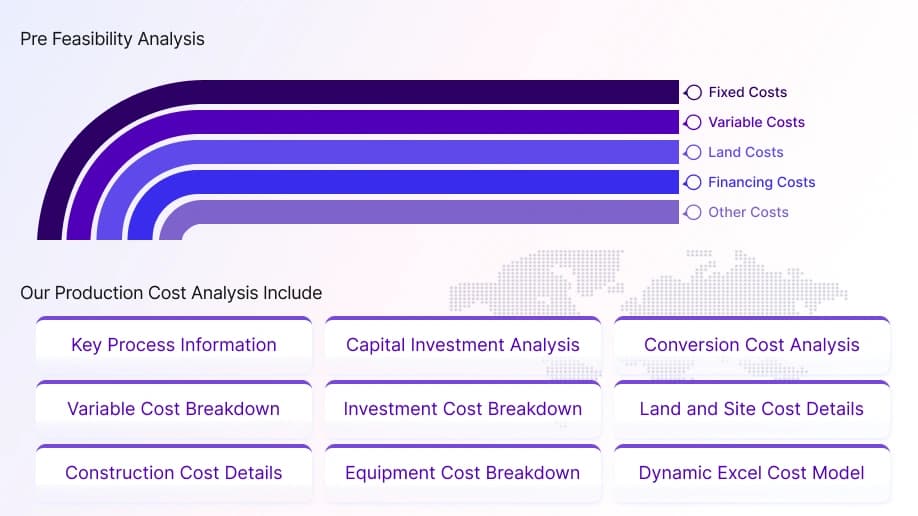
The report provides a detailed analysis essential for establishing a Matrine production plant. It encompasses all critical aspects necessary for Matrine production, including the cost of Matrine production, Matrine plant cost, Matrine production costs, and the overall Matrine production plant cost. Additionally, the study covers specific expenditures associated with setting up and operating a Matrine production plant.
These encompass production processes, raw material requirements, utility requirements, infrastructure needs, machinery and technology requirements, manpower requirements, packaging requirements, transportation requirements, and more.
Matrine is a natural alkaloid that is obtained from the dried roots of Sophora flavescens. It is extensively used as a bio-pesticide in farming due to its effectiveness against a wide variety of insects and pests, such as termites, whiteflies, aphids, etc. Moreover, the compound also finds its application as a component in a various medicinal formulation due to its potential anti-inflammatory, anti-cancer, antiviral, antibacterial, and immunomodulatory properties. Additionally, it is also incorporated in certain cosmetics and skin care products due to skin soothing properties.
The market of Matrine is largely driven by its application as a pesticide due to its action against various pests, which makes it a favored choice in the agriculture sector and pest control industries. Moreover, its application as a component in the production of various pharmaceuticals due to its antimicrobial and anti-inflammatory activities further enhances its demand in the medical and pharmaceutical industries.
Additionally, its employment as an antioxidant and anti-inflammatory agent in various cosmetic formulations to reduce redness and promote wound healing remarkably accelerates its demand in the cosmetics and personal care industries. Furthermore, several factors influence industrial marine procurement, such as the availability of raw materials (lysine, etc.), cost and pricing, compliance with pharmaceutical regulations, quality standards, technological advancements, environmental considerations, sustainability practices, distribution (including trading and shipping), logistics, safety standards, etc.
Raw Material for Matrine Production
According to the Matrine production plant project report, the major raw material for Matrine production includes Lysine.
Production Process of Matrine
The extensive Matrine production cost report consists of the following industrial production process:
- Production via Biosynthetic Pathway: This method of production involves the biosynthetic pathway that is initiated by the transformation of lysine into piperidine, which further undergoes dimerization to form quinolizidine. Through a sequence of oxidation, isomerization, and a Mannich-type reaction, an oxidized tetracyclic intermediate is produced. This intermediate undergoes further cyclization involving a pendant aldehyde, followed by reduction to yield (+)-matridine, a tetracyclic core. Finally, additional oxidation and modifications convert (+)-matridine into the alkaloid matrine.
Matrine is a form of tetracyclic quinoline alkaloid that is majorly found in plants from the Sophora genus. The molecular formula of the compound is C15H24N2O, and its molecular weight is 248.36 g/mol. Moreover, the compound is extremely toxic and majorly affects the nervous system. The compound is also observed to have a wide range of pharmacological activities, which include anti-fibrotic, antiarrhythmic, anti-inflammatory, and anti-viral. Additionally, the compound majorly finds its application in the clinical treatment and medical industry.