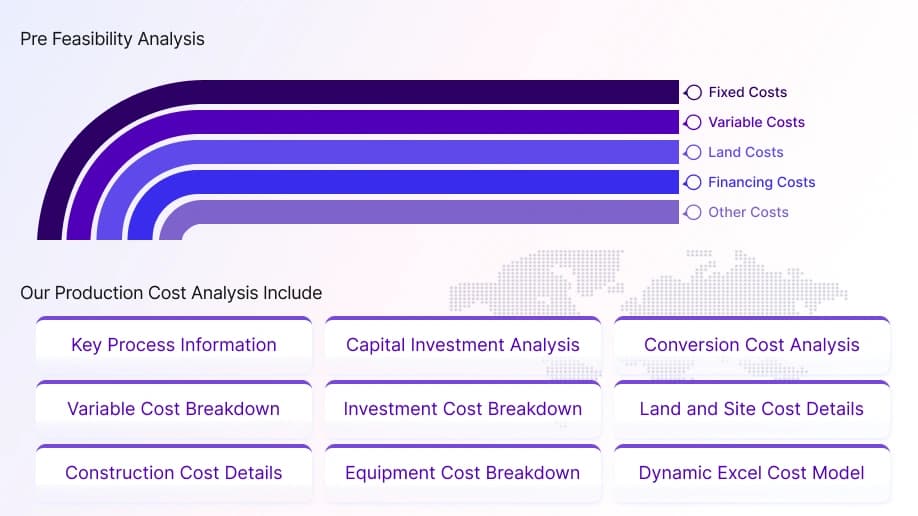
The report provides a detailed analysis essential for establishing a Methadone production plant. It encompasses all critical aspects necessary for Methadone production, including the cost of Methadone production, Methadone plant cost, Methadone production costs, and the overall Methadone production plant cost. Additionally, the study covers specific expenditures associated with setting up and operating a Methadone production plant. These encompass production processes, raw material requirements, utility requirements, infrastructure needs, machinery and technology requirements, manpower requirements, packaging requirements, transportation requirements, and more.
Methadone is a medication used in a wide range of applications in the medical field. It functions by duplicating the effects of natural painkillers on the body by activating specific receptors in the brain and nervous system. It is utilized for the treatment of severe pain that is unresponsive to non-opioid medications. It is used in managing severe pain related to cancer, neuropathy, or other conditions. Methadone is employed in treating Opioid Use Disorder (OUD) by relieving withdrawal symptoms and cravings. It is very helpful for those suffering from addiction to heroin or other opiates. It is prescribed under the supervision of specialized treatment programs with careful reduction of dosage to curtail withdrawal symptoms.
The market of Methadone is driven by its important role in pain management and opioid use disorder treatment. Its utilization in post-surgical and cancer-related pain contributes to high demand in the medical sector. Its effectiveness in treating opioid use disorder (OUD) makes it a very important and sought-after medication in medication-assisted treatment.
The involvement of the government in preventing opioid addiction and improving access to treatment further contributes to its demand. Hence, industrial methadone procurement is affected by its important role as a painkiller and its use in treating OUD, government initiatives to prevent opioid addiction, the growth of treatment centres, increased awareness among healthcare providers, along favorable market dynamics, such as competitive pricing and the availability of generic options.
Raw Material for Methadone Production
According to the Methadone production plant project report, the key raw materials used in the production of Methadone include Diphenyl Acetonitrile-(2-chloro-1-dimethylaminopropane)- Sodamide-Ethyl Magnesium Bromide-Hydrochloric Acid.
Production Process of Methadone
The extensive Methadone production cost report consists of the following major industrial production process:
- From Diphenyl Acetonitrile, 2-chloro-1-dimethylaminopropane, Sodamide, Ethyl Magnesium bromide, and Hydrochloric Acid: For the industrial production of Methadone, multiple steps are required. First, diphenyl acetonitrile and 2-chloro-1-dimethylaminopropane are reacted in the presence of sodamide. This reaction forms an intermediate compound that further reacts with ethyl magnesium bromide. After that, the compound from the above reaction goes through hydrolysis in the presence of hydrochloric acid, forming the hydrochloride salt of Methadone.
Methadone is a white crystalline powder. Its molecular formula is C21H27NO, and it has a molecular weight of around 309.4452 g/mol. It is soluble in water, chloroform, and alcohol. It has a partition coefficient value of around 4.59, making it lipophilic in nature. It has no hydrogen bond donors and seven rotatable bonds, and its topological polar surface area is 20.31 Ų. It has a bioavailability of a range of 36% to 100%. It has a long elimination half-life, making it have longer effects. All these physical and chemical properties contribute to its application in pharmaceutical applications.