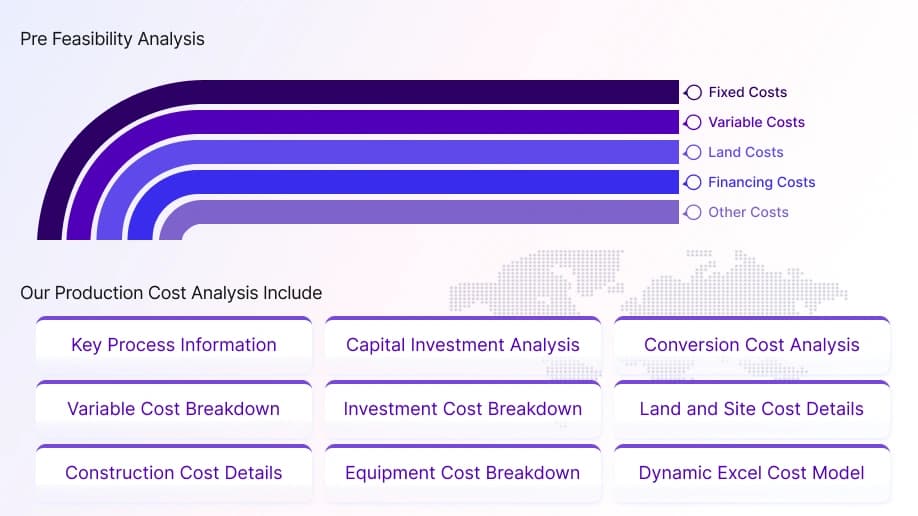
The report provides a detailed analysis essential for establishing a nitrogen production plant. It encompasses all critical aspects necessary for nitrogen production, including the cost of nitrogen production, nitrogen plant cost, nitrogen production costs, and the overall nitrogen production plant cost. Additionally, the study covers specific expenditures associated with setting up and operating a nitrogen production plant. These encompass production processes, raw material requirements, utility requirements, infrastructure needs, machinery and technology requirements, manpower requirements, packaging requirements, transportation requirements, and more.
Nitrogen is an element that occurs as a colorless gas that makes up to 78% of the atmospheric air. It is widely employed in the food and beverage industry. It is utilized to produce medications in the healthcare industry. Additionally, the chemical industry's growing need for industrial nitrogen will expand the opportunities available to the top companies. Also, continuing advancements in cryogenic fraction distillation technology substantiates the market for Nitrogen.
The market for nitrogen is extensively driven by its demand for its use in preserving food, which increases its demand in the food and beverage industry. Since food preservation is the main factor fueling the market's expansion, nitrogen is widely employed in the food and beverage industry.
It is also extensively used to create key components for various medications, which contributes to its demand in the healthcare and production industries. Moreover, it also plays an important role in preventing contamination and moisture during the production and storage of electronic components, which further enhances its market expansion for the electronic industries.
Also, the market's growth would be further aided by ongoing developments in cryogenic fraction distillation technology. Additionally, a number of factors influence industrial nitrogen procurement, such as the cost and availability of its feedstock (liquid air), the market prices of nitrogen, and its distribution, which includes trading and transportation, logistics, etc.
Raw Material for Nitrogen Production
According to the Nitrogen production plant project report, the major raw materials for Nitrogen production include Liquid Air.
Production Process of Nitrogen
The extensive Nitrogen production cost report consists of the following industrial production process:
- Production from Air: It entails the fractional distillation of liquid air using distillation columns in a cryogenic environment to produce nitrogen. Another byproduct created is oxygen.
Nitrogen is the lightest element in group 15, which is also called pnictogens. Dinitrogen is created when two atoms combine under conditions of pressure and temperature. Under cryogenic circumstances, fractional distillation of liquid air with distillation columns is used to produce nitrogen. As a by-product of the operation, oxygen is also created. Dinitrogen is a widely distributed, unreacted element that makes up around 78 percent of the Earth's atmosphere.
It is a typical element in the cosmos, believed to be eighth in the Milky Way and the Solar System in terms of overall abundance. It is a necessary component of life because it is a part of DNA and the genetic code. Nitrogen is denoted with the symbol N, and its atomic number is 7. It is an odourless and colourless diatomic gas and makes up about 78 percent of the Earth's atmosphere.
Nitrogen's structural formula is N2, and its molecular weight is 14 g/mol. The electronic configuration of nitrogen is [He] 2s22p3 and its density is 0.001145 g cm−3. The boiling point and melting point of nitrogen are 77.355 K and 63.2 K respectively. It is a little lighter than air. The ionic radius of nitrogen is 0.71 nm. At a standardized temperature and pressure, it is an inert gas. It is slightly soluble in water and air both. It is non-flammable in nature and does not support combustion.