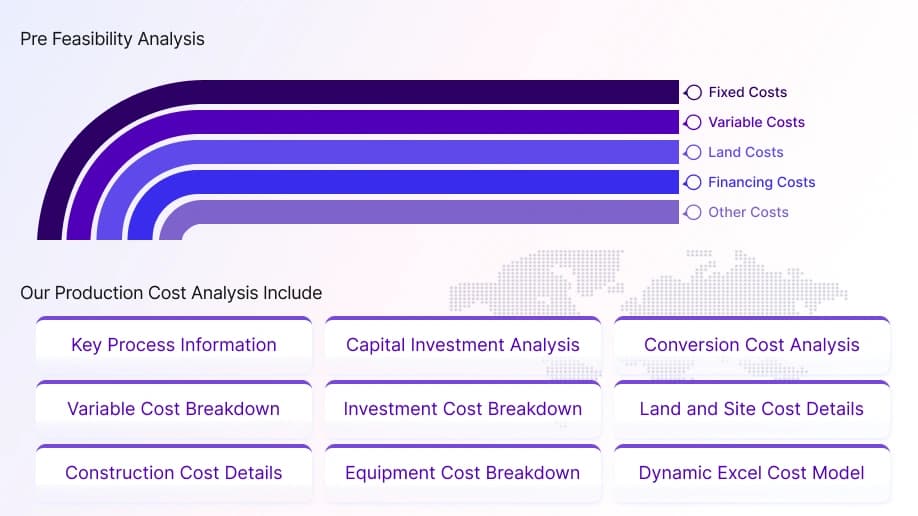
The report provides a detailed analysis essential for establishing a Potash production plant. It encompasses all critical aspects necessary for Potash production, including the cost of Potash production, Potash plant cost, Potash production costs, and the overall Potash production plant cost. Additionally, the study covers specific expenditures associated with setting up and operating a Potash production plant. These encompass production processes, raw material requirements, utility requirements, infrastructure needs, machinery and technology requirements, manpower requirements, packaging requirements, transportation requirements, and more.
Potash is a potassium-rich fertilizer salt important in agriculture and various industrial applications. Its main use is as a fertilizer to provide vital potassium that enhances crop yield improves disease resistance, and boosts food quality. Different forms of potash fertilizers, such as Muriate of Potash (MOP) and Sulfate of Potash (SOP), provide for diverse crop needs. Beyond agriculture, Potash is utilized in chemical production, pharmaceuticals, water treatment, food processing, and road de-icing.
The market for Potash is majorly driven by its application as an important nutrient required for optimal crop growth and productivity, which elevates its demand in the agriculture industry. The expansion of major agricultural sectors, mainly in the Asia-Pacific region, increases the demand for potash fertilizers to enhance their agricultural productivity, which boosts the market growth for Potash.
The shift towards sustainable agriculture also supports industrial Potash procurement, as farmers adopt practices that require efficient nutrient management, such as the use of potash fertilizers to improve crop resilience against climate change. Also, the utilization of Potash beyond agriculture in industrial applications, animal feed supplements, chemical production, glass production, metallurgy, and water treatment sectors further drives the market for Potash.
Raw Material for Potash Production
According to the Potash production plant project report, the key raw materials used in the production of Potash include raw ores.
Production Process of Potash
The extensive Potash production cost report consists of the following major industrial production processes:
- Production via underground mining: The production process of Potash occurs via underground mining. In this process, tunnel boring machines are used to dig out the raw ore, followed by its transportation to the processing mill at the ground level for milling. Finally, the ore is crushed and refined to extract the potassium salts from the Potash.
- Production via solution mining: The production process of Potash occurs via solution mining. In this method, a heated mixture of water, magnesium, and other salts called brine is injected deep below the earth's surface to dissolve the potash deposits. The solution is then pumped up to the surface, followed by cooling down the minerals in crystallization ponds to separate and condition the Potash.
Potash is a potassium-rich fertilizer salt that ranks seventh among all elements, makes up 2.6 percent of the planet's crust, and is a naturally occurring substance. It is mined from subsurface sources, mostly the potash and sylvinite rocks that originated from evaporating seabeds millions of years ago. It contains substances like phosphorous, nitrogen, and potassium. It is a key component of fertilizer and a necessary nutrient for plants and is included in a combination of compounds and minerals collectively. Potash mainly exists as potassium chloride (KCl), and its content is usually expressed in terms of potassium oxide (K2O). It appears to be silvery-white and has a silvery sheen.