The report provides a detailed analysis essential for establishing a PTA (Purified Terephthalic Acid) production plant. It encompasses all critical aspects necessary for PTA (Purified Terephthalic Acid) production, including the cost of PTA (Purified Terephthalic Acid) production, PTA (Purified Terephthalic Acid) plant cost, PTA (Purified Terephthalic Acid) production costs, and the overall PTA (Purified Terephthalic Acid) production plant cost.
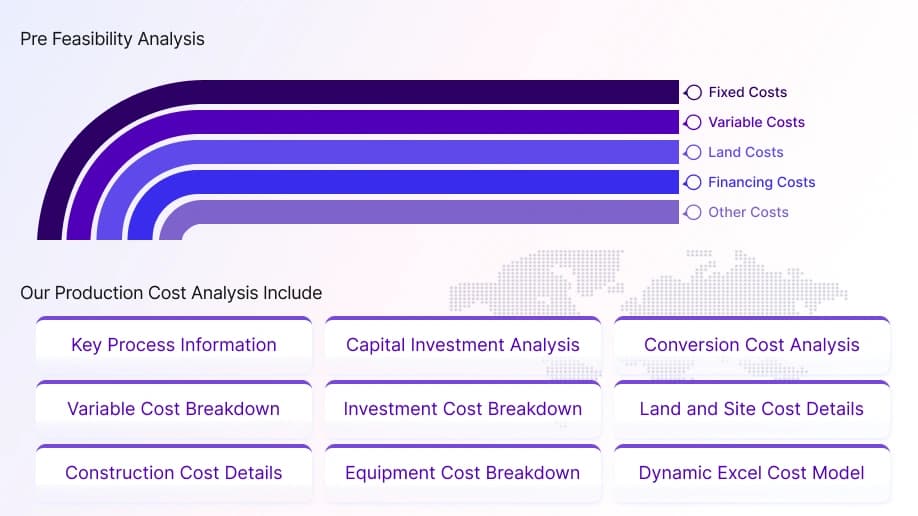
Additionally, the study covers specific expenditures associated with setting up and operating a PTA (Purified Terephthalic Acid) production plant. These encompass production processes, raw material requirements, utility requirements, infrastructure needs, machinery and technology requirements, manpower requirements, packaging requirements, transportation requirements, and more.
PTA (Purified Terephthalic Acid) is an organic compound that is used in a variety of commercial, domestic, upholstery, and automotive textiles, as well as in the cracking of shale gas, geotextiles, filtration, and roofing membranes. It is also used to manufacture polyester coatings resins for use in appliances, industrial maintenance, automotive, and coil coatings.
For outdoor, specialized, and protective apparel, they have become a popular fabric because of their ability to endure moisture and remain stain resistant. Pure PTA (Purified Terephthalic Acid) (PTA) is often combined with other chemicals to obtain PET (polyester), which is further utilized in packaging and films to mold parts for electronics, automotive, industrial maintenance, and coil coatings.
It commonly serves as an industrial aromatic precursor for polyethylene terephthalate (PET). Moreover, it also finds its applications in the production of plasticizers and polyester fibers/yarns for textiles & films and other diverse industries such as packaging, textiles, etc.
The market for Purified Terephthalic Acid is primarily driven by its applications in the manufacture of polyester coatings resins for its usage in automotive, general metal formulation, industrial maintenance, appliances, and coil coatings, which increases its demand in the textile, coatings, electronics, packaging, metal, and production industries. Moreover, it is also utilized as raw material in electronics, chemical fiber, light, polyester powder coatings, and construction industries, which further amplifies its market growth.
It is often used in packaging to mold parts for electronics and automotive, which boosts its demand in electronics and automotive industries. Moreover, the availability and cost of production of PTA (Purified Terephthalic Acid) feedstock (p-xylene, acetic acid, etc.), PTA (Purified Terephthalic Acid) market prices, regulatory compliances, distribution (including trading and shipping), logistics, etc., are some of the elements that influence industrial PTA (Purified Terephthalic Acid) procurement.
Raw Material for PTA (Purified Terephthalic Acid) Production
According to the PTA (Purified Terephthalic Acid) production plant project report, the major raw material for PTA (Purified Terephthalic Acid) production includes P-Xylene.
Production Process of PTA (Purified Terephthalic Acid)
The extensive PTA (Purified Terephthalic Acid) production cost report consists of the following industrial production process:
- Production via Hydrogenation of Crude Terephthalic Acid: This method involves oxidizing p-xylene in the presence of a catalyst to produce crude terephthalic acid. The crude terephthalic acid produced is further subjected to hydrogenation, crystallization, centrifuging, and drying to produce PTA (Purified Terephthalic Acid).
PTA (Purified Terephthalic Acid) is a condensation polymer. It is chemically known as Benzene-1,4-dicarboxylic acid. It is an industrial aromatic precursor for polyethylene terephthalate (PET). It finds its applications in diverse industries such as packaging, textile, etc.
The chemical formula of PTA (Purified Terephthalic Acid) is C8H6O4 and its molecular weight is 166.13 g/mol. The density of 1.52 g/cm³. The limit of solubility of PTA (Purified Terephthalic Acid) in water is 17 to 19 mg/L at 25 °C. The melting point of terephthalic is 300 °C (572 °F; 573 K). Polyester fibre is a long-chain polymer with an ester functional group in each repeating unit.
Polyester fibre accounts for a sizeable portion of the total PTA (Purified Terephthalic Acid) produced globally. The qualities of polyester fibres include strong strength, resilience, and durability. They are washable, rapid drying, and resistant to various chemicals, abrasion, stretching, and shrinkage.