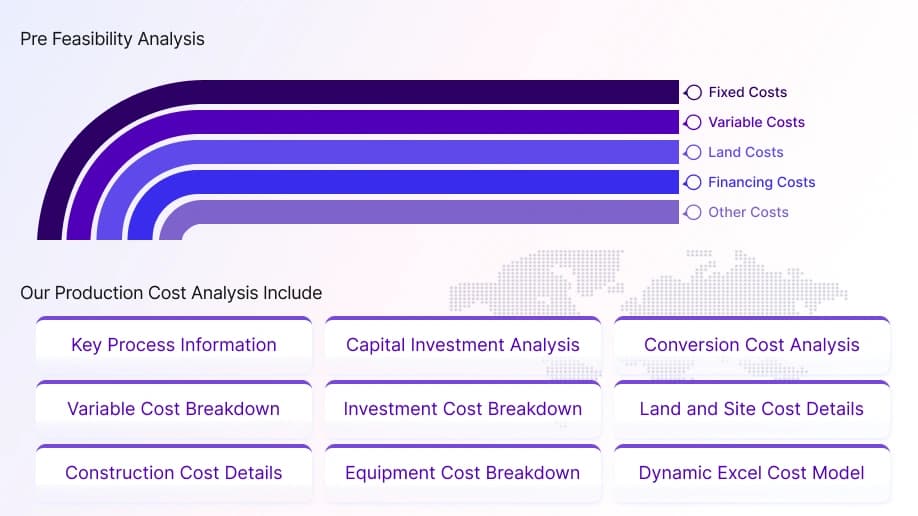
The report provides a detailed analysis essential for establishing a silver production plant. It encompasses all critical aspects necessary for silver production, including the cost of silver production, silver plant cost, silver production costs, and the overall silver production plant cost. Additionally, the study covers specific expenditures associated with setting up and operating a silver production plant. These encompass production processes, raw material requirements, utility requirements, infrastructure needs, machinery and technology requirements, manpower requirements, packaging requirements, transportation requirements, and more.
Silver refers to a precious metal which is broadly used in the production of coins, jewellery, electronics, and photography. Since, it is the best light reflector, it is used to build mirrors. Silver is also used in the electrical sector to create printed circuits with silver paints and computer keyboards with silver electrical contacts.
It is often used in dental alloys, batteries, electrical connections, and soldering and brazing alloys. Additionally, silver bromide and iodide are essential for use in photography because they are reactive to light. Furthermore, silver possesses antibacterial qualities, its nanoparticles are used in garments to stop bacteria from breaking down perspiration and producing offensive odors.
The threads of the element can be weaved into glove fingertips and used on touchscreen phones. Other end-uses of silver include solar panels production, air conditioning, water purification, dentistry, as an antibiotic coating on medical devices, thermal or infrared coatings and in high-capacity zinc long-life batteries.
The demand for silver is being driven by its use in applications, including jewelry, and silver tableware adds value to this commodity in the jewelry and silverware industry. Printed circuits, computer keyboards, membrane switches, multi-layer ceramic capacitors, silvered film, and many other applications are among the numerous uses of silver in the electronics sector, which boosts its demand for electrical industries.
Additionally, it is also utilized in production silver-threaded fabrics due to its antibacterial properties for odor control and hygiene and as a conductive ink in photovoltaic cells to transform sunlight into energy in apparel and solar energy industries, respectively.
Moreover, the availability and cost of production of silver's feedstock (silver ore), silver market prices, environmental regulations & safety concerns, storage, handling, distribution (including trading and shipping), logistics, etc., are some of the elements that influence an industrial silver procurement. The global procurement of this commodity is greatly influenced by its usage as a key component for the electrical, jewelry, tableware, apparel, and solar energy industries.
Raw Material for Silver Production
According to the Silver production plant project report, the major raw materials for Silver production include Silver ore.
Production Process of Silver
The extensive silver production cost report consists of this major industrial production processes:
- Production via Ore Preparation, Cyanide Addition, Precipitation and Filtration: The procedure begins with finely grinding the silver ore and adding lime to create an alkaline atmosphere. The crushed ore mixture is first mixed with water and cyanide solution, and then heaped onto a sloping pad to collect the silver-containing leaching solution. Silver is collected through precipitation by using Zinc dust. The precipitated silver is then, filtered out, melted, and cast into silver bars.
Silver (Ag) is a chemical element present in abundance in mineral-rich soils available in mixed form, usually in crystal form. Pure silver appears to be a white metal. The metal's atomic number is 47. It has properties like being soft, lustrous, very ductile, and malleable, and it is a great heat and electricity conductor. Silver doesn't oxidize in the air; however, when reacted with hydrogen sulfide in the air, it forms silver sulfide (tarnish). It stays stable in water. It has a density (g cm−3) of 10.5 and an atomic weight of 107.868 g/mol. Its melting, and boiling points are 960.8 °C (1,861.4 °F) and 2,212 °C (4,014 °F), respectively.