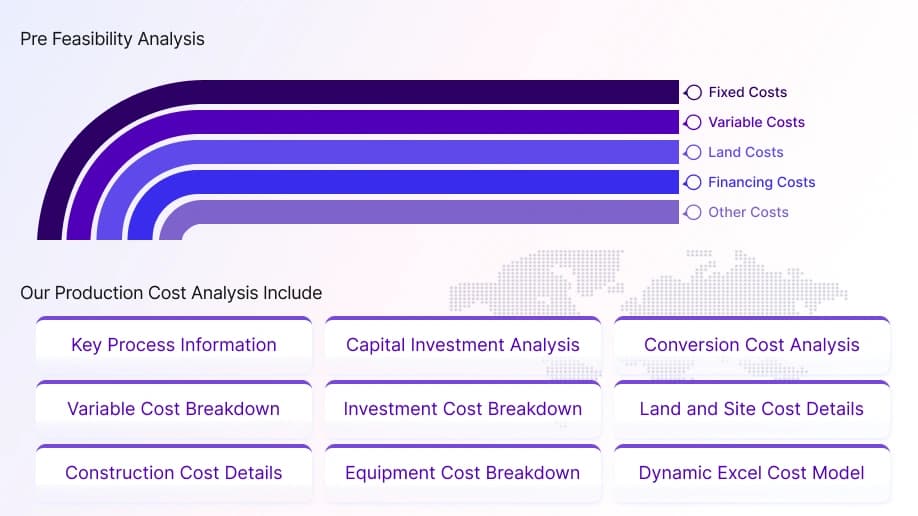
The report provides a detailed analysis essential for establishing a Tadalafil production plant. It encompasses all critical aspects necessary for Tadalafil production, including the cost of Tadalafil production, Tadalafil plant cost, Tadalafil production costs, and the overall Tadalafil production plant cost. Additionally, the study covers specific expenditures associated with setting up and operating a Tadalafil production plant. These encompass production processes, raw material requirements, utility requirements, infrastructure needs, machinery and technology requirements, manpower requirements, packaging requirements, transportation requirements, and more.
Tadalafil is a type of drug that is used to treat various medical disorders. It is used in the treatment of erectile dysfunction by acting as a muscle relaxant and increasing blood flow. It is utilized in benign prostatic hyperplasia because it relaxes bladder muscles and prostate. Tadalafil works in pulmonary hypertension by relaxing the blood vessels of the lungs to allow blood to flow more easily and thereby reduce the workload on the heart. It comes in a form that can be taken immediately or also in a low dose that can be taken daily for continuous relief from symptoms. It has some general side effects that include headache, back pain, bowel irritation, etc. Its combination with nitrate medications needs to be avoided as it can lead to low blood pressure.
The market for Tadalafil is driven by several factors. Its use in treating erectile dysfunction contributes to its growing demand. Its utilization in providing relief in benign prostatic hyperplasia makes it a popular medicine in the clinical field. Its use in pulmonary arterial hypertension for improving blood flow and reducing the workload on the heart makes it a sought-after medication.
Its convenience of flexible dosing improves patient compliance and satisfaction. Its availability makes it more affordable, which further contributes to its demand. Thus, industrial tadalafil procurement is influenced by its usage in erectile dysfunction, benign prostatic hyperplasia, and pulmonary arterial hypertension, along with expanding therapeutic indications, convenience of use, competitive pricing, and regulatory support.
Raw Material for Tadalafil Production
According to the Tadalafil production plant project report, the key raw materials used in the production of Tadalafil include Benzaldehyde-Acetone-Ammonia-Ethyl Chloroformate-(5-Cyanotryptamine).
Production Process of Tadalafil
The extensive Tadalafil production cost report consists of the following major industrial production process:
- Production via Chemical Synthesis: The process of industrial production for Tadalafil begins with the Pictet-Spengler cyclization reaction between D-tryptophan methyl ester and piperonal to form a key tetracyclic intermediate. Then, this intermediate goes through several further transformations, including acylation. Further, the compound is cyclized, deprotected, and coupled with other reagents to form the final diketopiperazine ring, which leads to the formation of Tadalafil as the final product.
Tadalafil is a white solid having a molecular formula of C22H19N3O4 and a molecular weight of 389.404 g/mol. Its melting point is at 301-302 °C, and it is almost insoluble in water. Its logP value is 2.89 making it moderately lipophilic. Its pKa value is 15.17 for the strongest acidic site and -4.2 for the strongest basic site. It contains one hydrogen bond donor and, four hydrogen bond acceptors, and one rotatable bond. Its polar surface area is 74.87 Ų, and it has a refractivity of 104.08 m³·mol?¹ and a polarizability of 40.92 ų. These physical and chemical properties contribute to its pharmacological behavior and its therapeutic applications.