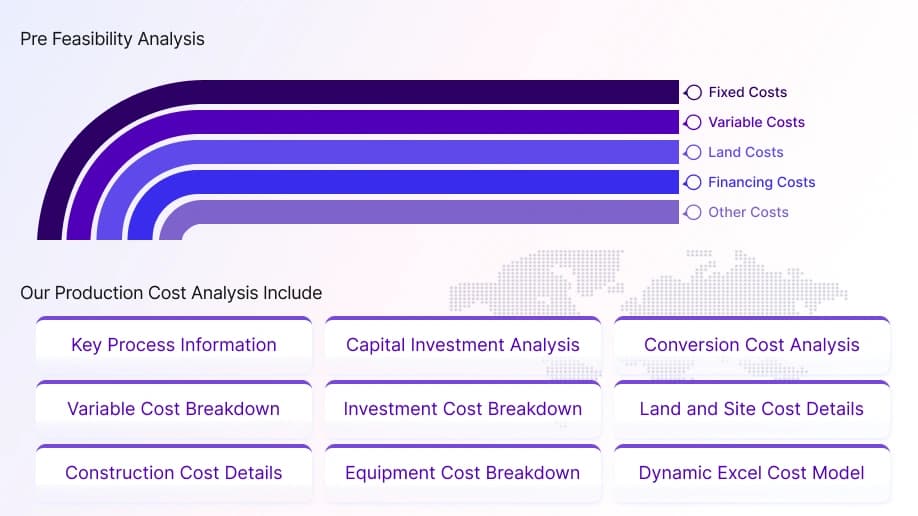
The report provides a detailed analysis essential for establishing a Trypsin production plant. It encompasses all critical aspects necessary for Trypsin production, including the cost of Trypsin production, Trypsin plant cost, Trypsin production costs, and the overall Trypsin production plant cost. Additionally, the study covers specific expenditures associated with setting up and operating a Trypsin production plant. These encompass production processes, raw material requirements, utility requirements, infrastructure needs, machinery and technology requirements, manpower requirements, packaging requirements, transportation requirements, and more.
Trypsin is an enzyme that is a part of protein digestion in the small intestine. It works by slicing off peptide bonds and helps in breaking down proteins into essential peptides and amino acids. It is used for removing dead tissues and enhancing healthy tissue growth in wounds and ulcers. It is utilised as a digestive aid in people that have enzyme deficiencies and can’t break down proteins effectively.
It helps in reducing inflammation and swelling in osteoarthritis and after sports injuries. Trypsin is used in the food industry for hydrolyzing proteins in products like medical foods and infant formulas. It is employed in veterinary products for wound care and dissolves. It is utilized in biotechnology and research to detach adherent cells from culture dishes by breaking down proteins that bind the cells to the surface.
The market of Trypsin is driven by several key factors that indicate its uses in various industries. Its use in pharmaceuticals for promoting healthy tissue growth in wounds and ulcers contributes to its demand. Its function as a digestive aid and for reducing inflammation makes it a sought-after product in the medicinal field. Its utilization in medical foods and infant formulas adds to its demand in the food industry. Its diverse usage, such as in veterinary products as well as in biotechnology and research, further contributes to its demand. A development in production methods has improved the overall production of Trypsin, making it more accessible. Thus, Industrial trypsin procurement is influenced by its usage in pharmaceutical, food, and biotechnology industries, along with advancements in production methods and regulatory compliance.
Raw Material for Trypsin Production
According to the Trypsin production plant project report, the key raw materials used in the production of Trypsin include Genetically Modified Yeast-Culture Media.
Production Process of Trypsin
The extensive Trypsin production cost report consists of the following major industrial production process:
- From Genetically Modified Yeast and Culture Media: The industrial production of Trypsin is a multi-step process. First, genetically engineered yeast is obtained that can secrete Trypsin. After that, yeast is cultured, keeping temperature, pH, and nutrient composition optimized for maximum yield of Trypsin. Then, the culture medium is purified using chromatography, giving pure Trypsin.
Trypsin is a white to off-white powder and has a molecular weight of around 23.3 kDa. It has a density of around 1.37 g/cm³ and a melting point of about 115°C. It is soluble in water and shows good activity at a pH of 8.0 to 8.5. Its isoelectric point ranges from 10.1 to 10.5, and it cleaves peptide bonds at the carboxyl side. Its stability is temperature and pH-dependent, and to prevent autolysis, it is stored at very low temperatures. These physical and chemical properties contribute to its applications in biotechnological processes.