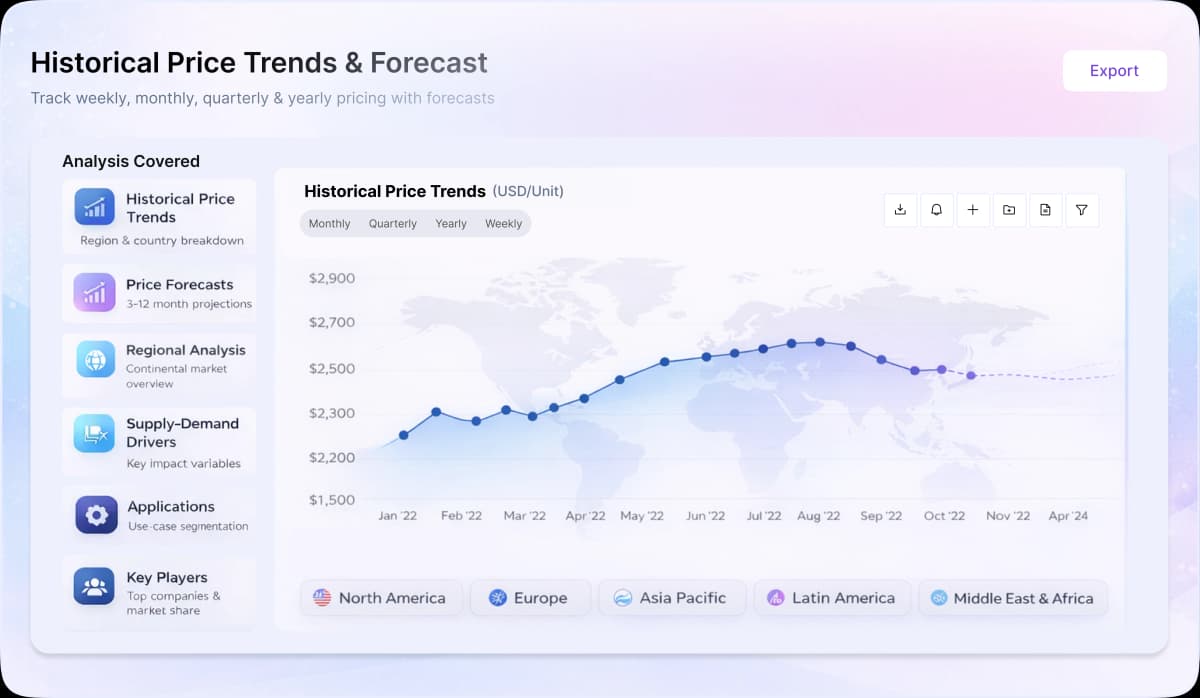
3-Hydroxypropanoic Acid Price Trend Analysis 2026: Latest News, Historical Prices, Supply Demand Analysis, Price Drivers & Market Insights

Udeesha Tomar profile photo
Written ByUdeesha Tomar

Procurement Resource Database

Laptop screen

Turn price intelligence into action with the Procurement Resource Database. Log in or subscribe to unlock live price trends, historical charts, supplier databases, cost curves, and analyst-backed insights across chemicals, agriculture, energy, packaging, and more. Use these tools to benchmark your contracts, plan budgets with confidence, and stay ahead of market moves on every product you buy.

0

+

Products

0

+

Regions

0

+

Subscriptions

Asia

The Asian region experienced considerable fluctuations in 2024. Q1 showed mixed trends with stable prices initially, followed by post-lunar new year declines. The second quarter witnessed significant upward momentum, driven by increased demand for food preservatives due to high global temperatures and rising upstream crude oil prices.

Port congestion and logistical challenges further supported the price surge. Q3 maintained this momentum with unprecedented price increases, particularly in China, where robust demand across various sectors and supply chain tightening contributed to a strong market position.

Europe

European markets displayed a cyclical pattern throughout 2024. Q1 began with bullish trends due to strong downstream demand and feedstock cost pressures, before easing in March. The second quarter showed mixed movements, with initial increases driven by food industry demand and plant closures, followed by a June downturn due to oversupply. Q3 maintained an upward trajectory, influenced by limited supply, higher import costs from Asia, and increased energy prices affecting production costs.

North America

North America demonstrated varied price movements throughout 2024. The first quarter began with a bullish trend driven by high downstream food industry demand and plant shutdowns, though prices declined by March. Q2 marked a significant downturn, with prices falling notably due to subdued demand from food preservatives and agrochemical sectors, coupled with abundant feedstock supply. However, Q3 showed a remarkable recovery with substantial price increases, driven by tight supply conditions and heightened demand from food preservation and packaging industries.

About 3-Hydroxypropanoic Acid

3-Hydroxypropanoic Acid is carboxylic acid with a hydroxyl group attached to the 3rd carbon. It is an important human metabolite and occurs naturally in aloe vera and pathogens like Phomopsis phaseoli. Its polymer forms an essential class of biodegradable polymers under green chemistry. It Is readily soluble in water and is an important intermediate in producing economically vital chemicals like acrylates. Hence, it is a valuable chemical with robust global demand.

3-Hydroxypropanoic Acid Product Detail

HS Code
38220090
Chemical Formula

C3H6O3

CAS Number
503-66-2
Molecular Weight
90.08 g/mol
Industrial Uses

Polymers, Acrylates, Bioplastics, Chemical Synthesis

Synonyms

3-Hydroxypropionic Acid, Hydracrylic Acid, Ethylene lactic acid, 3PH

Supplier Database

Hangzhou Dayang Chemical, Shandong Fine Chemical, Apollo Scientific, Cargill Inc, BASF SE, Novozymes, Chongqing Jiezhou Chemical

Regional Coverage

Asia Pacific

China, India, Indonesia, Pakistan, Bangladesh, Japan, Philippines, Vietnam, Iran, Thailand, South Korea, Iraq, Saudi Arabia, Malaysia, Nepal, Taiwan, Sri Lanka, UAE, Israel, Hongkong, Singapore, Oman, Kuwait, Qatar, Australia, and New Zealand

Europe

Germany, France, United Kingdom, Italy,Spain, Russia, Turkey, Netherlands, Poland, Sweden, Belgium, Austria, Ireland Switzerland, Norway, Denmark, Romania, Finland, Czech Republic, Portugal and Greece

North America

United States and Canada

Latin America

Brazil, Mexico, Argentina, Columbia, Chile, Ecuador, and Peru

Africa

South Africa, Nigeria, Egypt, Algeria, Morocco

CurrencyUS$ (Data can also be provided in local currency)

Supplier Database AvailabilityYes

Customization ScopeThe report can be customized as per the requirements of the customer

Post-Sale Analyst Support360-degree analyst support after report delivery

Note: Our supplier search experts can assist your procurement teams in compiling and validating a list of suppliers indicating they have products, services, and capabilities that meet your company's needs.

3-Hydroxypropanoic Acid Production Processes

  • Production of 3-Hydroxypropanoic acid from Glycerol using Klebsiella pneumoniae

A recombinant Escherichia coli strain can produce 3-HP from glycerol in the presence of vitamin B12 (coenzyme B12). However, the production of 3-HP in recombinant Klebsiella pneumoniae strains does not require the addition of the vitamin as it can naturally synthesize vitamin B12. Under proper aeration conditions, the mixture is fed in the glycerol fed-batch reactor, and the subsequent product mixture obtained is subject to further differentiation to separate the desired 3PH.

Frequently Asked Questions

The outlook for 3-Hydroxypropanoic Acid in 2025 remains bearish, with supply exceeding demand across Asia, Europe, and North America. Ample ethylene availability, surplus inventories, and subdued consumption from bioplastic and polymer end-users are the dominant headwinds. A meaningful price recovery would require a sustained drawdown in elevated inventories, a rebound in downstream demand from sustainable packaging and specialty chemicals, or a tightening of ethylene supply through unplanned outages or production rationalization. Any supportive policy shift toward bio-based chemicals could also provide upside.
3-Hydroxypropanoic acid prices are driven primarily by ethylene feedstock costs, since ethylene is the core upstream input for the chemical-synthesis production route. Plant operating rates and periodic maintenance turnarounds at major producers, along with regional inventory levels, determine how quickly feedstock cost changes pass through to buyers. Downstream demand from bioplastics, sustainable packaging, coatings, and specialty chemical producers sets the pace of offtake, and because 3-HP competes with established petrochemical routes to acrylic acid and 1,3-propanediol, the relative cost of those alternative routes also shapes pricing. Energy costs and regional supply disruptions add further variability.
China is the dominant producing region for 3-hydroxypropanoic acid, hosting the bulk of fermentation-based manufacturing capacity, while BASF SE (Germany), Cargill (United States), and Novozymes (Denmark) are among the established players active in bio-based production and enzyme supply for the fermentation route. Asia Pacific is the primary consumption region, with Europe and North America as the other major demand centers. The concentration of Chinese production means supply security is closely tied to domestic Chinese output and export availability.
3-Hydroxypropanoic acid is produced via microbial fermentation using glycerol or simple sugars such as glucose and xylose as primary feedstocks, with Klebsiella pneumoniae as the biocatalyst. The fermentation runs at 30-37°C under controlled aeration and pH, after which downstream recovery uses base neutralization and solvent or resin extraction. The finished acid feeds into acrylic acid, acrylates, acrylamide, 1,3-propanediol, and malonic acid, supporting bioplastics, adhesives, resins, and packaging fibers.
Demand for 3-hydroxypropanoic acid is driven primarily by the bioplastics, polymer, adhesives, packaging fibers, resins, coatings, and specialty chemicals sectors. These industries consume it as a precursor for acrylic acid, acrylamide, and polymer derivatives used in sustainable packaging and chemical synthesis. Weak consumption from these end-use segments, combined with oversupply from ample ethylene feedstock availability, has kept prices under sustained downward pressure across all major regions.
Procurement Resource assesses 3-Hydroxypropanoic acid prices through a structured, data-driven methodology combining primary engagement with producers, suppliers and traders, secondary market data, continuous monitoring of feedstock and input costs, trade-flow and inventory tracking, and exchange or spot benchmarks. All inputs are validated and translated into a transparent price assessment and outlook. The detailed methodology is available on the Procurement Resource website.

Our Price Analysis Methodology

About the Author

Udeesha Tomar profile photo

Udeesha Tomar

AVP - Strategy and Solutions

Leading procurement research solutions across chemicals, materials, and food & beverages, with expertise in price forecasting and market analytics.

Schedule Demo

Schedule A Demo

Experience how Procurement Resource transforms raw material price data into clear, decision ready intelligence. Optimise your performance with reliable, expert market data and analysis. Schedule your demo today to experience a live walk-through where our experts will showcase interactive price charts, forecasted prices, and insights driving the prices for your key commodities, tailored to your workflows. Contact us now!

Our Team will be happy to assist you

We are just a text away

+1

Still Need Help?

Europe & Africa

+44 7573 171117

Sales@procurementresource.com

USA & Canada

+1 307 363 1045

Sales@procurementresource.com

APAC

+91 8850629517

Sales@procurementresource.com

Unlock full access to Procurement Resource's price databases, interactive charts, and short-term forecasts for thousands of commodities. Elevate your sourcing decisions by comparing prices across regions, downloading historical data, and layering in analyst-backed insights, all with our flexible plans that scale as your portfolio grows.

Still have any Questions

Contact Us
Mastercard
Wire
VISA
Stripe

Why Procurement Database

Commodity Market Intelligence

Commodity Market Intelligence

Track prices, market movements, supply-demand dynamics, and industry developments across hundreds of commodities through a centralized intelligence platform built for informed procurement decisions.

Price Forecasts & Market Outlooks

Price Forecasts & Market Outlooks

Understand market fluctuations using analyst-backed forecasts, historical pricing patterns, and evolving industry trends to strengthen sourcing strategies and budget planning.

Cost & Procurement Optimization

Cost & Procurement Optimization

Leverage cost models, pricing benchmarks, and procurement insights to evaluate purchasing opportunities, improve negotiations, and enhance operational efficiency.

Global & Regional Market Insights

Global & Regional Market Insights

Access region-specific price trends, trade activities, capacity changes, and supply chain developments influencing commodity markets worldwide.

1/4