Acrylic Maleic Copolymer Price Trend Analysis 2026: Latest News, Market Insights, Supply Demand Analysis, Price Drivers & Historical Prices

Udeesha Tomar profile photo
Written ByUdeesha Tomar

Procurement Resource Database

Laptop screen

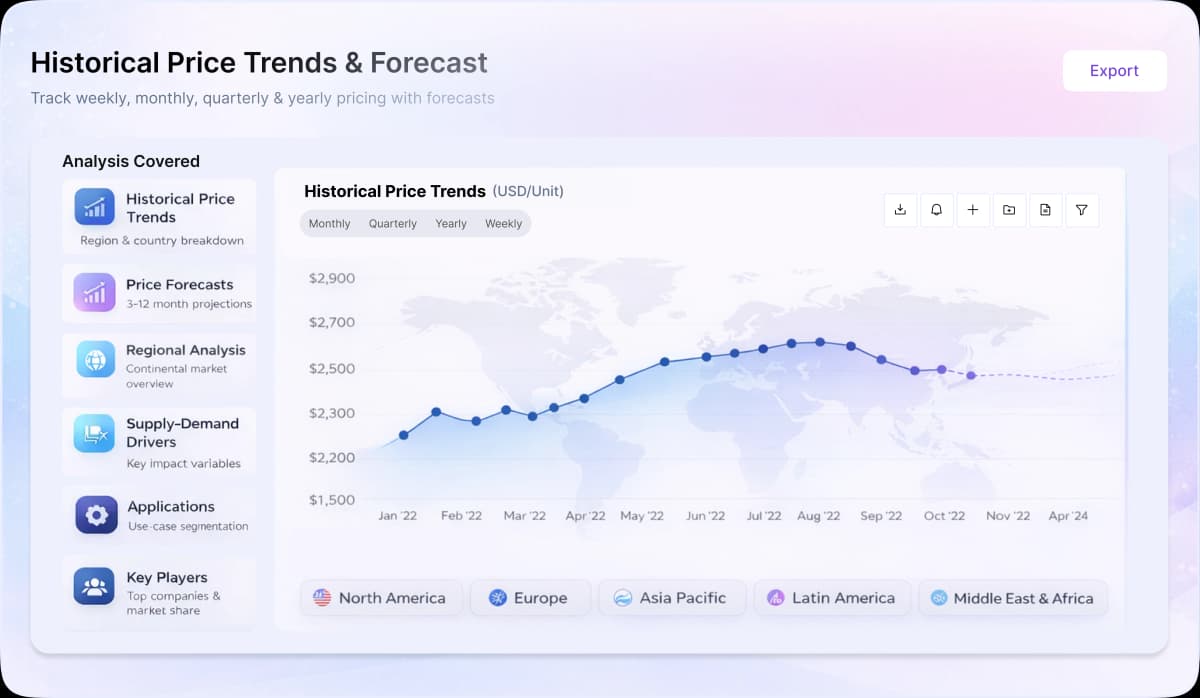
Turn price intelligence into action with the Procurement Resource Database. Log in or subscribe to unlock live price trends, historical charts, supplier databases, cost curves, and analyst-backed insights across chemicals, agriculture, energy, packaging, and more. Use these tools to benchmark your contracts, plan budgets with confidence, and stay ahead of market moves on every product you buy.

0

+

Products

0

+

Regions

0

+

Subscriptions

Asia

A striking dip in the prices of acrylic maleic copolymer was observed in the last two quarters of 2023 due to insufficient support from the downstream industries. The market fundamentals also wavered on the lower end due to the excessive rise in inventory levels and sudden fluctuations in feedstock prices. Initially, the increasing cost of raw materials favored the surge in the prices of acrylic maleic copolymer, but soon, the inclination turned against the market as the consumer shifted towards other alternatives, leading to a decline in acrylic maleic copolymer price trends.

Europe

The decline in acrylic maleic copolymer price trend was not only limited to the Asian countries as Europe also incurred a similar fate. During both the third and fourth quarters, the acrylic maleic copolymer market failed to acquire sufficient support from the downstream industries. The lack of interest of consumers was based on the economic turmoil being experienced by the European countries, which only caused an inclination in the level of inventories.

North America

Many factors influenced the southwards movement of acrylic maleic copolymer price trends during the last two quarters of 2023. Initially, the bullish run supported by the positive momentum of the paints and coatings industries was halted by the downslide in other downstream industries. The suppliers soon had to revise their quotations to match the existing dynamics of the acrylic maleic copolymer market. Additionally, there were certain instances where inventories surpassed the demand rate by a huge margin, raising the concerns of traders and the manufacturing sector.

About Acrylic Maleic Copolymer

Acrylic Maleic Copolymer, a high-density charge polymer, is the copolymer of acrylic and maleic acid. It is thermally stable and can be used at high temperatures. It is widely used in centralized heating and air conditioning. It is a highly versatile cooling system and is often used as a chelating agent in textiles during dyeing processes.

Acrylic Maleic Copolymer Product Detail

Chemical Formula

(C21H24O18)n

CAS Number
29132-58-9
Industrial Uses

Cooling Systems, Low-pressure boilers, Chelating Agent, Distillation Units

Synonyms

(z)-2-butenedioic acid polymer with 2-propenoic acid, Maleic acid-acrylic acid copolymer, POLY(ACRYLIC ACID-CO-MALEIC ACID)

Supplier Database

Xingrui Industry Co., Limited, Hangzhou Dayangchem Co. Ltd., Xiamen Equation Chemical Co., Ltd

Regional Coverage

Asia Pacific

China, India, Indonesia, Pakistan, Bangladesh, Japan, Philippines, Vietnam, Iran, Thailand, South Korea, Iraq, Saudi Arabia, Malaysia, Nepal, Taiwan, Sri Lanka, UAE, Israel, Hongkong, Singapore, Oman, Kuwait, Qatar, Australia, and New Zealand

Europe

Germany, France, United Kingdom, Italy,Spain, Russia, Turkey, Netherlands, Poland, Sweden, Belgium, Austria, Ireland Switzerland, Norway, Denmark, Romania, Finland, Czech Republic, Portugal and Greece

North America

United States and Canada

Latin America

Brazil, Mexico, Argentina, Columbia, Chile, Ecuador, and Peru

Africa

South Africa, Nigeria, Egypt, Algeria, Morocco

CurrencyUS$ (Data can also be provided in local currency)

Supplier Database AvailabilityYes

Customization ScopeThe report can be customized as per the requirements of the customer

Post-Sale Analyst Support360-degree analyst support after report delivery

Note: Our supplier search experts can assist your procurement teams in compiling and validating a list of suppliers indicating they have products, services, and capabilities that meet your company's needs.

Acrylic Maleic Copolymer Production Processes

  • Production of Acrylic Maleic Copolymer from Maleic Anhydride and Acrylic Acid

Maleic acid and distilled water are added along with RAFT reagent in the reactor with constant stirring and dissolving. The acrylic acid and peroxide initiator are added slowly at a controlled temperature. The mixture is continuously stirred at a constant speed. Later, an alkali is added to the mix to obtain the desired acrylic maleic copolymer.

Frequently Asked Questions

The acrylic maleic copolymer outlook for 2024 points to a fluctuating price trajectory. Prices are likely to remain sensitive to freight rate movements, given that shipping disruptions drove the mid-year surge across all regions. Downside pressure could emerge if upstream raw material costs continue declining, and demand softens, as seen in Q4. Conversely, seasonal restocking ahead of holidays or year-end shutdowns may produce periodic price upticks. The balance between stabilising supply chains and shifting feedstock costs will be the key determinant.
Acrylic maleic copolymer prices are driven primarily by maleic anhydride and acrylic acid feedstock costs, since these are the two monomers used in production. Freight rates and shipping route disruptions are a second major driver, particularly for import-dependent regions such as Europe, where landed costs rise sharply when carrier capacity tightens or routes are disrupted. Seasonal restocking ahead of holiday periods and year-end plant shutdowns can create periodic demand spikes, while normalized shipping conditions and softer raw material costs typically ease prices. Downstream demand from water treatment, detergent, and coatings producers sets the underlying pace of offtake.
Major producers include Dow Inc., Shandong ThFine Chemical, Shandong Taihe Technologies, Anderson Development Company, IRO Group, and Ataman Kimya, alongside trading companies such as Xingrui Industry, Hangzhou Dayangchem, and Xiamen Equation Chemical. Key consuming regions span Asia Pacific, Europe, and North America. China and India feature prominently among both producing and consuming countries, creating notable supply concentration risk given the commodity's reliance on maleic anhydride and acrylic acid feedstocks.
Acrylic maleic copolymer is produced by copolymerizing maleic anhydride and acrylic acid monomers under controlled polymerization conditions, typically in aqueous solution with a radical initiator. Maleic anhydride is derived from benzene or n-butane oxidation, while acrylic acid comes from propylene oxidation. The finished copolymer is supplied as a liquid concentrate and used primarily as a scale inhibitor and dispersant in water treatment, a builder in detergents and household cleaners, an additive in paints and coatings, a processing aid in textile finishing, and a scale inhibitor in oilfield operations.
Water treatment, detergents and household cleaning, paints and coatings, textiles, and oil field operations drive acrylic maleic copolymer demand. Water treatment applications in cooling systems and boilers anchor steady baseline consumption, while growth in automotive and construction coatings, textile processing, and oil field scale inhibition adds incremental demand. When these sectors expand, procurement volumes rise and suppliers face upward price pressure, particularly when maleic anhydride feedstock costs climb and shipping disruptions constrain supply.
Procurement Resource assesses acrylic maleic copolymer prices through a structured methodology combining direct engagement with producers, suppliers and traders, secondary market data, and continuous monitoring of feedstock costs, trade flows and inventory levels. Exchange and spot benchmarks are cross-checked against these inputs and validated into a transparent price assessment and outlook. The detailed methodology is available on the Procurement Resource website.

Our Price Analysis Methodology

About the Author

Udeesha Tomar profile photo

Udeesha Tomar

AVP - Strategy and Solutions

Leading procurement research solutions across chemicals, materials, and food & beverages, with expertise in price forecasting and market analytics.

Schedule Demo

Schedule A Demo

Experience how Procurement Resource transforms raw material price data into clear, decision ready intelligence. Optimise your performance with reliable, expert market data and analysis. Schedule your demo today to experience a live walk-through where our experts will showcase interactive price charts, forecasted prices, and insights driving the prices for your key commodities, tailored to your workflows. Contact us now!

Our Team will be happy to assist you

We are just a text away

+1

Still Need Help?

Europe & Africa

+44 7573 171117

Sales@procurementresource.com

USA & Canada

+1 307 363 1045

Sales@procurementresource.com

APAC

+91 8850629517

Sales@procurementresource.com

Unlock full access to Procurement Resource's price databases, interactive charts, and short-term forecasts for thousands of commodities. Elevate your sourcing decisions by comparing prices across regions, downloading historical data, and layering in analyst-backed insights, all with our flexible plans that scale as your portfolio grows.

Still have any Questions

Contact Us
Mastercard
Wire
VISA
Stripe

Why Procurement Database

Commodity Market Intelligence

Commodity Market Intelligence

Track prices, market movements, supply-demand dynamics, and industry developments across hundreds of commodities through a centralized intelligence platform built for informed procurement decisions.

Price Forecasts & Market Outlooks

Price Forecasts & Market Outlooks

Understand market fluctuations using analyst-backed forecasts, historical pricing patterns, and evolving industry trends to strengthen sourcing strategies and budget planning.

Cost & Procurement Optimization

Cost & Procurement Optimization

Leverage cost models, pricing benchmarks, and procurement insights to evaluate purchasing opportunities, improve negotiations, and enhance operational efficiency.

Global & Regional Market Insights

Global & Regional Market Insights

Access region-specific price trends, trade activities, capacity changes, and supply chain developments influencing commodity markets worldwide.

1/4