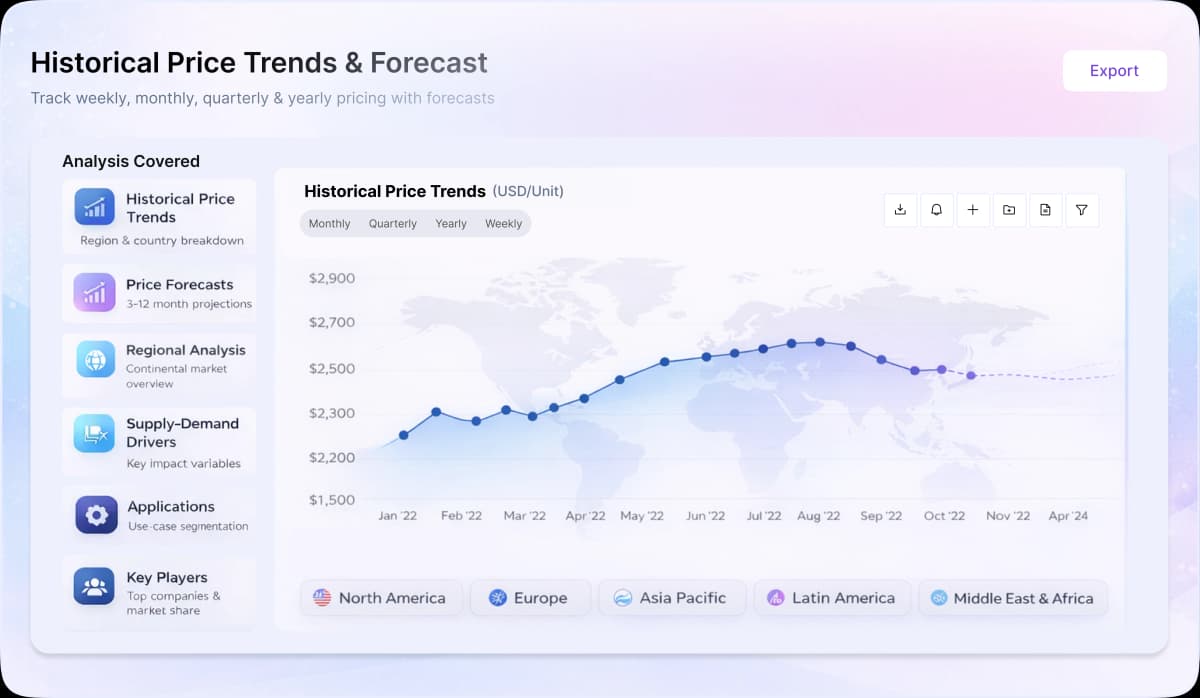
Boric Acid Price Trend Analysis 2026: Market Insights, Historical Prices, Supply Demand Analysis, Price Drivers & Latest News

Udeesha Tomar profile photo
Written ByUdeesha Tomar

Procurement Resource Database

Laptop screen

Turn price intelligence into action with the Procurement Resource Database. Log in or subscribe to unlock live price trends, historical charts, supplier databases, cost curves, and analyst-backed insights across chemicals, agriculture, energy, packaging, and more. Use these tools to benchmark your contracts, plan budgets with confidence, and stay ahead of market moves on every product you buy.

Boric Acid Dashboard Inclusions

Boric Acid Price Dasboard

0

+

Products

0

+

Regions

0

+

Subscriptions

Product Region Incoterm Basis Price Last Updated Month
Boric Acid China Spot 1110 USD/MT October 2025
Boric Acid China Spot 1146 USD/MT December 2025
Boric Acid Vietnam CFR 1150 USD/MT October 2025
Boric Acid Vietnam CFR 1127 USD/MT December 2025
Boric Acid North American CIF 748 USD/MT October 2025
Boric Acid North American CIF 770 USD/MT December 2025
Boric Acid Brazil CIF 935 USD/MT October 2025
Boric Acid Brazil CIF 913 USD/MT December 2025

Stay updated with the latest Boric Acid prices, historical data, and tailored regional analysis

Asia

The boric acid market across Asia displayed divergent pricing trends during the fourth quarter of 2025. In China, prices followed a steady and consistent upward trajectory throughout the period, rising gradually from the quarter's opening and continuing to climb through its close. The prices were about 1110 USD/MT (Spot) in October and around 1146 USD/MT in December. Demand from glass manufacturing, ceramics, and agricultural applications remained supportive, while supply conditions stayed sufficiently tight to sustain the upward price direction. The quarter ended with prices at their highest point of the period, reflecting a firm and well-supported market environment. In Vietnam, the trajectory was markedly different. The prices were about 1150 USD/MT (CFR) in October and around 1127 USD/MT in December. Prices opened at elevated levels before declining steadily through the middle of the quarter, reaching their lowest point before staging a gradual recovery in the latter weeks. Import availability and moderate end-user consumption shaped this movement, with cautious restocking activity contributing to the partial price recovery toward the quarter's close.

North America

The North American boric acid market, represented by the United States, exhibited a broadly positive trajectory through the fourth quarter. The prices were about 748 USD/MT (FOB) in October and around 770 USD/MT in December. Prices remained largely stable and range-bound through the opening phase of the quarter before turning sharply higher as the period progressed.
The acceleration in pricing was sustained and consistent, with values climbing steadily through the latter half of the quarter to close at the highest levels seen during the period. Demand from fiberglass insulation, flame retardant formulations, and specialty chemical applications provided a firm consumption base, while disciplined supply management supported the upward price direction. The market closed the quarter with a meaningful quarter-on-quarter gain.


South America

Brazil's boric acid market followed a pattern broadly similar to Vietnam during the fourth quarter. The prices were about 935 USD/MT (CIF) in October and around 913 USD/MT in December.  Prices opened the period at their highest point before declining steadily through the middle of the quarter, reaching a trough in the early part of the second half. A gradual recovery followed, with prices edging progressively higher through the remainder of the period. Despite the recovery, the market closed broadly in line with where it began, reflecting a quarter characterised by correction and partial stabilisation rather than a clear directional trend.

Analyst Insight

According to Procurement Resource, boric acid prices are expected to maintain a firm tone in the near term, supported by steady downstream demand from glass, ceramics, and fiberglass sectors across key consuming regions.

About Boric Acid

Boric acid is a weak acid with anti-viral, antiseptic and anti-fungal properties. It exists as a white crystalline solid with no characteristic odour. It is used widely in medicine as an antiseptic.

Boric Acid Product Detail

Hs Code
28100020
Chemical Formula

H3BO3

Cas Number
10043-35-3
Molecular Weight
61.83 g/mol
Industrial Uses

Textile fibreglass, panel display, jewellery, insecticide, antiseptic

Synonyms

Orthoboric acid

Supplier Database

BASF, Eti Maden, 3M

Regional Coverage

Asia Pacific

China, India, Indonesia, Pakistan, Bangladesh, Japan, Philippines, Vietnam, Iran, Thailand, South Korea, Iraq, Saudi Arabia, Malaysia, Nepal, Taiwan, Sri Lanka, UAE, Israel, Hongkong, Singapore, Oman, Kuwait, Qatar, Australia, and New Zealand

Europe

Germany, France, United Kingdom, Italy,Spain, Russia, Turkey, Netherlands, Poland, Sweden, Belgium, Austria, Ireland Switzerland, Norway, Denmark, Romania, Finland, Czech Republic, Portugal and Greece

North America

United States and Canada

Latin America

Brazil, Mexico, Argentina, Columbia, Chile, Ecuador, and Peru

Africa

South Africa, Nigeria, Egypt, Algeria, Morocco

CurrencyUS$ (Data can also be provided in local currency)

Supplier Database AvailabilityYes

Customization ScopeThe report can be customized as per the requirements of the customer

Post-Sale Analyst Support360-degree analyst support after report delivery

Note: Our supplier search experts can assist your procurement teams in compiling and validating a list of suppliers indicating they have products, services, and capabilities that meet your company's needs.

Boric Acid Production Processes

Boric acid is produced from borate minerals such as borax by dissolving borate minerals in an organic acid and crystallising the extracted boric acid.

Frequently Asked Questions

During Q1 2026, boric acid prices showed a downward trend across tracked regions. From January to March 2026, China showed a 2.6% decrease, Brazil showed a 1.8% decrease, and the USA showed a 3.1% decrease. The decline was mainly driven by stable supply, cautious procurement, and moderate demand from glass, ceramics, detergents, agriculture, and industrial applications.
On a quarter-on-quarter basis, boric acid prices showed mixed movement. China showed a 1.2% increase from Q4 2025 to Q1 2026, while Brazil showed a 1.4% decrease, and the USA showed a 4.1% increase. The movement reflected regional differences in import availability, inventory position, downstream demand, and freight-linked landed costs.
The boric acid outlook for 2026 remains steady to slightly weak in the near term. Balanced borate supply and cautious buying may limit strong price gains. Demand is expected to remain supported by glass, ceramics, detergents, fertilizers, insulation, electronics, and specialty chemical applications. Prices may strengthen if construction, fiberglass, agriculture, and industrial production improve later in the year.
The main factors affecting boric acid prices in Q1 2026 were sufficient supply and weak-to-moderate downstream demand. Stable borate production and import availability reduced cost pressure. Buyers in glass, ceramics, detergent, and agriculture markets focused on need-based procurement rather than building large inventories. In some regions, lower freight pressure and balanced feedstock availability also supported softer pricing.
Major boron and boric acid producing regions include Turkey, the United States, China, Chile, Peru, Bolivia, Russia, and Argentina. Turkey holds the largest reserve base and remains the leading refined borates producer. Key companies include Eti Maden, Rio Tinto, Quiborax, Searles Valley Minerals, Inkabor, Minera Santa Rita, Gujarat Boron Derivatives, and Borax Morarji.
In January 2026, Ioneer advanced the Rhyolite Ridge Lithium-Boron Project in Nevada through a mining services agreement with Empire Southwest. The project is planned to begin construction in 2026 and start commercial operations in 2029. Once developed, it is expected to provide a new U.S. source of boric acid as a byproduct of lithium-boron production.
Boric acid is produced from borate minerals, mainly colemanite, kernite, tincal, and ulexite. These minerals are mined, crushed, refined, reacted with acid or processed through dissolution and crystallization routes, then dried and packaged. The value chain includes borate mining, concentration, chemical conversion, purification, distribution, and use in glass, ceramics, detergents, fertilizers, flame retardants, pharmaceuticals, and specialty chemicals.
Boric acid demand is mainly driven by glass, fiberglass, ceramics, detergents, agriculture, pharmaceuticals, flame retardants, cosmetics, electronics, and wood preservation. Glass and ceramics remain major consumption areas because borates improve thermal resistance, durability, and chemical stability. Agriculture also supports demand through micronutrient fertilizers, while detergents and specialty chemical uses provide steady industrial consumption.
A specific 2026 policy development was Commission Implementing Decision (EU) 2026/1128, adopted on May 22, 2026, and published in the Official Journal on May 26, 2026. The decision postponed the expiry date of approval for boric acid used in product-type 8 biocidal products, mainly wood preservatives, to February 28, 2029. This supported continued EU market access for boric acid in wood protection applications and reduced the risk of supply disruption or product withdrawal.
Procurement Resource employs a structured methodology combining primary research, secondary market data, analytical models, and validation processes to assess boric acid prices and trends. Price evaluations incorporate supply-demand dynamics, feedstock movements, trade flows, and value chain analysis, supported by continuous market monitoring to ensure accurate and reliable insights.

About the Author

Udeesha Tomar profile photo

Udeesha Tomar

AVP - Strategy and Solutions

Leading procurement research solutions across chemicals, materials, and food & beverages, with expertise in price forecasting and market analytics.

Our Price Analysis Methodology

Schedule Demo

Schedule a demo

Experience how Procurement Resource transforms raw material price data into clear, decision ready intelligence. Optimise your performance with reliable, expert market data and analysis. Schedule your demo today to experience a live walk-through where our experts will showcase interactive price charts, forecasted prices, and insights driving the prices for your key commodities, tailored to your workflows. Contact us now!

Our Team will be happy to assist you

We are just a text away

+1

Still Need Help?

Europe & Africa

+44 7573 171117

[email protected]

USA & Canada

+1 307 363 1045

[email protected]

APAC

+91 8850629517

[email protected]

Other Related Reports

Sodium Tetraborate Production from Reaction of Boric Acid and Soda

The study offers a detailed cost analysis of Sodium Tetraborate Production from Reaction of Boric Acid and Soda. In addition, the report incorporates the manufacturing process with detailed process and material flow, operating costs along with financial expenses and depreciation charges.

Boric Acid Production via Borates

The study offers a detailed cost analysis of Boric Acid Production via Borates. In addition, the report incorporates the manufacturing process with detailed process and material flow, operating costs along with financial expenses and depreciation charges.

Unlock full access to Procurement Resource's price databases, interactive charts, and short-term forecasts for thousands of commodities. Elevate your sourcing decisions by comparing prices across regions, downloading historical data, and layering in analyst-backed insights, all with our flexible plans that scale as your portfolio grows.

Still have any Questions

Contact Us
Mastercard
Wire
VISA
Stripe

Related News

View All

Why Procurement Database

Commodity Market Intelligence

Commodity Market Intelligence

Track prices, market movements, supply-demand dynamics, and industry developments across hundreds of commodities through a centralized intelligence platform built for informed procurement decisions.

Price Forecasts & Market Outlooks

Price Forecasts & Market Outlooks

Understand market fluctuations using analyst-backed forecasts, historical pricing patterns, and evolving industry trends to strengthen sourcing strategies and budget planning.

Cost & Procurement Optimization

Cost & Procurement Optimization

Leverage cost models, pricing benchmarks, and procurement insights to evaluate purchasing opportunities, improve negotiations, and enhance operational efficiency.

Global & Regional Market Insights

Global & Regional Market Insights

Access region-specific price trends, trade activities, capacity changes, and supply chain developments influencing commodity markets worldwide.

1/4