Carbon Fibre Reinforced Plastic Price Trend Analysis 2026: Historical Prices, Price Drivers, Supply Demand Analysis, Latest News & Market Insights

Udeesha Tomar profile photo
Written ByUdeesha Tomar

Procurement Resource Database

Laptop screen

Turn price intelligence into action with the Procurement Resource Database. Log in or subscribe to unlock live price trends, historical charts, supplier databases, cost curves, and analyst-backed insights across chemicals, agriculture, energy, packaging, and more. Use these tools to benchmark your contracts, plan budgets with confidence, and stay ahead of market moves on every product you buy.

0

+

Products

0

+

Regions

0

+

Subscriptions

Asia

CFRP or Carbon Fibre Reinforced Plastic is a reinforced type of plastic that is being capaciously utilized in modern-day technological manufacturing in various sectors like aerospace, automobiles, robotics, sports, automation, etc. So, the market behavior is largely dependent on the demand fluctuations of all these sectors.

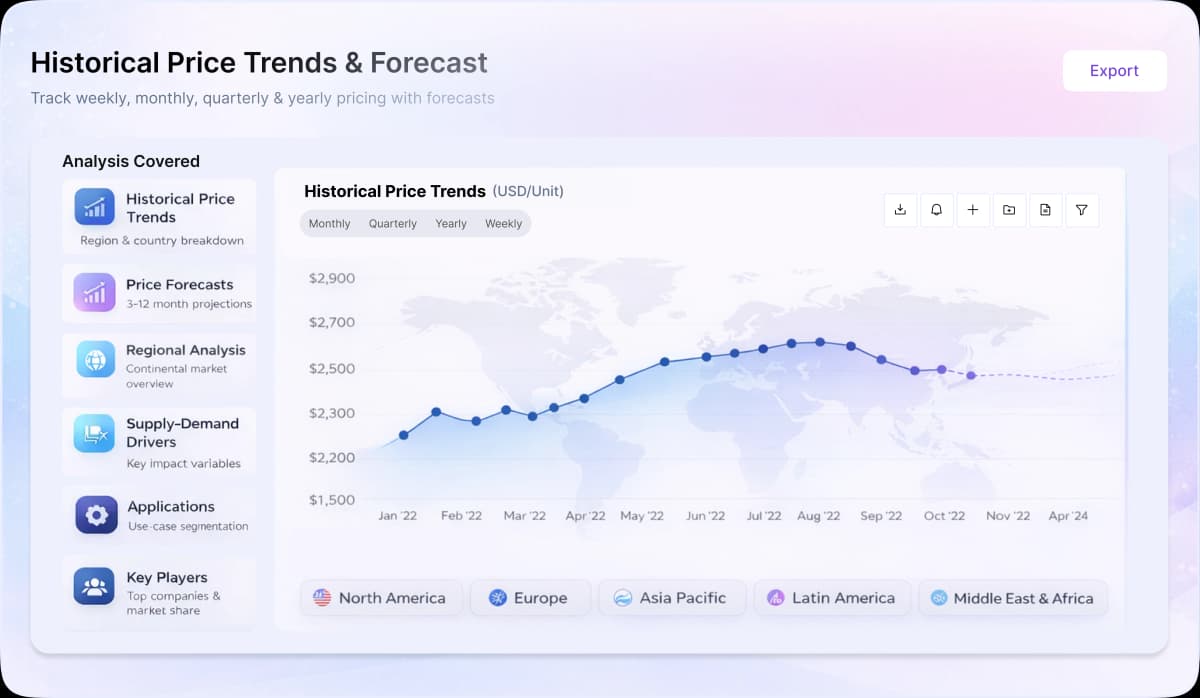
During the first half of the discussed span in Q3’23, the market prices were mostly observed to be wavering high as the demands from the above-mentioned industries kept rising. Suppliers increased production to garner more revenue and fill the supply gaps. This surge in the price graph went on till the middle of the following quarter. It was during the last months of Q4 that the prices dipped owing to the decline in industrial consumption during the New Year holiday season. Overall, positive market behavior was observed.

Europe

Despite some occasional reverse fluctuations, the Carbon Fibre Reinforced Plastic market outlook in Europe was generally positive for the most part. Influenced by the Asian market the prices here mostly dwelled on the inclined side of the curve. The purchasing power of the region started improving again after the economic mayhem of the previous years. This fueled up the regional manufacturing sector as well, and thus, a rising price trend was obtained for the most period. Some downward movement was seen during the later months of Q4.

North America

The North American Carbon Fibre Reinforced Plastic industry closely mimicked the growth in its Asian and European counterparts during the given period. The prices were observed to be inclining steadily here as well. With very supportive downstream demands and cautious suppliers, the market momentum was observed to be very positive throughout.

About Carbon Fibre Reinforced Plastic

Carbon Fibre Reinforced Plastic (CFRP) is a robust and lightweight reinforced plastic made up of carbon fibers. CFRP is five times lighter than steel and has only about 60 percent of the weight of aluminum. Owing to its high load-bearing capacity and thermal expansion, its demand is increasing for consumer and technical applications. CFRP is a material consisting of several constituents: a base or carrier substance, also called a matrix (usually a resin), and a second reinforcing component, the carbon fiber, embedded in the matrix.

Carbon Fibre Reinforced Plastic Product Detail

HS Code
39072090
Synonyms

CFRP, Carbon fiber-reinforced polymers, Carbon-fiber reinforced-thermoplastic(CFRTP), Carbon composite

Industrial Uses

Aerospace, Automotives, Shipping Industry, Sports Equipment, Robotics, Automation

Regional Coverage

Asia Pacific

China, India, Indonesia, Pakistan, Bangladesh, Japan, Philippines, Vietnam, Iran, Thailand, South Korea, Iraq, Saudi Arabia, Malaysia, Nepal, Taiwan, Sri Lanka, UAE, Israel, Hongkong, Singapore, Oman, Kuwait, Qatar, Australia, and New Zealand

Europe

Germany, France, United Kingdom, Italy,Spain, Russia, Turkey, Netherlands, Poland, Sweden, Belgium, Austria, Ireland Switzerland, Norway, Denmark, Romania, Finland, Czech Republic, Portugal and Greece

North America

United States and Canada

Latin America

Brazil, Mexico, Argentina, Columbia, Chile, Ecuador, and Peru

Africa

South Africa, Nigeria, Egypt, Algeria, Morocco

CurrencyUS$ (Data can also be provided in local currency)

Supplier Database AvailabilityYes

Customization ScopeThe report can be customized as per the requirements of the customer

Post-Sale Analyst Support360-degree analyst support after report delivery

Note: Our supplier search experts can assist your procurement teams in compiling and validating a list of suppliers indicating they have products, services, and capabilities that meet your company's needs.

Carbon Fibre Reinforced Plastic Production Processes

  • CFRP Production from Pitch; CFRP Production via Carbonization

The production of CFRP from pitch takes place in many steps. In the first step, all the impurities that affect the tensile strength of carbon fibers are removed, and the pitch is subjected to spinning. Then thermosetting of the pitch is carried out. This process is one of the most challenging processes.

Thermosetting uses an oxidation reaction, and it is imperative to remove heat from pitch fiber. Too fast a thermosetting response cause it to melt the surface of the fiber and stick to each other. To avoid this phenomenon, we must use a slow thermosetting reaction. Then the carbonization is carried out, and the desired product is obtained.

Frequently Asked Questions

The CFRP outlook is mixed regionally. Asia faces overcapacity and softer automotive and wind energy demand, sustaining downward price pressure, though aerospace grades tend to hold firm on defense orders. Europe tends to see stability to modest gains from wind energy and aerospace demand, though elevated energy costs and cautious procurement can cap upside. North America's aerospace and defense demand underpins specialized grades, but inventory buildups and construction weakness can weigh on commodity grades.
CFRP prices are shaped by regional drivers. In Asia, raw-material cost volatility can erode margins, while Chinese overcapacity and sluggish automotive and wind-energy demand tend to trigger aggressive price-cutting; weak offtake typically prevents improved raw-material economics from reaching margins. In Europe, energy cost fluctuations, supply-chain disruptions, and environmental compliance costs can raise expenses, though strong wind-energy and aerospace demand tends to absorb these increases.
The major CFRP producers are concentrated among five global companies: Toray Industries and Mitsubishi Chemical (Japan), Solvay (Belgium), SGL Carbon (Germany), and Hexcel (US). China is a significant manufacturing hub with overcapacity driving aggressive export pricing. Key consuming regions include Europe (aerospace and wind energy), North America (aerospace/defense), and Asia Pacific. This producer concentration creates supply security considerations, particularly as Chinese overcapacity intensifies competitive pressure on standard grades.
Carbon fibre reinforced plastic has two primary feedstocks: polyacrylonitrile (PAN) and pitch. PAN is produced by polymerising acrylonitrile monomer derived from propylene and ammonia, while pitch is a petroleum or coal tar by-product. From PAN, fibre forms through carbonization; from pitch, via mesophase pitch conversion, stabilization, carbonization, graphitization, and surface treatment. The carbon fibre is embedded in a resin matrix to produce CFRP, used in aerospace structures, automotive and EV components, wind turbine blades, sports equipment, medical devices, shipping, and robotics.

Aerospace and defense are the most consistent demand pillars, with defense orders keeping specialized grades stable even when broader markets weaken. Wind energy also provides meaningful support, particularly in Europe. Automotive demand tends to be the most cyclical, dragging on commodity-grade CFRP prices when it softens. In Asia, overcapacity and sluggish domestic auto demand can trigger aggressive price-cutting, while in North America inventory buildups and weak industrial consumption can add further downward pressure. Europe tends to hold up best, with wind and aerospace demand offsetting energy-cost headwinds.
Procurement Resource assesses carbon fibre reinforced plastic prices through a structured, data-driven methodology combining primary engagement with producers, suppliers and traders, secondary market data, monitoring of feedstock and input costs, trade-flow and inventory tracking, and exchange or spot benchmarks. These inputs are validated and translated into a transparent price assessment and outlook. The detailed methodology is available on the Procurement Resource website.

Our Price Analysis Methodology

About the Author

Udeesha Tomar profile photo

Udeesha Tomar

AVP - Strategy and Solutions

Leading procurement research solutions across chemicals, materials, and food & beverages, with expertise in price forecasting and market analytics.

Schedule Demo

Schedule A Demo

Experience how Procurement Resource transforms raw material price data into clear, decision ready intelligence. Optimise your performance with reliable, expert market data and analysis. Schedule your demo today to experience a live walk-through where our experts will showcase interactive price charts, forecasted prices, and insights driving the prices for your key commodities, tailored to your workflows. Contact us now!

Our Team will be happy to assist you

We are just a text away

+1

Still Need Help?

Europe & Africa

+44 7573 171117

Sales@procurementresource.com

USA & Canada

+1 307 363 1045

Sales@procurementresource.com

APAC

+91 8850629517

Sales@procurementresource.com

Unlock full access to Procurement Resource's price databases, interactive charts, and short-term forecasts for thousands of commodities. Elevate your sourcing decisions by comparing prices across regions, downloading historical data, and layering in analyst-backed insights, all with our flexible plans that scale as your portfolio grows.

Still have any Questions

Contact Us
Mastercard
Wire
VISA
Stripe

Why Procurement Database

Commodity Market Intelligence

Commodity Market Intelligence

Track prices, market movements, supply-demand dynamics, and industry developments across hundreds of commodities through a centralized intelligence platform built for informed procurement decisions.

Price Forecasts & Market Outlooks

Price Forecasts & Market Outlooks

Understand market fluctuations using analyst-backed forecasts, historical pricing patterns, and evolving industry trends to strengthen sourcing strategies and budget planning.

Cost & Procurement Optimization

Cost & Procurement Optimization

Leverage cost models, pricing benchmarks, and procurement insights to evaluate purchasing opportunities, improve negotiations, and enhance operational efficiency.

Global & Regional Market Insights

Global & Regional Market Insights

Access region-specific price trends, trade activities, capacity changes, and supply chain developments influencing commodity markets worldwide.

1/4