Coal India output decline tightens supply
Coal India's quarterly production fell while power demand grew, straining availability. Rising mining costs and higher e-auction realisations point to continued upward pressure on coal prices.
War in West Asia disrupts LNG supply through the Strait of Hormuz, forcing economies to increase coal-fired power generation. This surge in demand is tightening the coal market and pushing prices upward.
Carbon monoxide is generated mainly through the partial combustion of hydrocarbons drawn from crude oil, natural gas, and coal, tying its cost base closely to the upstream energy complex. The gas is a foundational chemical building block, feeding synthesis gas streams and the carbonylation routes to acetic acid and methanol, while also underpinning phosgene chemistry, metallurgical iron reduction and steelmaking, and pharmaceutical synthesis.
In the first half of 2026, carbon monoxide prices held on a broadly steady footing, carrying forward the balanced conditions seen at the close of 2025. Feedstock hydrocarbon costs stayed range-bound, lending consistent cost support without prompting producers to lift offers aggressively. Demand from acetic acid and methanol synthesis was firm but unspectacular, while metallurgical consumption tracked a subdued steel sector. Asian prices stayed within a narrow band as competitive regional supply capped sentiment, European material carried a modest premium against elevated energy costs and tighter logistics, and North American prices moved largely sideways as pharmaceutical and carbonyl-compound demand provided a stable base.
With range-bound feedstock costs and dependable, if soft, downstream demand, the market stayed in relative equilibrium through the half, while regulatory attention on production standards kept participants watchful for supply adjustments.
Analyst Insight
According to Procurement Resource, carbon monoxide prices are expected to remain broadly stable in the near term, with upstream hydrocarbon feedstock dynamics and the pace of chemical and metallurgical activity the principal drivers.
Related Report
Need latest Carbon Monoxide price?
Get real-time price assessments, periodic trends, forecasts and price driver insights across key global markets.
Unlock Price Insights NowOur Clients

Turn price intelligence into action with the Procurement Resource Database. Log in or subscribe to unlock live price trends, historical charts, supplier databases, cost curves, and analyst-backed insights across chemicals, agriculture, energy, packaging, and more. Use these tools to benchmark your contracts, plan budgets with confidence, and stay ahead of market moves on every product you buy.
0
+Products
0
+Regions
0
+Subscriptions
The market for Carbon Monoxide experienced fluctuating pricing dynamics throughout the year, influenced by movements in carbon dioxide, a key feedstock used in certain production processes. Early months witnessed price increases supported by demand from chemical synthesis applications, particularly acetic acid and methanol production, with industrial gas requirements contributing to steady consumption. Metallurgical sector demand from steel production and iron reduction processes maintained baseline support, though logistics constraints and feedstock availability created supply tightness that drove prices upward in several regional markets.
As the year progressed, prices eased with weakening demand from specialty chemical manufacturing and reduced metallurgical applications as steel sector activity softened. The middle months brought steady price movement with slight upward trends, though rising energy costs and feedstock supply complications caused fluctuations. Pharmaceutical manufacturing and carbonyl compound production maintained moderate consumption levels, providing stability amid broader market volatility. Later in the year, prices remained mostly firm owing to steady demand from chemical intermediates and industrial gas applications, particularly phosgene production and specialty synthesis operations. However, regulatory actions regarding production standards and environmental compliance kept market participants alert regarding possible supply adjustments. Trade activity reflected these varying conditions, with suppliers adjusting delivery volumes based on sector-specific requirements across chemical and metallurgical end-users.
Carbon monoxide is an odorless and colorless gas formed by the incomplete combustion of fuels. Carbon monoxide consists of one carbon atom and one oxygen atom connected by a triple bond. There are several environmental and biological sources that generate and emit a significant amount of carbon monoxide.


When people are exposed to CO gas, the CO molecules displace the oxygen in their bodies and lead to poisoning. Since CO has no odor, color, or taste, it cannot be detected by our senses, which means that dangerous concentrations of the gas can build up, and humans have no way to detect the problem until they become ill. It is also one of the major greenhouse gases responsible for climate change.
CO
Pharmaceuticals, Metal Industry, Chemicals like methanol, Fragrances, Food and Beverages, Electronics
Carbonic oxide, Carbonous oxide, Carbon(II) oxide
Air Liquide, Linde Plc., Sipchem, Messer, American Gas Products, Praxair
CurrencyUS$ (Data can also be provided in local currency)
Supplier Database AvailabilityYes
Customization ScopeThe report can be customized as per the requirements of the customer
Post-Sale Analyst Support360-degree analyst support after report delivery
Note: Our supplier search experts can assist your procurement teams in compiling and validating a list of suppliers indicating they have products, services, and capabilities that meet your company's needs.
Via Producer Gas: Producer gas is prepared by simultaneously blowing coke or coal with air and steam. In an oven, the air is passed through a coke bed, and the initially produced carbon dioxide reacts with the remaining hot carbon to produce the desired carbon monoxide.

Business Insights Analyst
Helping procurement and sourcing teams navigate complex markets through data-driven research, category intelligence, and actionable insights - with a focus on identifying market trends, analyzing supply-side developments, and delivering clear intelligence that supports informed business decisions.
Our Price Analysis Methodology

Experience how Procurement Resource transforms raw material price data into clear, decision ready intelligence. Optimise your performance with reliable, expert market data and analysis. Schedule your demo today to experience a live walk-through where our experts will showcase interactive price charts, forecasted prices, and insights driving the prices for your key commodities, tailored to your workflows. Contact us now!
Our Team will be happy to assist you
We are just a text away
Still Need Help?
Unlock full access to Procurement Resource's price databases, interactive charts, and short-term forecasts for thousands of commodities. Elevate your sourcing decisions by comparing prices across regions, downloading historical data, and layering in analyst-backed insights, all with our flexible plans that scale as your portfolio grows.
Still have any Questions
Contact Us


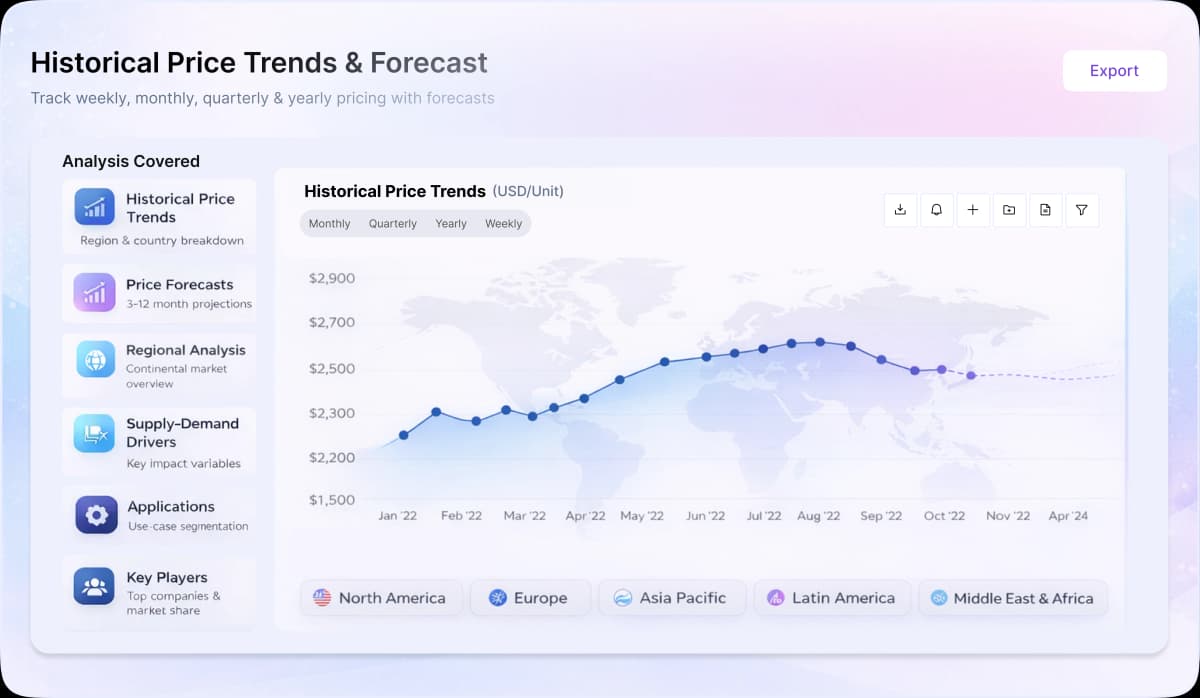
Price Trend Dashboard - What's Included
Price trends across a diverse portfolio of categories and products, spanning board to niche chemicals
Coverage extendable to grade-specific chemicals based on procurement requirements
Regular price tracking supported by robust historical datasets
News, policy updates, and key market drivers impacting price movements
Short-term and long-term price outlooks and forecasts
Supply-demand dynamics and capacity-driven market analysis