Colorants Price Trend Analysis 2026: Latest News, Price Drivers, Supply Demand Analysis, Market Insights & Historical Prices

Pragati Agarwal profile photo
Written ByPragati Agarwal

Procurement Resource Database

Laptop screen

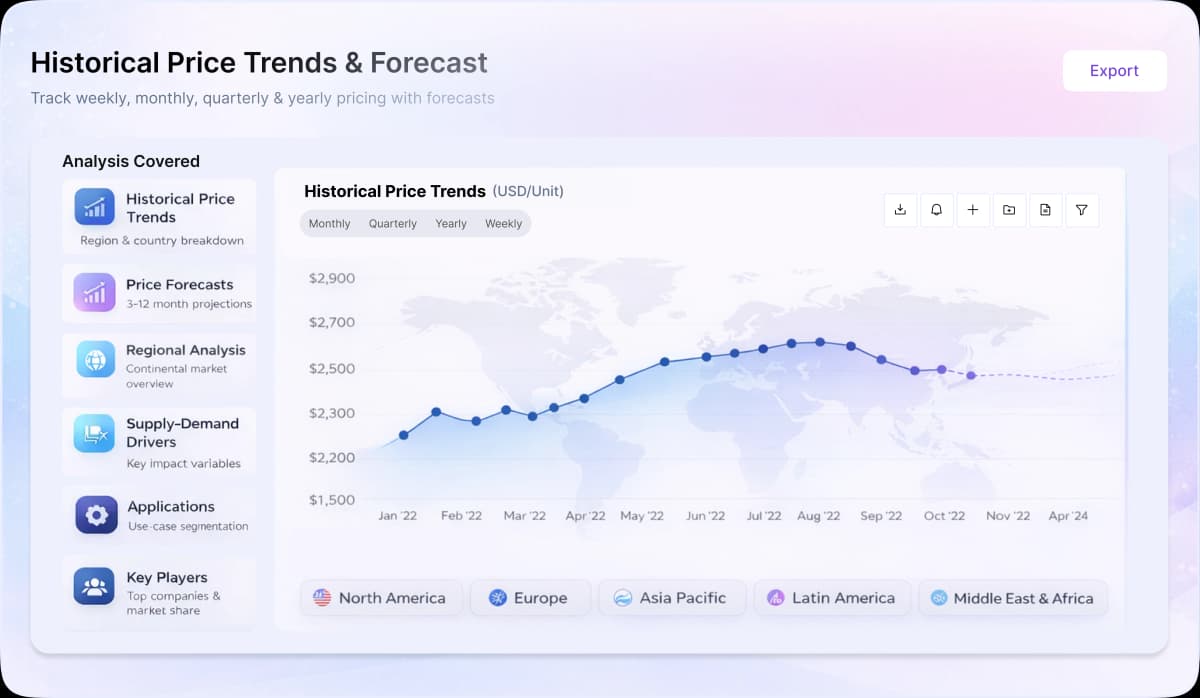
Turn price intelligence into action with the Procurement Resource Database. Log in or subscribe to unlock live price trends, historical charts, supplier databases, cost curves, and analyst-backed insights across chemicals, agriculture, energy, packaging, and more. Use these tools to benchmark your contracts, plan budgets with confidence, and stay ahead of market moves on every product you buy.

0

+

Products

0

+

Regions

0

+

Subscriptions

At the beginning of the year, manufacturers anticipated a reversal in the downward price trend of general colorant chemicals. During the first quarter, prices remained relatively stable, and the market retained an optimistic outlook. Demand from downstream sectors such as coatings, paper, plastics, and specialty industries showed signs of improvement. Production companies, including Tronox, began destocking as customers transitioned back to their standard purchasing patterns and initiated restocking activities.

Entering the second quarter, prices experienced a slight decline, primarily due to weakened demand, but stabilized as the quarter advanced. Some manufacturers responded to rising raw material costs and tightening profit margins by increasing colorant prices. They attempted to address these challenges through internal improvements and close communication with suppliers. However, rising freight costs, limited vessel availability, and delays in shipments, exacerbated by geopolitical tensions in the Red Sea region and the Suez Canal, presented additional difficulties.

Overall, the colorant market has remained volatile due to a range of factors, including supply chain disruptions, a shortage of skilled labor, stringent regulations, environmental concerns, anti-dumping taxes, insolvency issues, and fluctuating consumer confidence. These challenges have contributed to significant price variability in the market.

About Colorants

A colourant is known as a substance which is added or applied in order to alter or modify the colour of a material or surface. Colorants can be utilised for several or numerous purposes like printing, painting, and for colouring several types of materials like plastics, ceramics, etc.

Colorants Product Detail

Industrial Uses

Pigments and dyes, Paint and coatings, Plastics, Photographs, Printing inks, Fabrics and textiles, Printing technology, Ceramics, Food products and beverages

Supplier Database

Chr. Hansen A/S, BASF SE, Pidilite Industries Limited, Huntsman International LLC, Sensient Technologies Corporation, Clariant AG, Lanxess AG

Regional Coverage

Asia Pacific

China, India, Indonesia, Pakistan, Bangladesh, Japan, Philippines, Vietnam, Iran, Thailand, South Korea, Iraq, Saudi Arabia, Malaysia, Nepal, Taiwan, Sri Lanka, UAE, Israel, Hongkong, Singapore, Oman, Kuwait, Qatar, Australia, and New Zealand

Europe

Germany, France, United Kingdom, Italy,Spain, Russia, Turkey, Netherlands, Poland, Sweden, Belgium, Austria, Ireland Switzerland, Norway, Denmark, Romania, Finland, Czech Republic, Portugal and Greece

North America

United States and Canada

Latin America

Brazil, Mexico, Argentina, Columbia, Chile, Ecuador, and Peru

Africa

South Africa, Nigeria, Egypt, Algeria, Morocco

CurrencyUS$ (Data can also be provided in local currency)

Supplier Database AvailabilityYes

Customization ScopeThe report can be customized as per the requirements of the customer

Post-Sale Analyst Support360-degree analyst support after report delivery

Note: Our supplier search experts can assist your procurement teams in compiling and validating a list of suppliers indicating they have products, services, and capabilities that meet your company's needs.

Colorants Production Process

  • Production of Colorants (liquid) via Industrial Process: Colorants or more specifically liquid Colorants are developed from a pigment dispersed a nonvolatile liquid carrier, which include products like mineral oils and complex fatty acid derivatives. Further, surfactants are added to the mixture for providing improved dispersion results. The viscosity of these Colorants may range from maple syrup to gel-like consistencies.

Frequently Asked Questions

The 2026 colorants outlook is stable to firm. Downstream coatings and printing demand holds firm, while producers maintain disciplined inventory management. Prices are shaped by feedstock costs, energy and freight overheads, and regulatory compliance. Asian producers remain competitively positioned on ample capacity, while European and North American values carry premiums from elevated energy and freight costs. Risks include supply-chain disruptions, feedstock shocks, or weakening discretionary plastics and textile demand amid cautious consumer sentiment.


Colorants prices respond to several interacting factors. Feedstock costs for petrochemical intermediates and titanium dioxide move as producers manage inventories and defend margins, directly influencing pigment and dye pricing. Elevated energy costs and firmer freight rates tend to push European prices to a premium, while regulatory compliance costs add overhead. Ample Asian capacity and balanced feedstock generally keep Chinese and Indian offers range bound. Downstream demand tends to be mixed: coatings, packaging, and printing offer steady pull, partly boosted by sustainable water-based ink chemistries, while softer discretionary plastics and textile demand weighs on sentiment.
China and India are the principal producing and exporting countries, with ample capacity keeping Asian material competitively priced. Europe and North America are significant consuming markets, where prices carry a premium reflecting higher energy, compliance, and freight costs. Latin America and Africa also feature in trade flows. The supplier base is concentrated among BASF SE, Clariant AG, Lanxess AG, Huntsman International LLC, Chr. Hansen A/S, Sensient Technologies Corporation, and Pidilite Industries Limited, meaning supply security is closely tied to the operational continuity of these few major producers.
Colorants are produced by dispersing pigments into a nonvolatile liquid carrier, with mineral oils and complex fatty acid derivatives serving as the primary carriers. Surfactants are added during the mixing stage to improve pigment dispersion and stability, yielding liquid colorants with viscosities ranging from maple syrup to gel-like consistencies. The finished product is supplied to downstream industries including paint and coatings, plastics, printing inks, textiles, ceramics, and food and beverages, where color and functional properties are required.
Coatings, packaging, and printing are the primary demand drivers for colorants, offering a dependable pull that tends to keep prices broadly steady-to-firm. The shift toward sustainable, water-based ink chemistries has further supported printing demand. By contrast, discretionary plastics and textile outlets can remain subdued amid cautious consumer sentiment, limiting broader upside. This mixed but resilient downstream picture means price pressure tends to come mainly from coatings and printing activity rather than a broad-based demand surge.
Procurement Resource assesses colorants price trends through a structured, data-driven methodology combining primary engagement with producers, suppliers and traders, secondary market data, monitoring of feedstock and input costs, trade-flow and inventory tracking, and exchange or spot benchmarks. These inputs are validated and translated into a transparent price assessment and outlook. The detailed methodology is available on the Procurement Resource website.

Our Price Analysis Methodology

About the Author

Pragati Agarwal profile photo

Pragati Agarwal

Senior Business Insights Analyst

Delivering price trend analysis and procurement market insights at Procurement Resource, with expertise in identifying commodity patterns, supporting purchasing strategies, and improving cost efficiency through actionable market intelligence.

Schedule Demo

Schedule A Demo

Experience how Procurement Resource transforms raw material price data into clear, decision ready intelligence. Optimise your performance with reliable, expert market data and analysis. Schedule your demo today to experience a live walk-through where our experts will showcase interactive price charts, forecasted prices, and insights driving the prices for your key commodities, tailored to your workflows. Contact us now!

Our Team will be happy to assist you

We are just a text away

+1

Still Need Help?

Europe & Africa

+44 7573 171117

[email protected]

USA & Canada

+1 307 363 1045

[email protected]

APAC

+91 8850629517

[email protected]

Unlock full access to Procurement Resource's price databases, interactive charts, and short-term forecasts for thousands of commodities. Elevate your sourcing decisions by comparing prices across regions, downloading historical data, and layering in analyst-backed insights, all with our flexible plans that scale as your portfolio grows.

Still have any Questions

Contact Us
Mastercard
Wire
VISA
Stripe

Why Procurement Database

Commodity Market Intelligence

Commodity Market Intelligence

Track prices, market movements, supply-demand dynamics, and industry developments across hundreds of commodities through a centralized intelligence platform built for informed procurement decisions.

Price Forecasts & Market Outlooks

Price Forecasts & Market Outlooks

Understand market fluctuations using analyst-backed forecasts, historical pricing patterns, and evolving industry trends to strengthen sourcing strategies and budget planning.

Cost & Procurement Optimization

Cost & Procurement Optimization

Leverage cost models, pricing benchmarks, and procurement insights to evaluate purchasing opportunities, improve negotiations, and enhance operational efficiency.

Global & Regional Market Insights

Global & Regional Market Insights

Access region-specific price trends, trade activities, capacity changes, and supply chain developments influencing commodity markets worldwide.

1/4