Udeesha Tomar
AVP - Strategy and Solutions
Leading procurement research solutions across chemicals, materials, and food & beverages, with expertise in price forecasting and market analytics.
Globally, copolymer prices followed a fluctuating trend throughout 2025, closely mirroring movements in upstream feedstock costs. Prices opened the year at relatively elevated levels before entering a downward phase as raw material costs softened progressively.
Crude oil prices, which serve as a primary cost driver for petrochemical-derived copolymers, exhibited considerable instability across the year. After an early peak, values declined before staging a partial mid-year recovery, then resumed a downward path through the latter months, closing the year at lower levels. Copolymer prices broadly tracked this pattern, with upstream cost reductions feeding through to downstream pricing with some lag. Demand from key copolymer-consuming industries, including packaging, automotive components, consumer goods, and construction materials, remained mixed throughout the year. While certain segments maintained steady offtake, overall consumption growth was insufficient to provide meaningful price support against the backdrop of softening input costs and adequate supply availability. Producer margins fluctuated in line with the spread between feedstock costs and finished product prices. Overall, copolymer prices
Analyst Insight
According to Procurement Resource, copolymer prices are expected to remain subdued in the near term, reflecting continued weakness in upstream energy markets and tempered demand from key industrial end user sectors.
Related Report
Get real-time price assessments, periodic trends, forecasts and price driver insights across key global markets.
Unlock Price Insights NowOur Clients

Turn price intelligence into action with the Procurement Resource Database. Log in or subscribe to unlock live price trends, historical charts, supplier databases, cost curves, and analyst-backed insights across chemicals, agriculture, energy, packaging, and more. Use these tools to benchmark your contracts, plan budgets with confidence, and stay ahead of market moves on every product you buy.

0
+Products
0
+Regions
0
+Subscriptions
In the latter half of 2024, the copolymer market experienced divergent regional dynamics, characterized by complex price movements and fluctuating market forces. North America witnessed an upward pricing trend, driven by steady demand from packaging, automotive, and consumer goods sectors. The market maintained resilience despite macroeconomic challenges, with manufacturers responding to strong consumption patterns.
Conversely, the Asian region encountered significant downward pressure on copolymer prices. Reduced demand from construction and automotive industries, coupled with global raw material cost fluctuations, contributed to a consistently bearish market sentiment. Seasonal slowdowns and economic uncertainties further compounded the pricing challenges.
European markets displayed a more balanced pricing environment, with fluctuating yet relatively stable copolymer prices. Manufacturers navigated complex market conditions by optimizing inventory management and focusing on operational efficiency. Steady demand from key sectors like automotive and consumer goods helped maintain market equilibrium.
The overall copolymer market in H2’24 was marked by regional variations, supply chain complexities, and cautious market adaptations, reflecting the broader economic uncertainties and sector-specific challenges.
Analyst Insight
According to Procurement Resource, the Copolymer market is likely to remain sensitive to global economic recovery, industrial demand shifts, and raw material price volatility.
Copolymer refers to a polymer that is composed of two or more monomer species, unlike homopolymers, which contain only one type of monomer unit. Several polymers of commercial importance are copolymers, for example, polyethylene-vinyl acetate (PEVA), nitrile rubber, styrene/butadiene co-polymer (SBR), acrylonitrile butadiene styrene (ABS), and others.
Copolymers are further categorised based on their structures. into linear copolymers and branched copolymers. Copolymer obtained via copolymerisation demonstrates the many benefits of hybrid materials and offers enhanced properties to the product to meet the specific needs, for example, to reduce crystallinity, limit wetting properties or to improve solubility.
Thermoplastic elastomers, Construction Materials, Paints and Adhesives, Automotive
LyondellBasell Industries N.V, China Petroleum & Chemical Corporation (Sinopec), The Dow Chemical Company, BASF SE, SABIC, PetroChina Company Limited
CurrencyUS$ (Data can also be provided in local currency)
Supplier Database AvailabilityYes
Customization ScopeThe report can be customized as per the requirements of the customer
Post-Sale Analyst Support360-degree analyst support after report delivery
Note: Our supplier search experts can assist your procurement teams in compiling and validating a list of suppliers indicating they have products, services, and capabilities that meet your company's needs.
In order to produce Copolymer, copolymerisation of two or more monomers is carried out at a specific temperature and conditions. Since the physicochemical characteristics of each monomer are unique, their nature of copolymerisation also varies depending on the monomer involved in the process. The obtained products unite the beneficial properties of their monomeric species while often negating their disadvantageous properties.

AVP - Strategy and Solutions
Leading procurement research solutions across chemicals, materials, and food & beverages, with expertise in price forecasting and market analytics.
Our Price Analysis Methodology

Experience how Procurement Resource transforms raw material price data into clear, decision ready intelligence. Optimise your performance with reliable, expert market data and analysis. Schedule your demo today to experience a live walk-through where our experts will showcase interactive price charts, forecasted prices, and insights driving the prices for your key commodities, tailored to your workflows. Contact us now!
Our Team will be happy to assist you
We are just a text away
Still Need Help?
Unlock full access to Procurement Resource's price databases, interactive charts, and short-term forecasts for thousands of commodities. Elevate your sourcing decisions by comparing prices across regions, downloading historical data, and layering in analyst-backed insights, all with our flexible plans that scale as your portfolio grows.
Still have any Questions
Contact Us


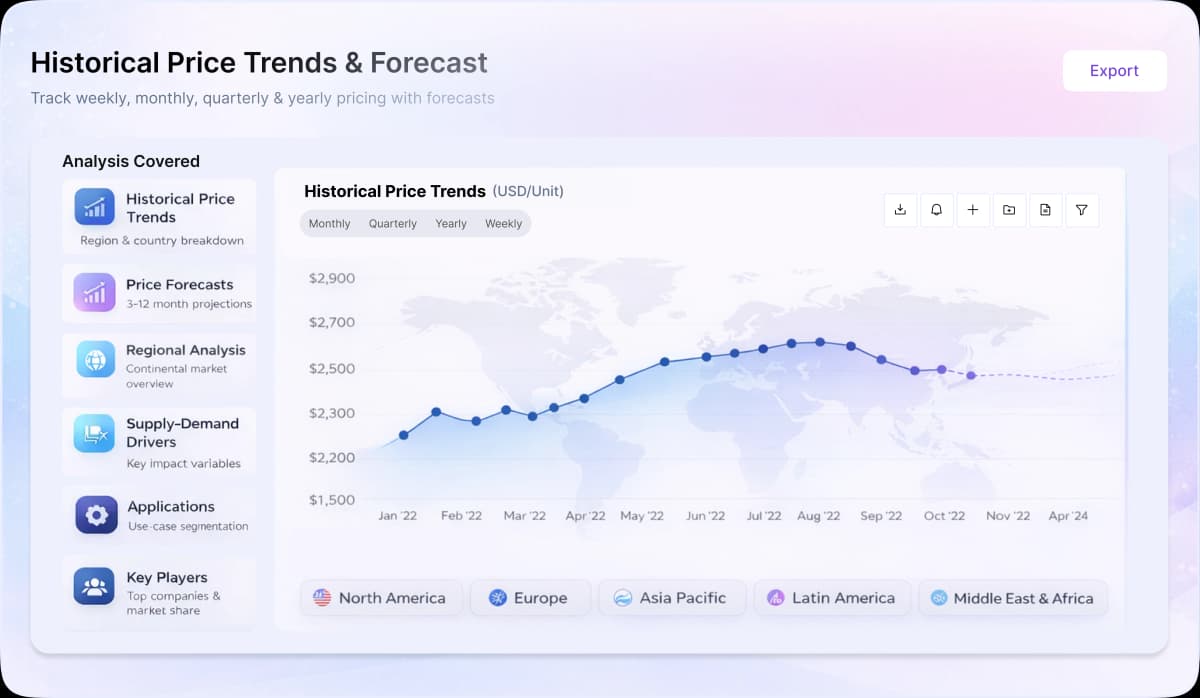
Price Trend Dashboard - What's Included
Price trends across a diverse portfolio of categories and products, spanning board to niche chemicals
Coverage extendable to grade-specific chemicals based on procurement requirements
Regular price tracking supported by robust historical datasets
News, policy updates, and key market drivers impacting price movements
Short-term and long-term price outlooks and forecasts
Supply-demand dynamics and capacity-driven market analysis