Durum Wheat Price Trend Analysis 2026: Price Drivers, Latest News, Market Insights, Supply Demand Analysis & Historical Prices

Neha Gawande profile photo
Written ByNeha Gawande

Procurement Resource Database

Laptop screen

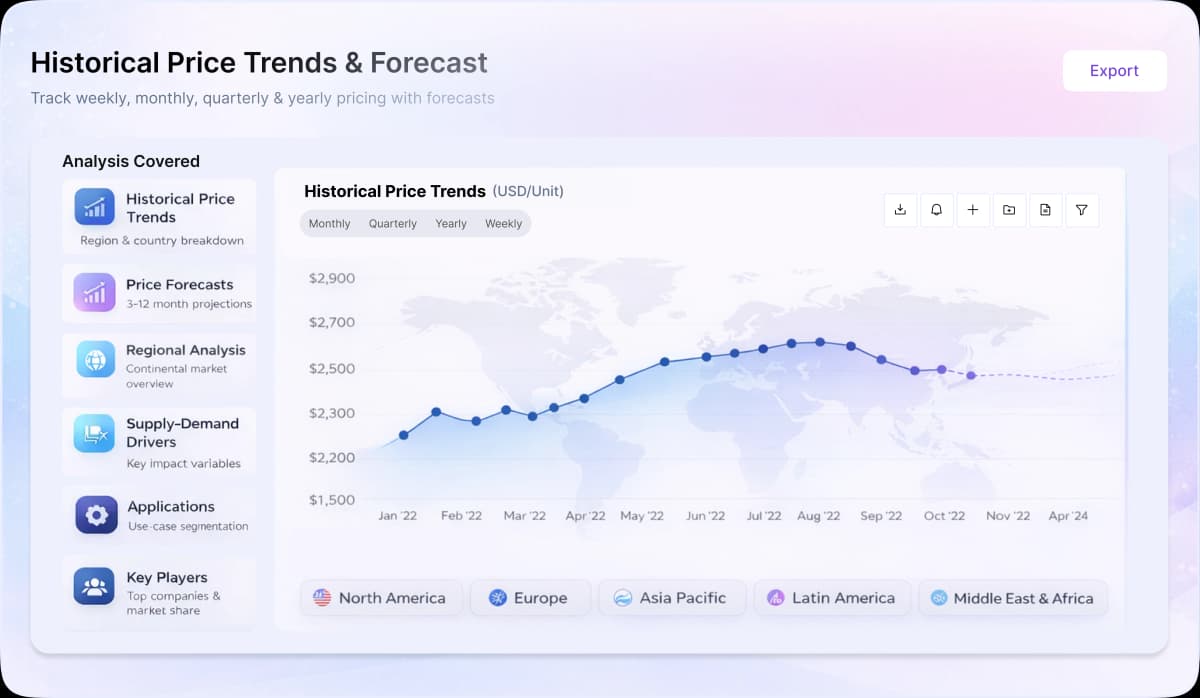
Turn price intelligence into action with the Procurement Resource Database. Log in or subscribe to unlock live price trends, historical charts, supplier databases, cost curves, and analyst-backed insights across chemicals, agriculture, energy, packaging, and more. Use these tools to benchmark your contracts, plan budgets with confidence, and stay ahead of market moves on every product you buy.

0

+

Products

0

+

Regions

0

+

Subscriptions

In the second half of 2024, durum wheat prices moved through a complex cycle shaped by uneven global supply and competitive export dynamics. At the start of H2, prices showed initial firmness, supported by tight global inventories and strong demand from North African and European buyers. Weather-related crop issues in countries like France and Italy contributed to a decline in local availability, encouraging imports and lifting global demand.

However, as the months progressed, rising production from key exporters like Canada and Turkey added downward pressure. Canada reported a significant year-on-year jump in output, which created surplus availability, while Turkey’s unexpectedly large harvest increased market competition. These developments limited any strong price rally, even as demand remained steady in traditional importing nations.

Moreover, Russia’s quality issues with its durum crop and reduced competitiveness in the Black Sea region briefly lifted market sentiment. Still, the overall global supply picture improved enough to keep prices from rising significantly. Export competition, especially from Turkey, further weighed on price momentum. Although Canadian exporters saw decent early sales, logistical disruptions and moderate demand kept the pace below potential.

About Durum Wheat

Durum Wheat, also known as pasta wheat or macaroni wheat (Triticum durum or Triticum turgidum subsp. durum) is basically a tetraploid species of wheat. It is the hardest of all wheat species. It was produced and developed via artificial selection of the domesticated emmer wheat strains, which were grown in Central Europe and the Near East during the ancient time.

It is known to be the second most cultivated species of wheat after common wheat, although it represents only 5% to 8% share in the global wheat production. It is milled and the endosperm is ground into a fine product called semolina, which is used for premium pastas and breads.

Durum Wheat Product Detail

Industrial Uses

Flour, Pasta, Biscuits, Shortcrust Pastry, Thicken Sauces

Synonyms

Pasta wheat, Macaroni wheat, Breads

Supplier Database

Bühler Group, Ardent MillsEuropean Flour Millers

Regional Coverage

Asia Pacific

China, India, Indonesia, Pakistan, Bangladesh, Japan, Philippines, Vietnam, Iran, Thailand, South Korea, Iraq, Saudi Arabia, Malaysia, Nepal, Taiwan, Sri Lanka, UAE, Israel, Hongkong, Singapore, Oman, Kuwait, Qatar, Australia, and New Zealand

Europe

Germany, France, United Kingdom, Italy,Spain, Russia, Turkey, Netherlands, Poland, Sweden, Belgium, Austria, Ireland Switzerland, Norway, Denmark, Romania, Finland, Czech Republic, Portugal and Greece

North America

United States and Canada

Latin America

Brazil, Mexico, Argentina, Columbia, Chile, Ecuador, and Peru

Africa

South Africa, Nigeria, Egypt, Algeria, Morocco

CurrencyUS$ (Data can also be provided in local currency)

Supplier Database AvailabilityYes

Customization ScopeThe report can be customized as per the requirements of the customer

Post-Sale Analyst Support360-degree analyst support after report delivery


Note: Our supplier search experts can assist your procurement teams in compiling and validating a list of suppliers indicating they have products, services, and capabilities that meet your company's needs.

Durum Wheat Production Process

  • Production of Durum Wheat via Cultivation

Durum Wheat is cultivated in favourable climatic conditions, followed by its harvesting. It is subject to four processes, that are, cleaning, tempering, milling and purifying, before its commercial use in the industry.

Frequently Asked Questions

The durum wheat outlook remains cautiously bearish, with improved U.S. production and building domestic inventories offsetting tighter North American supplies from reduced Arizona and Mexico acreage. Canadian exports reached approximately 5.8 MMT in 2025/26, while Agriculture and Agri-Food Canada projects all-wheat production falling from 40 MMT to 35.3 MMT in 2026/27. U.S. ending stocks are forecast down 21 percent to a three-year low, offering some support. Trade policy clarity remains the key swing factor, and persistent dryness in North Dakota and Montana poses yield and quality risks that could shift the balance.
Trade policy uncertainty is a recurring driver of durum wheat pricing, as tariff-related delays targeting Canada and Mexico, a critical supplier, can leave buyers cautious and hand-to-mouth, suppressing forward demand. Accelerated pre-tariff imports of Canadian durum can build domestic inventories and add downward pressure on local markets. On the supply side, US production gains can be offset by reduced acreage in Arizona and Mexico driven by water constraints and withdrawn subsidies, while persistent dryness in North Dakota and Montana keeps production risk elevated.
Canada dominates global durum wheat trade as the primary supplier, with buyers sometimes accelerating imports ahead of potential tariffs. The United States is the other major North American producer, though production can face headwinds from reduced acreage in Arizona and Mexico due to water constraints and withdrawn subsidies, alongside persistent dryness in North Dakota and Montana. European and North African markets are key import destinations, with shipments routing through Texas Gulf ports, creating meaningful exposure for buyers dependent on a single-source supplier amid ongoing trade policy uncertainty.
Drought conditions are a recurring risk to durum wheat production, with dryness in North Dakota and Montana and water constraints reducing acreage in Arizona and Mexico. Severe drought in Southern Italy has at times driven production to decade lows, with cultivated areas falling under 1.2 million hectares and some regions seeing up to 17% area reduction. Drought-like conditions across Saskatchewan and Alberta have previously slashed Canadian output by roughly 31% in a single season, lifting global prices and triggering export restrictions by Russia and Türkiye.
Durum wheat follows a seasonal crop cycle that shapes supply and pricing. Key North American producers Canada and the US sow in spring, with persistent dryness in North Dakota and Montana threatening yield potential. Because Canada's harvest arrives ahead of the US crop, buyers can rush to secure imports around tariff-related deadlines, accelerating stock-building and exerting downward price pressure. This seasonal timing creates predictable stock cycles that procurement teams must plan around to manage costs effectively.
The food industry is the dominant downstream driver of durum wheat demand, with pasta manufacturers (spaghetti, linguini, ravioli) and bread producers forming the core consumption base. Biscuit, shortcrust pastry, and sauce-thickening applications add further industrial pull. Animal feed compounding also absorbs meaningful volumes. Strong consumer preference for high-protein, nutritious flour varieties reinforces food-sector procurement, while importers rushing to secure Canadian supplies ahead of potential tariffs can amplify buying urgency and build domestic inventories, exerting downward price pressure across North American markets.
Several policy actions shaped the durum wheat market heading into late 2026. Russia's Agriculture Ministry revised its wheat intervention price bands for the 2026/2027 season, effective July 1, 2026, while raising rye thresholds and keeping barley unchanged. Separately, dry US weather reduced harvest expectations, and Black Sea export disruptions, including Ukrainian port attacks and Russian shipping restrictions, tightened export availability and supported firmer durum wheat pricing. These supply-side constraints were especially consequential for Mediterranean and North African buyers reliant on timely shipments.
In the 2025/26 crop year, U.S. durum wheat was planted on approximately 1.78 million acres with a yield of about 38.4 bushels per acre, producing roughly 66.4 million bushels. Canada seeded approximately 5.9 million acres of durum and exported about 5.8 MMT over the crop year. The 23% year-on-year drop in U.S. output, combined with reduced Canadian seeded area, signals tightening North American supply, which supports firmer price sentiment even when hand-to-mouth buying and tariff uncertainty weigh on markets.
Procurement Resource assesses durum wheat price trends through a structured, data-driven methodology combining primary engagement with producers, suppliers and traders, secondary market data, monitoring of feedstock and input costs, trade-flow and inventory tracking, and exchange or spot benchmarks. These inputs are validated and translated into a transparent price assessment and outlook. The detailed methodology is available on the Procurement Resource website.

Our Price Analysis Methodology

About the Author

Neha Gawande profile photo

Neha Gawande

Senior Lead Analyst

Delivering procurement intelligence and commodity research across automotive, oil & gas, chemicals, aerospace, and energy, helping sourcing teams decode complex supply chain data to sharpen purchasing strategies and achieve sustainable cost outcomes.

Schedule Demo

Schedule A Demo

Experience how Procurement Resource transforms raw material price data into clear, decision ready intelligence. Optimise your performance with reliable, expert market data and analysis. Schedule your demo today to experience a live walk-through where our experts will showcase interactive price charts, forecasted prices, and insights driving the prices for your key commodities, tailored to your workflows. Contact us now!

Our Team will be happy to assist you

We are just a text away

+1

Still Need Help?

Europe & Africa

+44 7573 171117

[email protected]

USA & Canada

+1 307 363 1045

[email protected]

APAC

+91 8850629517

[email protected]

Other Related Reports

Wheat Starch Production from Scandinavian Process

In this process, wheat flour is fed into a streamlet of water where a slurry mixture of wheat and water is formed.

Wheat Starch Production from Martin Process

This report provides the cost structure of wheat starch production from the Martin process. Martin process refers to the wet milling process.

Unlock full access to Procurement Resource's price databases, interactive charts, and short-term forecasts for thousands of commodities. Elevate your sourcing decisions by comparing prices across regions, downloading historical data, and layering in analyst-backed insights, all with our flexible plans that scale as your portfolio grows.

Still have any Questions

Contact Us
Mastercard
Wire
VISA
Stripe

Related News

View All

Why Procurement Database

Commodity Market Intelligence

Commodity Market Intelligence

Track prices, market movements, supply-demand dynamics, and industry developments across hundreds of commodities through a centralized intelligence platform built for informed procurement decisions.

Price Forecasts & Market Outlooks

Price Forecasts & Market Outlooks

Understand market fluctuations using analyst-backed forecasts, historical pricing patterns, and evolving industry trends to strengthen sourcing strategies and budget planning.

Cost & Procurement Optimization

Cost & Procurement Optimization

Leverage cost models, pricing benchmarks, and procurement insights to evaluate purchasing opportunities, improve negotiations, and enhance operational efficiency.

Global & Regional Market Insights

Global & Regional Market Insights

Access region-specific price trends, trade activities, capacity changes, and supply chain developments influencing commodity markets worldwide.

1/4