Need latest Galvanized Sheet prices?
Get real-time price assessments, periodic trends, forecasts and price driver insights across key global markets.
Unlock Price Insights NowOur Clients
In the second half of 2025, galvanized sheet prices were mostly stable, with only minor fluctuations. Supportive government measures, such as Egypt’s stimulus package for local steel production, helped increase supply and reduce dependence on imports, keeping the market balanced. Costs for hot-rolled steel, which is the main raw material for galvanized sheets, rose slightly, but producers managed prices carefully to maintain margins.
Demand from construction, automotive, and household appliance sectors remained steady, without any sudden surges or drops. Import volumes continued, adding competition to local markets and preventing significant price increases. In Europe, weak demand from the automotive and construction industries limited price growth, while trade uncertainties and carbon adjustment policies made buyers cautious. In North America, domestic production was steady, and inventories were sufficient to meet regular demand, which also helped keep prices calm. Overall, the market showed a balance between stable supply and moderate demand.
Analyst Insight
According to Procurement Resource, Galvanized Sheet prices are expected to remain mostly steady in the near term, with only small changes likely if raw material costs or industrial demand shift significantly.
Get real-time price assessments, periodic trends, forecasts and price driver insights across key global markets.
Unlock Price Insights NowOur Clients

Turn price intelligence into action with the Procurement Resource Database. Log in or subscribe to unlock live price trends, historical charts, supplier databases, cost curves, and analyst-backed insights across chemicals, agriculture, energy, packaging, and more. Use these tools to benchmark your contracts, plan budgets with confidence, and stay ahead of market moves on every product you buy.

0
+Products
0
+Regions
0
+Subscriptions
In the first half of 2025, galvanized sheet prices showed mixed movement across global markets. In Asia, prices saw a slight rise early in the year, supported by limited supply and cautious optimism in construction and auto demand. However, by the second quarter, higher zinc costs and weaker downstream demand, especially in infrastructure, pushed prices under pressure. Seasonal weather disruptions in South China also led to reduced construction activity, further slowing demand.
In Europe, prices gradually moved upward in Q1, helped by lower imports and producers’ efforts to raise offers. While initial demand remained weak, tight supply conditions gave prices some support. Still, Q2 brought a more cautious tone as demand from construction and automotive sectors stayed subdued. Labour shortages and slow project approvals limited stronger recovery.
In North America, prices followed a firm upward path throughout H1. Stronger manufacturing activity and construction recovery drove steady demand. Higher input costs and limited supply availability also contributed to a supportive price environment. Despite global uncertainties, sentiment in the region stayed largely positive.
Galvanized Sheets, as the name says, are the steel sheets that are Galvanized by coating it with zinc. Surface of Galvanized steel has evenly distributed layer of zinc material, which plays a role of anodic protection for base material. Since zinc weathers at a very slow rate, the coating generally has a long life. They are also known for excellent shiny surfaces, strength, and durability, and include a range of hot dip Galvanized and electro-Galvanized sheets.


Agriculture, Automobile sector, Construction, Electrical appliances, Furniture and fixtures
JSW Steel Coated Products Limited, Agrasen Ispat (P) Ltd, Shandong Hengze New Material Group Co.,Ltd, Nippon Steel Corporation, Gupta Iron & Steel Co
CurrencyUS$ (Data can also be provided in local currency)
Supplier Database AvailabilityYes
Customization ScopeThe report can be customized as per the requirements of the customer
Post-Sale Analyst Support360-degree analyst support after report delivery
Hot dipping process based on zinc (Zn) alloy is widely used in order to protect steel sheets against atmospheric corrosion. Hot- dip Galvanized steel sheets are manufactured either by hot or cold rolling in coil form on continuous zinc coating lines. The thickness of the sheets produced from hot and cold rolling ranges from 2.01 to 3.0mm and from 0.27 to 2.0mm respectively.
Our Price Analysis Methodology

Experience how Procurement Resource transforms raw material price data into clear, decision ready intelligence. Optimise your performance with reliable, expert market data and analysis. Schedule your demo today to experience a live walk-through where our experts will showcase interactive price charts, forecasted prices, and insights driving the prices for your key commodities, tailored to your workflows. Contact us now!
Our Team will be happy to assist you
We are just a text away
Still Need Help ?
This report presents a detailed cost analysis of Aluminium Chloride (AlCl3) production from aluminium metal through exothermic reaction.
The report revolves around the cost analysis of production of carbon monoxide as a byproduct of the reduction of metal oxide ores with carbon.
The report is a detailed cost analysis of production of ammonium nitrate by a typical metathesis reaction.
Unlock full access to Procurement Resource's price databases, interactive charts, and short-term forecasts for thousands of commodities. Elevate your sourcing decisions by comparing prices across regions, downloading historical data, and layering in analyst-backed insights, all with our flexible plans that scale as your portfolio grows.
Still have any Questions
Contact Us


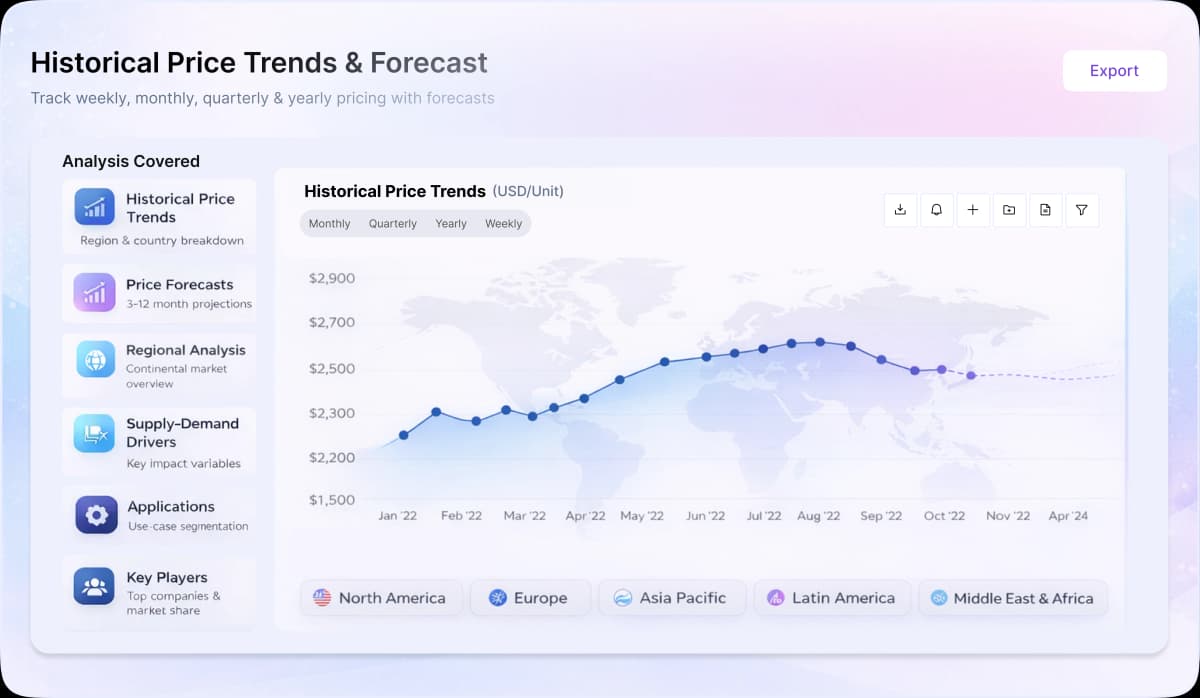
Price Trend Dashboard - What's Included
Price trends across a diverse portfolio of categories and products, spanning board to niche chemicals
Coverage extendable to grade-specific chemicals based on procurement requirements
Regular price tracking supported by robust historical datasets
News, policy updates, and key market drivers impacting price movements
Short-term and long-term price outlooks and forecasts
Supply–demand dynamics and capacity-driven market analysis