Need latest Micro Crystalline Cellulose prices?
Get real-time price assessments, periodic trends, forecasts and price driver insights across key global markets.
Unlock Price Insights NowOur Clients
Asia
In Asia, MCC prices moved mostly downward throughout 2025. Early in the year, several suppliers reduced production, but the impact was limited because demand from major sectors such as construction, textiles, and industrial applications stayed weak. In China, large inventories and softer export orders added to the pressure, while the pharmaceutical and food industries offered only modest support. As logistics improved compared to earlier disruptions, material availability increased further, keeping the market well supplied. By mid-year, prices slipped again as buyers preferred short-term contracts and avoided bulk purchasing due to economic uncertainty. The third quarter brought no major improvement, as oversupply continued in China and regional sentiment stayed cautious. Overall, Asia saw a year of steady softness driven by high stock levels and restrained downstream activity.
Europe
Europe also experienced a largely downward trend in MCC during 2025. The second quarter set the tone for the year as pulp-related weakness, rising competition from Asian suppliers, and delayed orders in the region pushed prices lower. New U.S. tariffs on imported pulp products created additional hesitation among buyers connected to international markets. Inventory levels increased at ports, reflecting slower movement of goods. Although pharmaceutical and food segments provided some stable demand, consumption from industrial sectors remained muted. Throughout the year, European buyers resisted higher quotations, and sellers struggled to reduce accumulated stocks. As a result, the regional market stayed under pressure with few signs of recovery.
North America
North America showed more stability compared to Asia and Europe, but pricing still leaned slightly lower in 2025. Supply remained steady because domestic plants ran reliably and there were no major disruptions. However, weaker export opportunities and cautious end-user demand kept any upward movement limited. The pharmaceutical and personal-care industries supported a baseline of consumption, but buyers overall stayed conservative due to ongoing economic uncertainty and trade-related risks. Even so, controlled inventory management prevented strong declines, and the region traded in a narrow range through most of the year.
Analyst Insight
According to Procurement Resource, MCC prices are expected to stay soft in the near term, with trade policies and downstream demand trends likely to guide any changes in market direction.
Get real-time price assessments, periodic trends, forecasts and price driver insights across key global markets.
Unlock Price Insights NowOur Clients

Turn price intelligence into action with the Procurement Resource Database. Log in or subscribe to unlock live price trends, historical charts, supplier databases, cost curves, and analyst-backed insights across chemicals, agriculture, energy, packaging, and more. Use these tools to benchmark your contracts, plan budgets with confidence, and stay ahead of market moves on every product you buy.

0
+Products
0
+Regions
0
+Subscriptions
Asia
The Asian region witnessed fluctuating trends during 2024. The first half maintained relatively stable pricing, while the third quarter saw corrections due to accumulating inventories. Currency fluctuations played a significant role, as the weakening Chinese yuan made exports more competitive but pressured domestic margins.
By the fourth quarter, Chinese suppliers engaged in aggressive destocking through discounted pricing strategies, partly responding to geopolitical uncertainties including potential new tariffs. Low production costs from weak feedstock wood pulp prices allowed manufacturers to maintain margins despite lower selling prices.
Europe
European MCC markets experienced a consistent downward trajectory throughout 2024. Initial optimism quickly gave way to bearish sentiment as economic challenges in the Eurozone limited growth. The euro's depreciation against the dollar increased import costs, while competitive Asian supplies influenced market dynamics. The second half saw further price deterioration due to sluggish demand and limited procurement. Operational challenges, including weather conditions and logistical disruptions at major ports, created additional complexities. High inventory levels from cautious stockpiling created market imbalances that pushed prices lower in the final months.
North America
The North American Microcrystalline Cellulose (MCC) market followed a predominantly bearish pattern throughout 2024. The market started stable but declined as competition from Asian imports intensified. U.S. buyers delayed purchases anticipating further price drops, while high domestic inventories forced suppliers to implement aggressive pricing strategies. Reduced demand from the pharmaceutical sector, especially for cholesterol-lowering medications, weakened the market further. The depreciation of the U.S. dollar against the yuan made Chinese imports more cost-effective, driving prices lower by year-end.
Microcrystalline cellulose (MCC) is a partially depolymerized form of cellulose derived from the -cellulose nucleus (type I), produced as a paste from fibrous crop tissue and depolymerized to a small extent using hydrochloric alcohol.

C14H26O11
Anti-caking agent, Bulking agent in food production, Texturizer
Cellulose, microcrystalline, Cellulose gel
DowDupont Inc, Asahi Kasei Corporation, DFE Pharma, Libraw Pharma, Wei Ming Pharmaceutical Mfg Co. Ltd
CurrencyUS$ (Data can also be provided in local currency)
Supplier Database AvailabilityYes
Customization ScopeThe report can be customized as per the requirements of the customer
Post-Sale Analyst Support360-degree analyst support after report delivery
Note: Our supplier search experts can assist your procurement teams in compiling and validating a list of suppliers indicating they have products, services, and capabilities that meet your company's needs.
MCC is a partially depolymerized cellulose formed from the α-cellulose nucleus, created as a paste from fibrous crop tissue and polymerized with hydrochloric alcohol. MCC can be synthesised using a variety of methods, including reactive extrusion, enzyme-mediated, steam explosion, and acid hydrolysis. In most cases, it is made by spray-drying a neutralised liquid slurry of hydrolyzed cellulose.
Our Price Analysis Methodology

Experience how Procurement Resource transforms raw material price data into clear, decision ready intelligence. Optimise your performance with reliable, expert market data and analysis. Schedule your demo today to experience a live walk-through where our experts will showcase interactive price charts, forecasted prices, and insights driving the prices for your key commodities, tailored to your workflows. Contact us now!
Our Team will be happy to assist you
We are just a text away
Still Need Help ?
Unlock full access to Procurement Resource's price databases, interactive charts, and short-term forecasts for thousands of commodities. Elevate your sourcing decisions by comparing prices across regions, downloading historical data, and layering in analyst-backed insights, all with our flexible plans that scale as your portfolio grows.
Still have any Questions
Contact Us


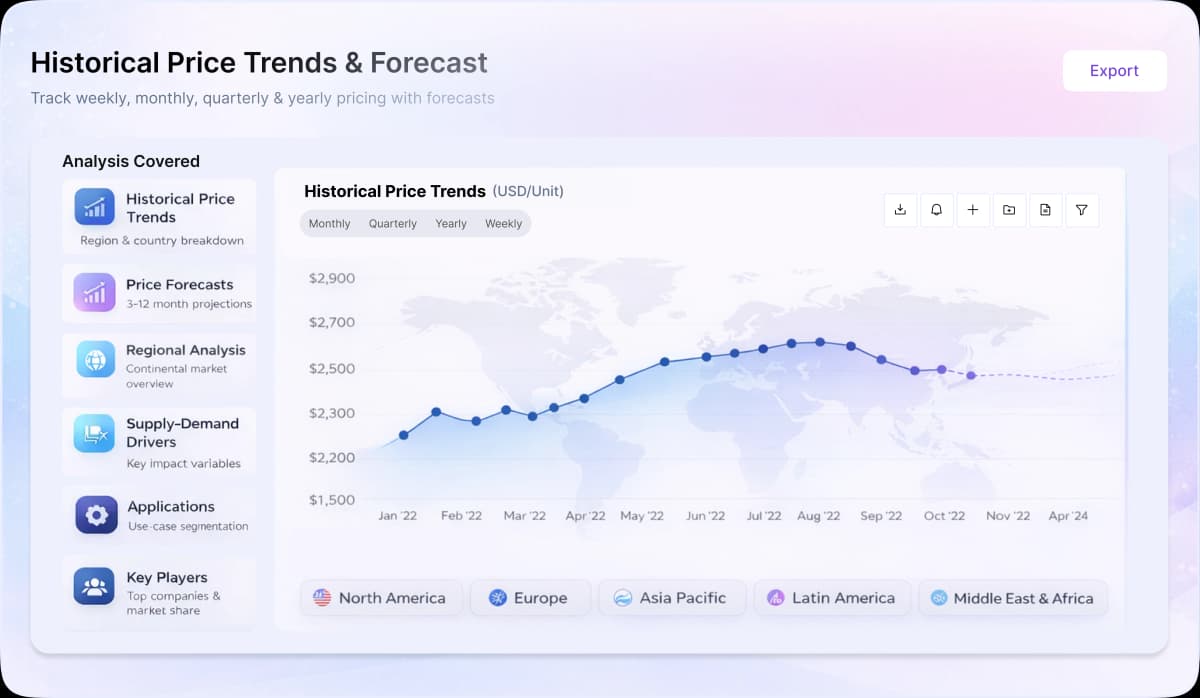
Price Trend Dashboard - What's Included
Price trends across a diverse portfolio of categories and products, spanning board to niche chemicals
Coverage extendable to grade-specific chemicals based on procurement requirements
Regular price tracking supported by robust historical datasets
News, policy updates, and key market drivers impacting price movements
Short-term and long-term price outlooks and forecasts
Supply–demand dynamics and capacity-driven market analysis