Udeesha Tomar
AVP - Strategy and Solutions
Leading procurement research solutions across chemicals, materials, and food & beverages, with expertise in price forecasting and market analytics.
In 2025, Nylon POY prices moved in waves, showing periods of decline, recovery, and stabilization through the year. Early in the year, prices were supported by strong cost pressure. International energy markets were affected by extreme weather and geopolitical tensions, which pushed up crude oil and related raw-material costs. Although many downstream mills slowed production before the Spring Festival, the high cost of upstream materials kept prices from falling sharply.
After the holiday, the market stayed quiet. Downstream factories resumed work slowly, and many buyers had stocked enough materials earlier, so purchasing was mainly limited to daily needs. Even so, several spinning units carried out maintenance and reduced production, which stopped prices from weakening too much.
Mid-year, the market saw short-lived surges in trading. Temporary easing in overseas trade and adjustments in import duties boosted confidence, leading to a sudden rise in orders and higher production and sales for a few days. But once these orders were delivered, demand softened again. Weaving mills faced slow fabric sales and rising inventories, so they bought cautiously. High operating rates in the fibre industry increased supply pressure, and some sellers became more flexible with negotiations.
Toward the end of the year, Nylon POY prices moved within a narrow range. Cost support was uneven because raw-material markets fluctuated, while downstream demand stayed modest and mostly driven by rigid consumption. Inventory levels were manageable overall, which prevented large price drops.
Analyst Insight
According to Procurement Resource, Nylon POY prices are expected to stay steady-to-weak in the short term, with any changes mainly tied to crude oil trends, supply cuts, and downstream operating rates.
Related Report
Get real-time price assessments, periodic trends, forecasts and price driver insights across key global markets.
Unlock Price Insights NowOur Clients

Turn price intelligence into action with the Procurement Resource Database. Log in or subscribe to unlock live price trends, historical charts, supplier databases, cost curves, and analyst-backed insights across chemicals, agriculture, energy, packaging, and more. Use these tools to benchmark your contracts, plan budgets with confidence, and stay ahead of market moves on every product you buy.

0
+Products
0
+Regions
0
+Subscriptions
During the second half of 2024, the Nylon POY market showed a mostly soft pattern, with only short periods of support. At the start of H2, prices in Asia rose slightly as production costs increased for a brief time, but this strength faded quickly.
Demand from major textile areas remained weak, as weaving units continued to run at lower rates and relied on their existing inventory instead of fresh buying. Even when export activity improved for a short period in late Q3, downstream confidence stayed limited, and the market could not hold onto the early gains.
In Europe, the situation was similar. Slight cost-driven support appeared early in the period, but consumption in textiles and related industries stayed muted. Buyers ordered cautiously, and manufacturers hesitated to make firm upward adjustments. Any improvement in sentiment during Q3 did not translate into sustained growth, keeping the overall trend soft.
North America also experienced a cautious market. A short-lived boost appeared when logistics improved and some textile units increased activity, but this recovery was limited. As Q4 approached, downstream buyers cut back on purchases again due to soft demand, leading to a mostly stable-to-soft environment.
Nylon POY or partially oriented yarn is an incompletely stretched filament produced by high spinning and is used to manufacture nylon DTY by texturing. It has 2-5% crystallinity and is available in three forms- semi-dull, full dull, and bright. It can be dyed using dope-dying technology.


C54H102N6O6
Weaving of Slack fabrics, manufacturing of nylon DTY
Koninklijke DSM N.V., Nylstar SA, Evonik Industries AG, Ascend Performance Materials, Reliance Industries Limited, Zig Sheng Industrial Co., Ltd., and Universal Fibers, DuPont de Nemours, Inc., BASF SE, Li Peng Enterprise Co. Ltd.
CurrencyUS$ (Data can also be provided in local currency)
Supplier Database AvailabilityYes
Customization ScopeThe report can be customized as per the requirements of the customer
Post-Sale Analyst Support360-degree analyst support after report delivery
Note: Our supplier search experts can assist your procurement teams in compiling and validating a list of suppliers indicating they have products, services, and capabilities that meet your company's needs.
Nylon POY production starts with taking the nylon chips or flakes, and melting them, followed by spinning the melt. During the spinning, the filaments are only partially stretched, and the speed of the spinnerets is high, giving rise to the formation of Nylon POY.

AVP - Strategy and Solutions
Leading procurement research solutions across chemicals, materials, and food & beverages, with expertise in price forecasting and market analytics.
Our Price Analysis Methodology

Experience how Procurement Resource transforms raw material price data into clear, decision ready intelligence. Optimise your performance with reliable, expert market data and analysis. Schedule your demo today to experience a live walk-through where our experts will showcase interactive price charts, forecasted prices, and insights driving the prices for your key commodities, tailored to your workflows. Contact us now!
Our Team will be happy to assist you
We are just a text away
Still Need Help?
Unlock full access to Procurement Resource's price databases, interactive charts, and short-term forecasts for thousands of commodities. Elevate your sourcing decisions by comparing prices across regions, downloading historical data, and layering in analyst-backed insights, all with our flexible plans that scale as your portfolio grows.
Still have any Questions
Contact Us


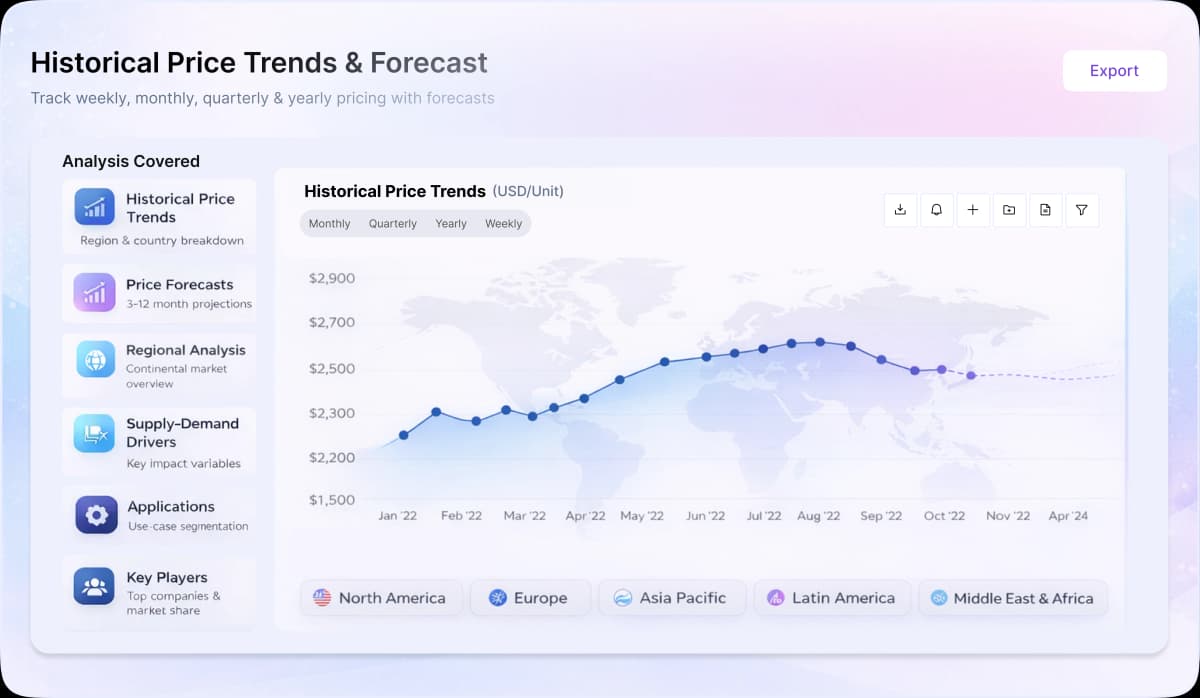
Price Trend Dashboard - What's Included
Price trends across a diverse portfolio of categories and products, spanning board to niche chemicals
Coverage extendable to grade-specific chemicals based on procurement requirements
Regular price tracking supported by robust historical datasets
News, policy updates, and key market drivers impacting price movements
Short-term and long-term price outlooks and forecasts
Supply-demand dynamics and capacity-driven market analysis