

Udeesha Tomar
AVP - Strategy and Solutions
Leading procurement research solutions across chemicals, materials, and food & beverages, with expertise in price forecasting and market analytics.

| Product | Region | Incoterm Basis | Price | Last Updated Month |
|---|---|---|---|---|
| Polymethyl Methacrylate (PMMA) | China | FOB | USD 2,075.24/MT | August 2026 |
| Polymethyl Methacrylate (PMMA) | India | CIF | USD 2,166.24/MT | August 2026 |
| Polymethyl Methacrylate (PMMA) | USA | CIF | USD 2,231.24/MT | August 2026 |
| Polymethyl Methacrylate (PMMA) | Germany | CIF | USD 2,189.24/MT | August 2026 |
| Polymethyl Methacrylate (PMMA) | Canada | CIF | USD 2,241.24/MT | August 2026 |
| Polymethyl Methacrylate (PMMA) | China | FOB | USD 2,045.48/MT | July 2026 |
| Polymethyl Methacrylate (PMMA) | India | CIF | USD 2,152.48/MT | July 2026 |
| Polymethyl Methacrylate (PMMA) | USA | CIF | USD 2,232.48/MT | July 2026 |
| Polymethyl Methacrylate (PMMA) | Germany | CIF | USD 2,179.48/MT | July 2026 |
| Polymethyl Methacrylate (PMMA) | Canada | CIF | USD 2,242.48/MT | July 2026 |
Stay updated with the latest Polymethyl Methacrylate (PMMA) prices, historical data, and tailored regional analysis
Asia
In the first half of 2025, PMMA prices in the Asia-Pacific region remained largely weak, with overall subdued momentum. During Q1, prices either fell or stayed flat due to limited demand from key industries such as construction and automotive. While supply remained steady, it was not enough to counter the low market activity and cautious buyer sentiment.
Even with minor feedstock fluctuations and a temporary supply disruption mid-quarter, prices did not experience any sharp movements. Moving into Q2, the situation improved slightly with stable conditions in China and growing demand in India. However, Japan continued to face falling prices, and overall regional sentiment stayed cautious. Stimulus discussions in some countries showed promise, but any positive effects had not yet materialized into real demand by June.
Europe
European PMMA prices showed a steady upward movement in Q1, supported by stable supply and consistent demand, especially from the automotive sector. Rising feedstock costs such as acetone and improved market confidence helped lift prices gradually through the quarter.
As Q2 began, the market started to shift, with prices declining due to slower seasonal demand and increased competitive imports from Asia. By June, the earlier optimism faded slightly, and European PMMA prices experienced some downward pressure. Despite this, the market remained more balanced compared to other regions, and supply chains stayed resilient throughout the first half.
North America
PMMA prices in North America followed a downward path in Q1’25, largely because of weak demand from major end-use sectors like construction and automotive. While supply stayed uninterrupted, high inventory levels and reduced industrial activity led to sluggish buying.
Falling MMA feedstock prices added to the downward pressure, although rising acetone costs slightly increased production costs. In Q2, market conditions began to stabilize with price levels flattening. Buyers remained cautious, but the influence of tariffs and adjusted procurement strategies helped prevent further declines.
Analyst Insight
According to Procurement Resource, the PMMA market is expected to remain uneven, with raw material cost fluctuations and regional demand variations continuing to shape pricing trends.
Related Report
Need Latest Polymethyl Methacrylate (PMMA) Prices?
Get real-time price assessments, periodic trends, forecasts and price driver insights across key global markets.
Our Clients


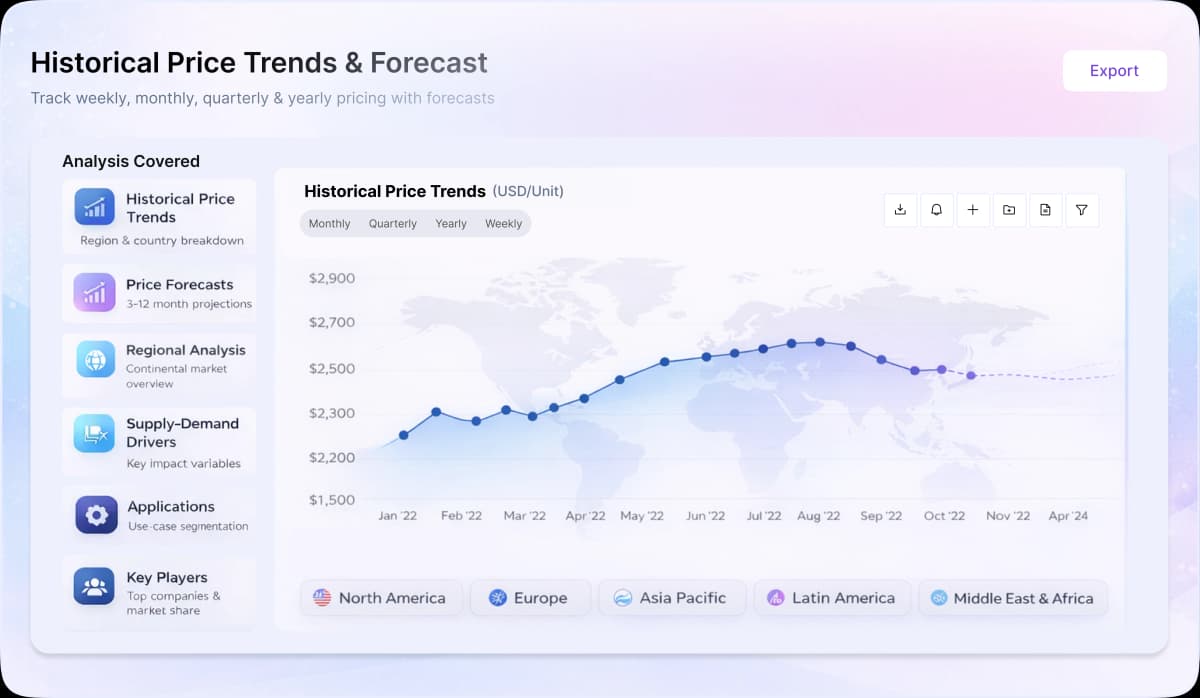
Turn price intelligence into action with the Procurement Resource Database. Log in or subscribe to unlock live price trends, historical charts, supplier databases, cost curves, and analyst-backed insights across chemicals, agriculture, energy, packaging, and more. Use these tools to benchmark your contracts, plan budgets with confidence, and stay ahead of market moves on every product you buy.
0
+Products
0
+Regions
0
+Subscriptions
Asia
PMMA-related market conditions in Asia remained soft throughout the quarter. Despite minor improvements in some end-use segments, overall demand was sluggish.
Producers maintained steady output, but downstream consumption didn’t pick up enough to support stronger pricing. With production costs easing and buyers hesitant to commit to large volumes, price levels remained under pressure for most of the quarter.
Europe
European PMMA prices declined gradually during Q4 as market fundamentals stayed weak. Demand from core industries like construction and automotive failed to recover meaningfully, while oversupply and competition from imported materials further strained the market. Economic concerns and seasonal slowdowns contributed to reduced buying activity, and prices faced downward momentum as the quarter progressed.
North America
In the final quarter of 2024, PMMA prices in North America held steady. Although demand from key industries like automotive was underwhelming, other sectors such as construction and household goods helped support market activity. Limited import availability and stable domestic production helped prevent any significant drop in prices. Inventory levels were carefully managed, and broader economic indicators remained positive, helping to maintain market balance.
PMMA or polymethyl methacrylate is a rigid, transparent resin produced by the polymerization of methyl methacrylate. It can perfectly transmit visible light through it and is used as a substitute for glass in lighted signs, skylights, shatterproof windows, and aircraft canopies.
(CH2=C[CH3]CO2H)n
Illuminated signs, domed skylights, aircraft canopies, luminous ceilings, swimming pool enclosures, optical fibres.
Plexiglas, Lucite, Perspex.
Röhm GmbH, ChiMei Corporation, Plaskolite LLC, Kuraray Co., Ltd, Lotte Chemical Corporation, Kolon Industries Inc., Toray Industries, Inc., Trinseo S.A, LG Chem Ltd, SABIC, Mitsubishi Chemical Holdings Corporation, Sumitomo Chemical Co., Ltd.
CurrencyUS$ (Data can also be provided in local currency)
Supplier Database AvailabilityYes
Customization ScopeThe report can be customized as per the requirements of the customer
Post-Sale Analyst Support360-degree analyst support after report delivery
Note: Our supplier search experts can assist your procurement teams in compiling and validating a list of suppliers indicating they have products, services, and capabilities that meet your company's needs.
The polymerization of methyl methacrylate forms PMMA. The production starts by obtaining propylene from the crude oil, which reacts with benzene giving cumene. The cumene is oxidized and reacted with an acid to give acetone, which is converted to methyl methacrylate. Finally, PMMA is obtained by the polymerization of methyl methacrylate.
Our Price Analysis Methodology
AVP - Strategy and Solutions
Leading procurement research solutions across chemicals, materials, and food & beverages, with expertise in price forecasting and market analytics.

Experience how Procurement Resource transforms raw material price data into clear, decision ready intelligence. Optimise your performance with reliable, expert market data and analysis. Schedule your demo today to experience a live walk-through where our experts will showcase interactive price charts, forecasted prices, and insights driving the prices for your key commodities, tailored to your workflows. Contact us now!
Our Team will be happy to assist you
We are just a text away
Still Need Help?
Unlock full access to Procurement Resource's price databases, interactive charts, and short-term forecasts for thousands of commodities. Elevate your sourcing decisions by comparing prices across regions, downloading historical data, and layering in analyst-backed insights, all with our flexible plans that scale as your portfolio grows.
Still have any Questions
Contact Us



Price Trend Dashboard - What's Included
Price trends across a diverse portfolio of categories and products, spanning board to niche chemicals
Coverage extendable to grade-specific chemicals based on procurement requirements
Regular price tracking supported by robust historical datasets
News, policy updates, and key market drivers impacting price movements
Short-term and long-term price outlooks and forecasts
Supply–demand dynamics and capacity-driven market analysis

Track prices, market movements, supply-demand dynamics, and industry developments across hundreds of commodities through a centralized intelligence platform built for informed procurement decisions.

Understand market fluctuations using analyst-backed forecasts, historical pricing patterns, and evolving industry trends to strengthen sourcing strategies and budget planning.

Leverage cost models, pricing benchmarks, and procurement insights to evaluate purchasing opportunities, improve negotiations, and enhance operational efficiency.
Access region-specific price trends, trade activities, capacity changes, and supply chain developments influencing commodity markets worldwide.