Polytrimethylene Terephthalate Price Trend Analysis 2026: Supply Demand Analysis, Market Insights, Price Drivers, Latest News & Historical Prices

Procurement Resource Database

Laptop screen

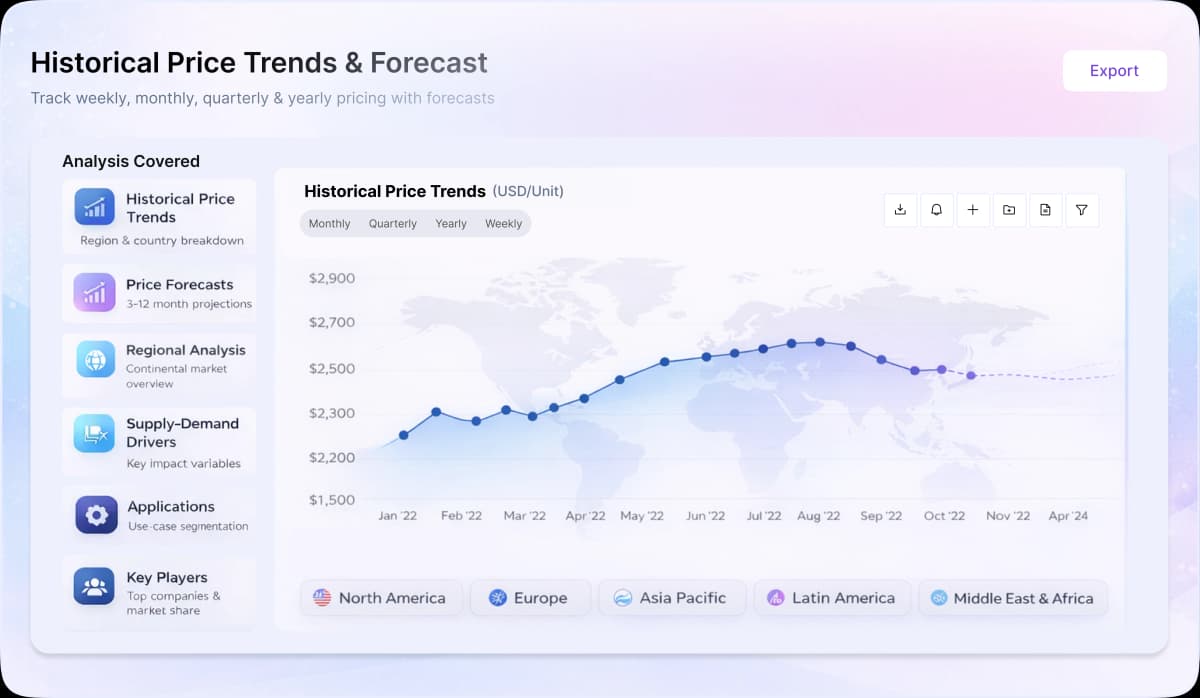
Turn price intelligence into action with the Procurement Resource Database. Log in or subscribe to unlock live price trends, historical charts, supplier databases, cost curves, and analyst-backed insights across chemicals, agriculture, energy, packaging, and more. Use these tools to benchmark your contracts, plan budgets with confidence, and stay ahead of market moves on every product you buy.

Polytrimethylene Terephthalate Dashboard Inclusions

Polytrimethylene Terephthalate Price Dasboard

0

+

Products

0

+

Regions

0

+

Subscriptions

The price trend of Polytrimethylene Terephthalate (PTT) in 2024 experienced fluctuations, tied to shifts in the European automotive market. PTT is used in seat covers and door panels, so its demand is linked to new vehicle production. The European car market faced significant challenges, with registrations at their lowest in over two years. A decline in battery-electric vehicle (BEV) sales contributed to the slowdown, reducing demand for PTT-based materials. The European Automobile Manufacturers Association reported an 18.3% drop in car registrations in August, affecting raw material procurement.

Germany and France were particularly affected, with registration declines of 27.8% and 24.3%, respectively. Italy and Spain also saw declines. Rising production costs in the auto industry, including higher financing rates and inflation, further pressured PTT demand. Some European markets, like Poland and Denmark, saw slight growth, but it was insufficient to counteract the broader slowdown. By the end of 2024, PTT prices remained under strain due to weak demand from the auto sector, compounded by lower vehicle production and financial headwinds in the European car market.

About Polytrimethylene Terephthalate

PTT is a semi-aromatic thermoplastic polyester which can be easily thermoformed and spun in high-quality fibres. It is obtained by polymerizing or transesterifying 1,3-propanediol and terephthalic acid or dimethyl terephthalate. Its mechanical properties resemble PET, whereas its flexibility and moulding capabilities resemble PBT. PTT is widely used in making fibres for carpets due to its high tensile strength, durability, and excellent abrasion resistance.

Polytrimethylene Terephthalate Product Detail

Chemical Formula

(C11H10O4)n

Cas Number
26590-75-0
Molecular Weight
Variable
Industrial Uses

Automotives, Textiles, Electronics, Packaging and Films

Synonyms

PTT, Poly-1,3-propylene terephthalate

Supplier Database

DuPont, RTP, Sinopec, Eastman Chemical Co., Royal Dutch/Shell Group of Companies

Regional Coverage

Asia Pacific

China, India, Indonesia, Pakistan, Bangladesh, Japan, Philippines, Vietnam, Iran, Thailand, South Korea, Iraq, Saudi Arabia, Malaysia, Nepal, Taiwan, Sri Lanka, UAE, Israel, Hongkong, Singapore, Oman, Kuwait, Qatar, Australia, and New Zealand

Europe

Germany, France, United Kingdom, Italy,Spain, Russia, Turkey, Netherlands, Poland, Sweden, Belgium, Austria, Ireland Switzerland, Norway, Denmark, Romania, Finland, Czech Republic, Portugal and Greece

North America

United States and Canada

Latin America

Brazil, Mexico, Argentina, Columbia, Chile, Ecuador, and Peru

Africa

South Africa, Nigeria, Egypt, Algeria, Morocco

CurrencyUS$ (Data can also be provided in local currency)

Supplier Database AvailabilityYes

Customization ScopeThe report can be customized as per the requirements of the customer

Post-Sale Analyst Support360-degree analyst support after report delivery

Note: Our supplier search experts can assist your procurement teams in compiling and validating a list of suppliers indicating they have products, services, and capabilities that meet your company's needs.

Polytrimethylene Terephthalate Production Processes

  • Production of Polytrimethylene Terephthalate from Esterification

PTT is produced by the polymerization of 1,3-propanediol and terephthalic acid or dimethyl terephthalate. The feedstocks are initially fed into the system, which turns them into a feed slurry. From there, it is transported to the reactors, where the esterification occurs in the presence of suitable catalysts. Then, vacuum and heat are applied to remove water for polymerization to occur, giving the desired PTT.

About the Author

Vishakha Agrawal profile photo

Vishakha Agrawal

Lead - Social & Development Research

Delivering procurement intelligence and supply chain analytics across healthcare, FMCG, and chemicals sectors, with expertise in cost modeling, vendor mapping, and spend optimization to support data-driven sourcing decisions and procurement outcomes.

Our Price Analysis Methodology

Schedule Demo

Schedule a demo

Experience how Procurement Resource transforms raw material price data into clear, decision ready intelligence. Optimise your performance with reliable, expert market data and analysis. Schedule your demo today to experience a live walk-through where our experts will showcase interactive price charts, forecasted prices, and insights driving the prices for your key commodities, tailored to your workflows. Contact us now!

Our Team will be happy to assist you

We are just a text away

+1

Still Need Help?

Europe & Africa

+44 7573 171117

[email protected]

USA & Canada

+1 307 363 1045

[email protected]

APAC

+91 8850629517

[email protected]

Other Related Reports

Polyethylene Terephthalate (PET) Production From Terephthalic Acid

This report provides the cost structure of PET production through esterification of ethylene glycol and terephthalic acid.

Polyethylene Terephthalate (PET) Production From DMT

The report contains the cost analysis of PET production using DMT process.

Unlock full access to Procurement Resource's price databases, interactive charts, and short-term forecasts for thousands of commodities. Elevate your sourcing decisions by comparing prices across regions, downloading historical data, and layering in analyst-backed insights, all with our flexible plans that scale as your portfolio grows.

Still have any Questions

Contact Us
Mastercard
Wire
VISA
Stripe

Related News

View All

Why Procurement Database

Commodity Market Intelligence

Commodity Market Intelligence

Track prices, market movements, supply-demand dynamics, and industry developments across hundreds of commodities through a centralized intelligence platform built for informed procurement decisions.

Price Forecasts & Market Outlooks

Price Forecasts & Market Outlooks

Understand market fluctuations using analyst-backed forecasts, historical pricing patterns, and evolving industry trends to strengthen sourcing strategies and budget planning.

Cost & Procurement Optimization

Cost & Procurement Optimization

Leverage cost models, pricing benchmarks, and procurement insights to evaluate purchasing opportunities, improve negotiations, and enhance operational efficiency.

Global & Regional Market Insights

Global & Regional Market Insights

Access region-specific price trends, trade activities, capacity changes, and supply chain developments influencing commodity markets worldwide.

1/4