Udeesha Tomar
AVP - Strategy and Solutions
Leading procurement research solutions across chemicals, materials, and food & beverages, with expertise in price forecasting and market analytics.
| Product | Region | Incoterm Basis | Price (USD/MT) | Time Period |
| Sebacic Acid | China | CIF | USD 4187/MT | January 2026 |
| Sebacic Acid | USA | CIF | USD 4272/MT | January 2026 |
| Sebacic Acid | Germany | CIF | USD 4308/MT | January 2026 |
| Sebacic Acid | India | CIF | USD 4295/MT | January 2026 |
| Sebacic Acid | Japan | CIF | USD 4229/MT | January 2026 |
Stay updated with the latest Sebacic Acid Price, historical data, and tailored regional analysis
During Q1’26, sebacic acid prices largely followed softer feedstock market conditions as castor oil prices in India declined by approximately 6.2% from January to March due to heavy arrivals of fresh castor seed during the domestic harvest season. Increased processing activity across Gujarat and Rajasthan improved feedstock availability and reduced upstream cost pressure for sebacic acid production. In Asia, the market remained stable as downstream demand from nylon 6,10, engineering plastics, industrial lubricants, and specialty coatings provided consistent support despite elevated inventories. Export activity from China and India continued steadily, although higher freight and insurance costs linked to Strait of Hormuz disruptions increased overall logistics expenses across chemical trade routes. In Europe, demand from automotive coatings, lubricants, and specialty polymer applications remained moderate amid cautious industrial activity, while higher import-related costs supported regional market sentiment.
Analyst Insight
According to Procurement Resource, sebacic acid prices are expected to remain stable to firm as seasonal feedstock pressure eases and downstream specialty chemical demand gradually improves.
Related Report
Get real-time price assessments, periodic trends, forecasts and price driver insights across key global markets.
Unlock Price Insights NowOur Clients

Turn price intelligence into action with the Procurement Resource Database. Log in or subscribe to unlock live price trends, historical charts, supplier databases, cost curves, and analyst-backed insights across chemicals, agriculture, energy, packaging, and more. Use these tools to benchmark your contracts, plan budgets with confidence, and stay ahead of market moves on every product you buy.

0
+Products
0
+Regions
0
+Subscriptions
In Q4 2025, sebacic acid prices in India followed a fluctuating yet overall declining pattern, closely aligned with movements in its primary feedstock, castor oil. Prices increased during the early part of the quarter as feedstock values strengthened, raising production costs and prompting suppliers to adjust offers upward. This initial firmness reflected steady procurement from downstream sectors, including nylon intermediates, plasticizers, lubricants, and specialty polymers, where consumption remained stable. As the quarter progressed, feedstock prices reversed direction and moved lower, reducing cost pressure on producers. The easing in raw material costs gradually translated into softer sebacic acid prices. At the same time, downstream demand showed limited expansion, with buyers maintaining cautious purchasing strategies and avoiding bulk restocking. Export activity remained measured, and domestic supply conditions appeared sufficient to meet prevailing requirements. Toward the close of the quarter, prices continued to edge downward, reflecting weaker upstream cost support and balanced supply-demand fundamentals. Overall, the market experienced an early rise followed by a sustained correction, ending the quarter below its peak levels.
Sebacic acid comes in the form of a white powdery granule. Sebacic acid is the 1,8-dicarboxy derivative of octane and is an alpha, omega-dicarboxylic acid. It serves as both a human and a plant metabolite. It is a dicarboxylic fatty acid and an alpha, omega-dicarboxylic acid. It is a sebacate(2-) and sebacate conjugate acid. It comes from a decane hydride.
C10H18O4
Production of lubricants, Production of plasticizers, Used as plant and human metabolite
1,8-Octane Dicarboxylic acid, 1,10-Decanedioic acid
Arkema Group, Hokoku Co., Ltd., Shipra Agrichem Pvt Ltd (SAPL), BASF SE
CurrencyUS$ (Data can also be provided in local currency)
Supplier Database AvailabilityYes
Customization ScopeThe report can be customized as per the requirements of the customer
Post-Sale Analyst Support360-degree analyst support after report delivery
Note: Our supplier search experts can assist your procurement teams in compiling and validating a list of suppliers indicating they have products, services, and capabilities that meet your company's needs.
The main fatty acid found in castor beans is produced through a procedure that involves extracting ricinoleic acid from sodium hydroxide and alkaline solutions. Approximately 87% of castor oil contains ricinoleic acid. Following caustic digestion, the ricinoleic acid is broken down to produce capryl alcohol and sebacic acid. Sebacic acid is often produced with a lesser yield, hence purification techniques are employed to get higher yields of purity.
Udeesha Tomar
AVP - Strategy and Solutions
Leading procurement research solutions across chemicals, materials, and food & beverages, with expertise in price forecasting and market analytics.
Our Price Analysis Methodology

Experience how Procurement Resource transforms raw material price data into clear, decision ready intelligence. Optimise your performance with reliable, expert market data and analysis. Schedule your demo today to experience a live walk-through where our experts will showcase interactive price charts, forecasted prices, and insights driving the prices for your key commodities, tailored to your workflows. Contact us now!
Our Team will be happy to assist you
We are just a text away
Still Need Help?
Unlock full access to Procurement Resource's price databases, interactive charts, and short-term forecasts for thousands of commodities. Elevate your sourcing decisions by comparing prices across regions, downloading historical data, and layering in analyst-backed insights, all with our flexible plans that scale as your portfolio grows.
Still have any Questions
Contact Us


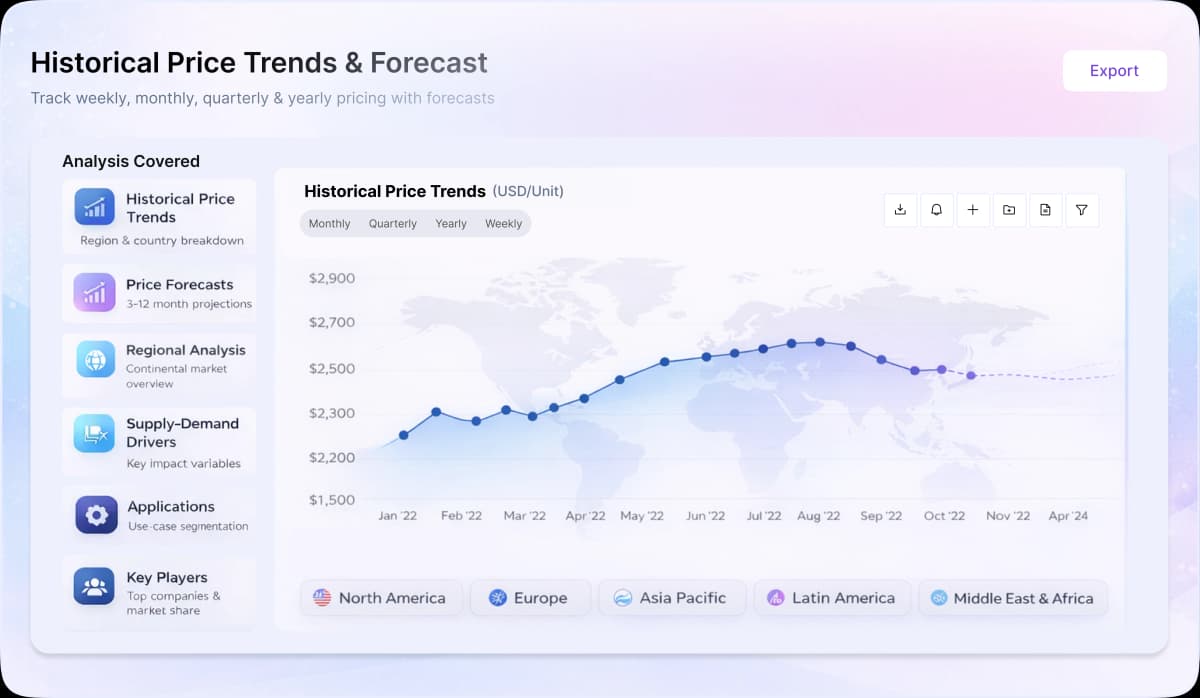
Price Trend Dashboard - What's Included
Price trends across a diverse portfolio of categories and products, spanning board to niche chemicals
Coverage extendable to grade-specific chemicals based on procurement requirements
Regular price tracking supported by robust historical datasets
News, policy updates, and key market drivers impacting price movements
Short-term and long-term price outlooks and forecasts
Supply-demand dynamics and capacity-driven market analysis