Silica Sand Price Trend Analysis 2026: Market Insights, Latest News, Supply Demand Analysis, Historical Prices & Price Drivers

Rakesh Nandi profile photo
Written ByRakesh Nandi

Procurement Resource Database

Laptop screen

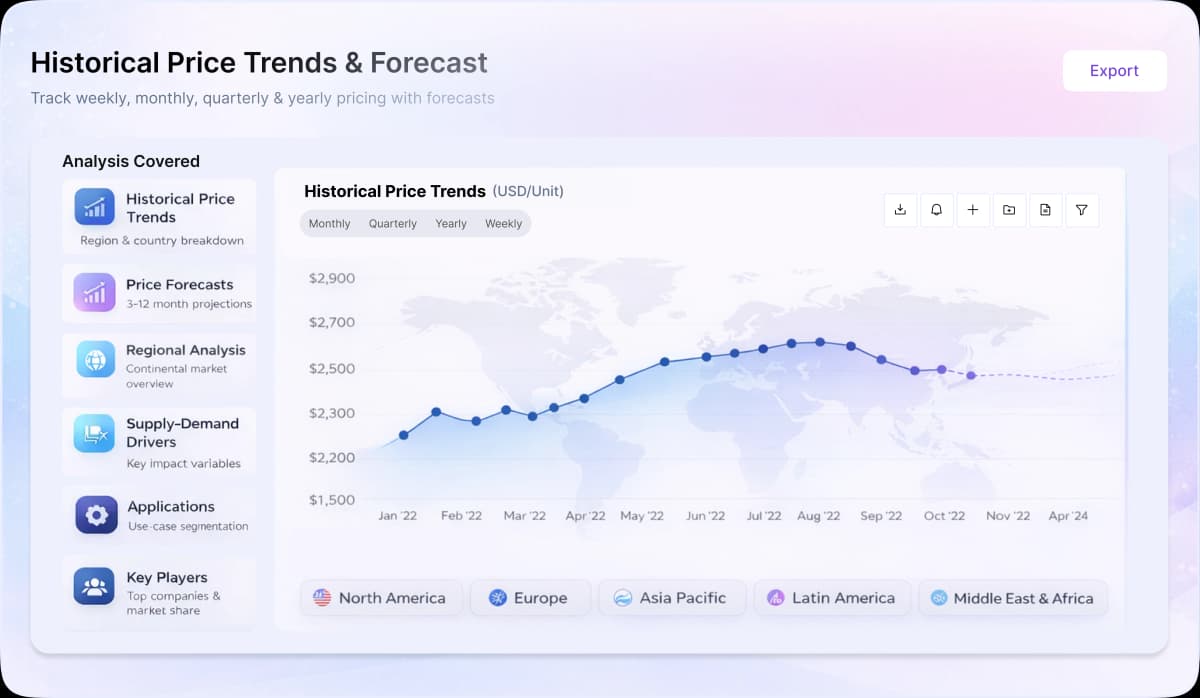
Turn price intelligence into action with the Procurement Resource Database. Log in or subscribe to unlock live price trends, historical charts, supplier databases, cost curves, and analyst-backed insights across chemicals, agriculture, energy, packaging, and more. Use these tools to benchmark your contracts, plan budgets with confidence, and stay ahead of market moves on every product you buy.

Silica Sand Dashboard Inclusions

Silica Sand Price Dasboard

0

+

Products

0

+

Regions

0

+

Subscriptions

Product Category Region Price Last Updated Month
Silica Sand Energy, Metals and Minerals North America 55.1 USD/MT October 2025

During the fourth quarter, silica sand markets exhibited cautious sentiment as supply conditions loosened and demand weakened across key end-use sectors. The period was characterized by extended discussions for long-term import agreements, with major integrated enterprises and leading crucible manufacturers entering negotiations with overseas suppliers. These deliberations continued throughout the quarter as buyers carefully evaluated pricing terms amid shifting market conditions. Demand from the silicon wafer sector remained measured, leading crucible producers to adopt conservative procurement strategies. This tempered buying activity influenced upstream market dynamics, with participants closely monitoring consumption patterns. Meanwhile, domestic production maintained elevated output levels early in the quarter, while anticipated capacity additions from import sources shaped market expectations.

Inventory positions gradually accumulated across the supply chain, prompting some smaller domestic sand enterprises to explore flexible pricing arrangements to maintain order flows, though transaction activity remained selective. Crucible companies adjusted their purchasing timelines for domestic material while awaiting clarity on import contract outcomes. Certain sand producers, facing evolving raw material situations and cautious downstream demand, reassessed operational schedules. Trade activity reflected careful positioning throughout the period as buyers evaluated market developments.

About Silica Sand

Silica Sand contains at least 95% SiO2 and less than 0.6% iron oxide. The most common form of SiO2 is quartz, which is mined from hard rock deposits. It is chemically inert and is often white/colorless. However, the color of each sand deposit depends on the variety of minerals and rock detritus that make up the deposit. The regular/construction sand will also contain SiO2 but less than the 95% mark/level.

Silica Sand Product Detail

Chemical Formula

(C6H10O5)n

Industrial Uses

Industrial Abrasives, Water Filtration, Glass Making, Ceramics, Paints and Coatings, Construction Materialsl 

Synonyms

Quartz Sand, Industrial Sand, White Sand

Supplier Database

Badger Mining Corp, Quarzwerke Group, AVIC Glass, Lianxin Group, Emerge Energy Services LP, Toyota Tsusho, Tokai Sand

Regional Coverage

Asia Pacific

China, India, Indonesia, Pakistan, Bangladesh, Japan, Philippines, Vietnam, Iran, Thailand, South Korea, Iraq, Saudi Arabia, Malaysia, Nepal, Taiwan, Sri Lanka, UAE, Israel, Hongkong, Singapore, Oman, Kuwait, Qatar, Australia, and New Zealand

Europe

Germany, France, United Kingdom, Italy,Spain, Russia, Turkey, Netherlands, Poland, Sweden, Belgium, Austria, Ireland Switzerland, Norway, Denmark, Romania, Finland, Czech Republic, Portugal and Greece

North America

United States and Canada

Latin America

Brazil, Mexico, Argentina, Columbia, Chile, Ecuador, and Peru

Africa

South Africa, Nigeria, Egypt, Algeria, Morocco

CurrencyUS$ (Data can also be provided in local currency)

Supplier Database AvailabilityYes

Customization ScopeThe report can be customized as per the requirements of the customer

Post-Sale Analyst Support360-degree analyst support after report delivery

Note: Our supplier search experts can assist your procurement teams in compiling and validating a list of suppliers indicating they have products, services, and capabilities that meet your company's needs.

Silica Sand Production Process

Quartz is mined from hard rock deposits and then subjected to further processing involving steps like crushing, grinding, sizing, beneficiation, dewatering, and drying. The first stage is to reduce the size of quartz so that it can be processed to remove impurities.

In the second stage, the size is reduced further so that it can be ready for the beneficiation stage where impurities are removed. Impurities like oxides, mica, heavy minerals, etc., are removed via multiple stages of flotation cells and separation screens. The next step involves drying off any excess liquid followed by the final drying stage.

Frequently Asked Questions

In Q1 2026, silica sand prices showed divergent trends across major markets. In China, prices decreased by ~0.71% from January to March, while in India they increased by ~2.02% over the same period. These movements reflected local supply demand balances, cost pressures, and variations in feedstock and logistics conditions affecting producers and buyers in each region.
The outlook for silica sand in 2026 remains stable with moderate growth. Continued demand from glass manufacturing, foundry applications, construction materials, and industrial uses such as chemical and electronics applications is expected to underwrite consumption. Regional infrastructure spending and steady glass production in Asia and North America should support baseline prices, though freight, energy, and quality constraints may influence localized price movement.
Silica sand prices during Q1 2026 were influenced by logistics and freight costs, regional demand unevenness, and production scheduling. Congestion at rail and port facilities in key producing regions limited prompt deliveries at times, supporting modest price gains in India. In contrast, adequate local inventory and slower demand growth in China helped moderate price declines despite transport cost pressures.
China, the United States, India, and Australia are among the leading silica sand markets in both production and consumption. China and India dominate the regional supply and use for glass and foundry needs. The United States and Australia produce high purity sand used in specialized glass, chemical, and industrial applications. Germany serves as a key European marketplace for engineered silica sand used in advanced manufacturing.
In April 2026, the Cabot Sanmar announced a ₹220 crore brownfield expansion of its fumed silica manufacturing facility at Mettur, Tamil Nadu. The project is expected to double the plant’s capacity and be commissioned by the fourth quarter of 2027. Although this is fumed silica rather than raw silica sand, it is relevant because it reflects rising demand for silica-based materials in pharmaceuticals, food, paints and coatings, adhesives, sealants, personal care, and specialty chemicals.
Silica sand supply chain begins with mining or quarrying natural silica-bearing sand, followed by washing, screening, attrition scrubbing, drying, magnetic separation, and particle-size classification. Higher-purity grades may need beneficiation to reduce iron and clay impurities. The processed sand is then supplied to glass, foundry, construction, filtration, ceramics, chemicals, and solar glass manufacturers.
Key end use industries include glass manufacturing (flat glass, container glass, fiberglass), foundry casting, construction materials (such as mortar and concrete additives), oil and gas proppants, and high purity chemical and electronics applications. In Q1 2026, glass and foundry sectors were the predominant demand drivers, with steady orders for container and architectural glass helping underpin silica sand consumption and influencing mill operating rates.
Quality specifications, such as silica content, grain size distribution, and absence of iron, directly influence pricing. High purity silica sand (typically >99% SiO₂) used in specialty glass and electronics commands a premium over standard construction grade material. In Q1 2026, enhanced beneficiation at select plants improved availability of high specification sand, supporting stable premium pricing even as standard grades saw modest price pressure.
Procurement Resource employs a structured methodology combining primary research, secondary market data, analytical models, and validation processes to assess silica sand prices and trends. Price evaluations incorporate supply-demand dynamics, mining activities, trade flows, and value chain analysis, supported by continuous market monitoring to ensure accurate and reliable insights.

About the Author

Rakesh Nandi profile photo

Rakesh Nandi

Team Lead - Market Research

Leading procurement-focused market intelligence across chemicals, composites, advanced materials, aerospace & defense, and energy, delivering commodity forecasts, supply chain analysis, and competitive benchmarking to support sourcing decisions.

Our Price Analysis Methodology

Schedule Demo

Schedule a demo

Experience how Procurement Resource transforms raw material price data into clear, decision ready intelligence. Optimise your performance with reliable, expert market data and analysis. Schedule your demo today to experience a live walk-through where our experts will showcase interactive price charts, forecasted prices, and insights driving the prices for your key commodities, tailored to your workflows. Contact us now!

Our Team will be happy to assist you

We are just a text away

+1

Still Need Help?

Europe & Africa

+44 7573 171117

[email protected]

USA & Canada

+1 307 363 1045

[email protected]

APAC

+91 8850629517

[email protected]

Unlock full access to Procurement Resource's price databases, interactive charts, and short-term forecasts for thousands of commodities. Elevate your sourcing decisions by comparing prices across regions, downloading historical data, and layering in analyst-backed insights, all with our flexible plans that scale as your portfolio grows.

Still have any Questions

Contact Us
Mastercard
Wire
VISA
Stripe

Related News

View All

Why Procurement Database

Commodity Market Intelligence

Commodity Market Intelligence

Track prices, market movements, supply-demand dynamics, and industry developments across hundreds of commodities through a centralized intelligence platform built for informed procurement decisions.

Price Forecasts & Market Outlooks

Price Forecasts & Market Outlooks

Understand market fluctuations using analyst-backed forecasts, historical pricing patterns, and evolving industry trends to strengthen sourcing strategies and budget planning.

Cost & Procurement Optimization

Cost & Procurement Optimization

Leverage cost models, pricing benchmarks, and procurement insights to evaluate purchasing opportunities, improve negotiations, and enhance operational efficiency.

Global & Regional Market Insights

Global & Regional Market Insights

Access region-specific price trends, trade activities, capacity changes, and supply chain developments influencing commodity markets worldwide.

1/4