Coal India output decline tightens supply
Coal India's quarterly production fell while power demand grew, straining availability. Rising mining costs and higher e-auction realisations point to continued upward pressure on coal prices.
War in West Asia disrupts LNG supply through the Strait of Hormuz, forcing economies to increase coal-fired power generation. This surge in demand is tightening the coal market and pushing prices upward.
| Product | Category | Region | Price | Last Updated Month |
| Steam | Operating Costs, Logistics and Utilities | China | 223 USD/MT | Oct'2021 |
| Steam | Operating Costs, Logistics and Utilities | Europe | 150 USD/MT | Oct'2021 |
Stay updated with the latest Steam prices, historical data, and tailored regional analysis
In thermal power plants, coal is the most often used fuel to convert water to superheated steam. Bituminous coal, often known as brown coal, is commonly used as a boiler fuel in India because its volatile content ranges from 8% to 33% and its ash content ranges from 5% to 16%. One tonne of steam requires 118.5 kilos of BB-coal, of which 83%, or 98.4 kilogrammes, is raw coal. China was a big contributor to the rise in coal prices in 2021. The increase in demand induced by a supply deficit was exacerbated when China declined to continue trading coal with Australia.
The price in China reached an all-time high of 223 USD/MT in October 2021. The cost of production had risen considerably as steel prices rose. This was also due to the ongoing rise in gasoline prices. The Chinese government made strenuous efforts to put the price spike under control, and by mid-November 2021, it had succeeded. In Europe, the price has remained stable at roughly 150 USD/MT. The prices of coal and natural gas impact steam prices.
Related Report
Need latest Steam price?
Get real-time price assessments, periodic trends, forecasts and price driver insights across key global markets.
Unlock Price Insights NowOur Clients

Turn price intelligence into action with the Procurement Resource Database. Log in or subscribe to unlock live price trends, historical charts, supplier databases, cost curves, and analyst-backed insights across chemicals, agriculture, energy, packaging, and more. Use these tools to benchmark your contracts, plan budgets with confidence, and stay ahead of market moves on every product you buy.
0
+Products
0
+Regions
0
+Subscriptions
Steam basically refers to the water in its gaseous form. Steam is obtained through boiling or evaporation of water. While the steam that is saturated or superheated is invisible, the real steam or wet steam is often formed upon the condensation of water vapour.
Traditionally, steam is created by heating a boiler and burning coal or other fuels, but now-a-days, it can also be created using solar energy. The enthalpy of vaporization is the energy that is needed to turn water into the gaseous form as it increases in volume by 1,700 times at standard temperature and pressure.
Heat treatment, Sterilization, Energy/electricity production, Agricultural, Energy storage, Lifting gas, Mechanical effort, Wood treatment, Concrete treatment
CurrencyUS$ (Data can also be provided in local currency)
Supplier Database AvailabilityYes
Customization ScopeThe report can be customized as per the requirements of the customer
Post-Sale Analyst Support360-degree analyst support after report delivery
Note: Our supplier search experts can assist your procurement teams in compiling and validating a list of suppliers indicating they have products, services, and capabilities that meet your company's needs.
In order to produce Steam, water is heated at standard temperature and pressure. As the water starts to boil at 1000C, its evaporation takes place, thus, leading to the formation of Steam.
Vice President - Sales and Operations
Driving growth and operational excellence at Procurement Resource by partnering with global enterprises on procurement consulting and client solutions, with expertise in scaling research operations and delivering actionable commodity intelligence.
Our Price Analysis Methodology

Experience how Procurement Resource transforms raw material price data into clear, decision ready intelligence. Optimise your performance with reliable, expert market data and analysis. Schedule your demo today to experience a live walk-through where our experts will showcase interactive price charts, forecasted prices, and insights driving the prices for your key commodities, tailored to your workflows. Contact us now!
Our Team will be happy to assist you
We are just a text away
Still Need Help?
This study shows the cost structure of syngas production through a coal gasification process.
This report presents a cost analysis of syngas production from heavy fuel (heavy hydrocarbons)
This report provides the cost structure of coal liquefication by the indirect liquefaction process. In this process, coal is converted into synthesis gas or syngas, a mixture of CO and H2 gas.
This report provides the cost structure of coal liquefication by direct liquefaction. In this process, coal is exposed to hydrogen at 450°C along with high pressure for one hour in the presence of recycled solvent and iron-based catalyst.

Unlock full access to Procurement Resource's price databases, interactive charts, and short-term forecasts for thousands of commodities. Elevate your sourcing decisions by comparing prices across regions, downloading historical data, and layering in analyst-backed insights, all with our flexible plans that scale as your portfolio grows.

Still have any Questions
Contact Us


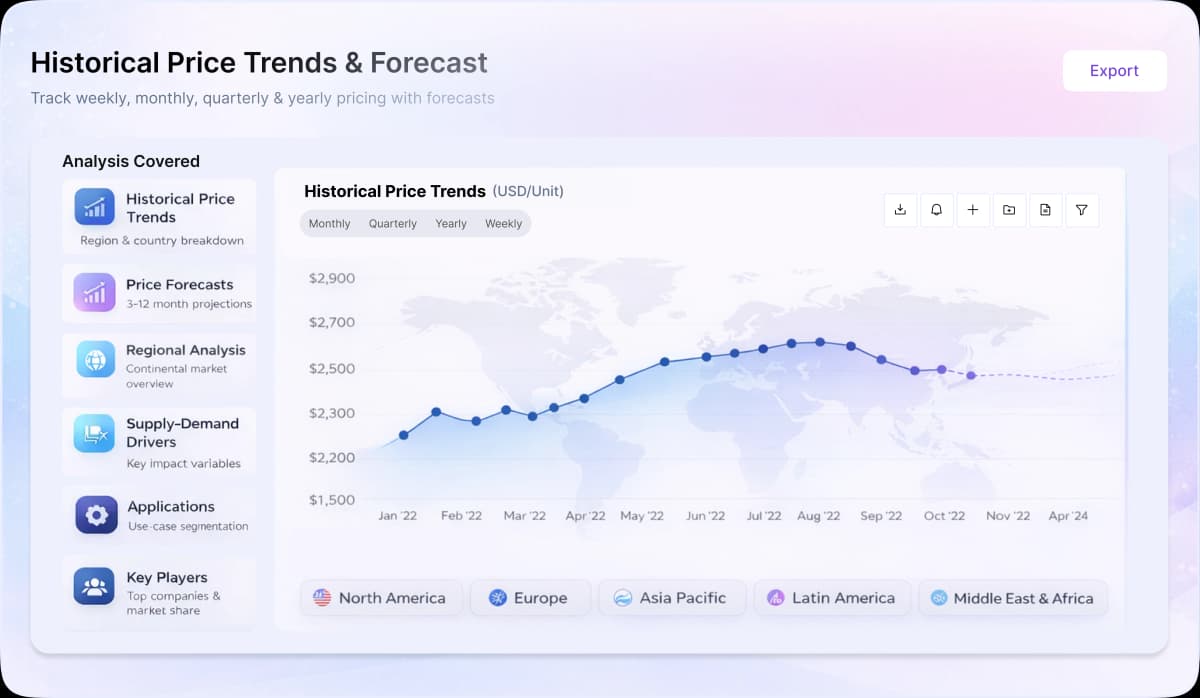
Price Trend Dashboard - What's Included
Price trends across a diverse portfolio of categories and products, spanning board to niche chemicals
Coverage extendable to grade-specific chemicals based on procurement requirements
Regular price tracking supported by robust historical datasets
News, policy updates, and key market drivers impacting price movements
Short-term and long-term price outlooks and forecasts
Supply-demand dynamics and capacity-driven market analysis