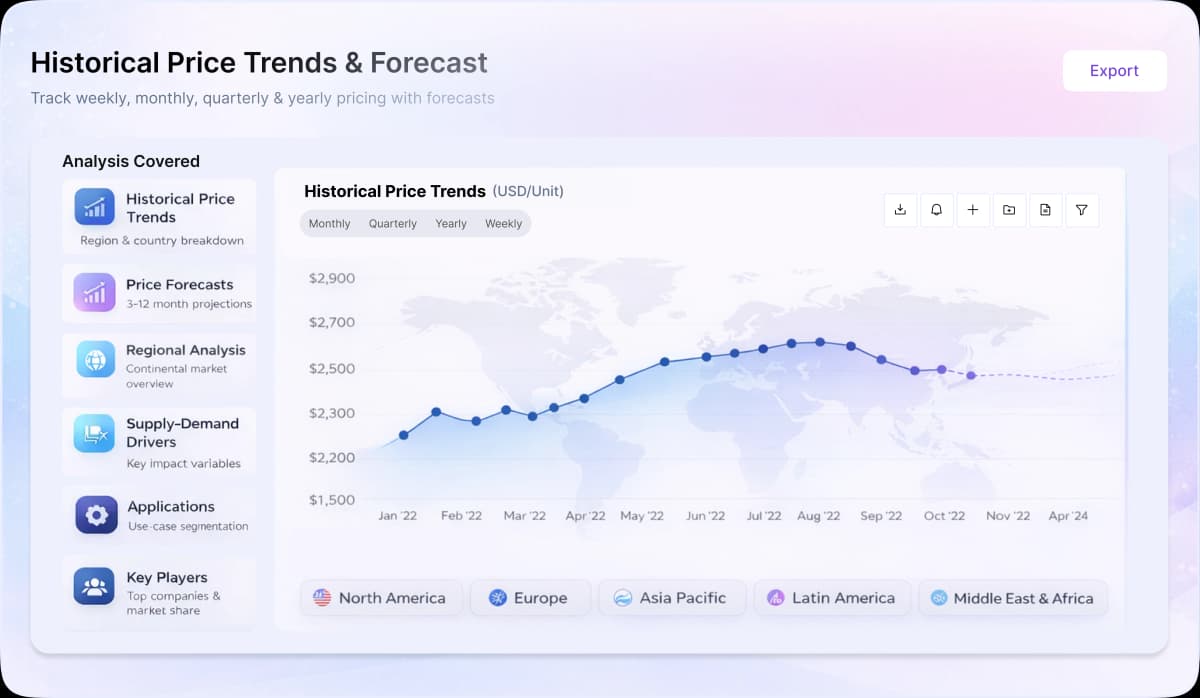
Need latest Toluenediamine prices?
Get real-time price assessments, periodic trends, forecasts and price driver insights across key global markets.
Unlock Price Insights NowOur Clients
Asia
In Q1’25, the Asian Toluenediamine (TDA) market experienced mixed price trends driven by regional production dynamics. China's strengthened domestic production capabilities, following CNOOC's Daxie expansion, created downward pressure on TDA prices across the region. Chinese producers, particularly those affiliated with Sinopec, strategically adjusted their TDA pricing to maintain market share while balancing production costs.
The increased self-sufficiency in toluene production directly impacted TDA manufacturing costs, allowing Chinese producers to offer more competitive pricing. Other Asian markets struggled with weak demand from the polyurethane sector, which remained a key consumption driver for TDA. By March, the market had achieved some stability, though at lower price levels compared to Q4 2024, as manufacturers navigated between serving domestic needs and pursuing export opportunities.
Europe
European TDA prices in Q1’25 followed a volatile path, beginning with an upward trajectory in January driven by tight supplies and increasing feedstock costs. February saw prices peak as crude oil costs rose and competition intensified from Chinese imports. The proposed EU industrial strategy aimed at reducing energy costs provided some optimism for regional TDA producers who had been operating under significant cost pressures.
Major chemical companies like BASF restructured their operations during this period, impacting the overall supply-demand balance for TDA and related products. The quarter ended with prices stabilizing but remaining elevated compared to Q4’24 levels, supported by increased intra-regional trade that partially alleviated supply constraints. European producers maintained cautious production rates given the persistent uncertainty in downstream polyurethane and construction markets.
North America
The North American TDA market navigated a challenging first quarter in 2025. The market began slowly, with limited trading activity around the Presidential Day holiday in February reflecting seasonal patterns. As the quarter progressed, significant maintenance activities across key production facilities temporarily constrained TDA supply, providing some support to prices despite modest demand.
The ongoing impact of Trump's presidency and associated tariff policies affected chemical supply chains, creating cost pressures for TDA producers reliant on imported feedstocks. By March, the market had reached a relative equilibrium, with prices stabilizing as supply constraints eased. Demand from the construction sector showed early signs of improvement, though not enough to drive significant price increases.
Analyst Insight
According to Procurement Resource, TDA prices are likely to rally strong in the coming months. While regional price disparities will likely persist, recovery in construction and automotive sectors coupled with stabilizing energy costs may provide more balanced market conditions in the coming months.
Related Report
Get real-time price assessments, periodic trends, forecasts and price driver insights across key global markets.
Unlock Price Insights NowOur Clients

Turn price intelligence into action with the Procurement Resource Database. Log in or subscribe to unlock live price trends, historical charts, supplier databases, cost curves, and analyst-backed insights across chemicals, agriculture, energy, packaging, and more. Use these tools to benchmark your contracts, plan budgets with confidence, and stay ahead of market moves on every product you buy.

0
+Products
0
+Regions
0
+Subscriptions
Asian
The Asian region witnessed a volatile year for TDA pricing in 2024. The first quarter showed promising upward momentum, particularly in India, driven by strong demand from agrochemicals and pharmaceuticals sectors. However, this positive trend was short-lived as oversupply issues emerged by Q2, pushing prices downward. South Korean TDA prices were particularly affected by maintenance at GS Caltex and fluctuating feedstock costs.
In China, reduced demand from end-use industries such as polyurethane manufacturing created further downward pressure. The second half of 2024 saw continued price erosion across the region, exacerbated by logistical challenges including port congestion and container repositioning issues. By Q4, the market had stabilized at lower levels with sufficient stockpiles meeting the subdued demand.
Europe
European TDA prices in 2024 demonstrated consistent decline throughout the year. Beginning with a downward trend in Q1 due to reduced fertilizer sector demand and farmer protests across the region, the negative price environment persisted into Q2 with an oversupply situation. The construction sector, particularly housing, struggled throughout the year, weakening demand for TDA in paints and coatings applications.
Rising interest rates and inflation further constrained purchasing power. By Q3, the European construction sector had fallen into a deep slump, accelerating TDA price drops. The final quarter of 2024 continued this bearish trend, with high inventories and balanced but underwhelming demand from industries such as polyurethane and other aromatics. Geopolitical uncertainties and fluctuating crude oil prices exerted additional pressure on prices.
North America
In North America, Toluenediamine (TDA) prices followed a downward trajectory throughout 2024. The first quarter started with moderate pricing, but as the year progressed, prices steadily declined due to weakening demand from the polyurethane sector. This trend was heavily influenced by the bearish performance of its feedstock toluene, which experienced significant price drops throughout the year.
Supply chain disruptions, including the Longshoremen's Association strike in Q4, further complicated market dynamics. Despite some growth in the construction industry, the broader economic slowdown dampened TDA demand, particularly in the latter half of 2024. Manufacturers responded by reducing production rates, but this was insufficient to offset the oversupply situation that persisted through year-end.
Toluenediamine is collectively used to refer to all the ortho and para isomeric forms of toulenediamine with the same common formula. But, depending on the position of the -amino groups, the properties of the isomers change. 2,4-diaminotoluene (one of the isomeric forms) is produced by hydrogenating 2,4-dinitrotoluene using a nickel catalyst. Its reaction with the chemical compound benzene diazonium chloride gives the cationic azo dye Basic Orange 1.
C7H10N2
Organic Dyes, Hair Dyes, Rubber Industry, Chemical Substrate
Diaminotoluene, Methylphenylene diamine, TDA, Toluenediamine isomers, Tolylenediamine
BASF SE, Cangzhou Dahua Group Co., Ltd., Covestro AG, Fujian Southeast Electrochemical Co., Ltd.

CurrencyUS$ (Data can also be provided in local currency)
Supplier Database AvailabilityYes
Customization ScopeThe report can be customized as per the requirements of the customer
Post-Sale Analyst Support360-degree analyst support after report delivery
Note: Our supplier search experts can assist your procurement teams in compiling and validating a list of suppliers indicating they have products, services, and capabilities that meet your company's needs.
In process involves hydrogenating dinitrotoluene in the presence of an acid catalyst in a continuous well-stirred tank reactor. Then the unreacted substrates are separated, giving crude toluenediamine refined via distillation.
Our Price Analysis Methodology

Experience how Procurement Resource transforms raw material price data into clear, decision ready intelligence. Optimise your performance with reliable, expert market data and analysis. Schedule your demo today to experience a live walk-through where our experts will showcase interactive price charts, forecasted prices, and insights driving the prices for your key commodities, tailored to your workflows. Contact us now!
Our Team will be happy to assist you
We are just a text away
Still Need Help ?
Unlock full access to Procurement Resource's price databases, interactive charts, and short-term forecasts for thousands of commodities. Elevate your sourcing decisions by comparing prices across regions, downloading historical data, and layering in analyst-backed insights, all with our flexible plans that scale as your portfolio grows.
Still have any Questions
Contact Us


Price Trend Dashboard - What's Included
Price trends across a diverse portfolio of categories and products, spanning board to niche chemicals
Coverage extendable to grade-specific chemicals based on procurement requirements
Regular price tracking supported by robust historical datasets
News, policy updates, and key market drivers impacting price movements
Short-term and long-term price outlooks and forecasts
Supply–demand dynamics and capacity-driven market analysis