Udeesha Tomar
AVP - Strategy and Solutions
Leading procurement research solutions across chemicals, materials, and food & beverages, with expertise in price forecasting and market analytics.
Asia
In Q1’25, the price trend for Triethanolamine Lauryl Sulfate (TEALS) in Asia showed a steady upward movement. This was largely influenced by a reduced supply of its key raw material, Triethanolamine (TEA), as manufacturers in major producing countries like China and India faced operational constraints. Environmental regulations introduced in late 2024 led to lower production rates, tightening the supply chain for downstream products.
At the same time, demand for TEALS remained stable, particularly from the personal care industry where the product is commonly used in shampoos and cleansers. Seasonal upticks in demand from the agricultural sector also indirectly supported price growth through herbicide and surfactant usage. With rising feedstock and energy costs, several producers adjusted prices upwards during February to offset cost pressures. This combination of steady demand and limited supply created a firm pricing environment across the region.
Europe
In Europe, TEALS prices increased more sharply compared to other regions during the first quarter of 2025. The market experienced multiple plant shutdowns and maintenance turnarounds at key chemical facilities, which reduced the regional availability of TEA and disrupted supply chains. As a result, TEALS producers struggled to maintain output levels, even as demand stayed consistent across personal care, cleaning, and industrial applications.
The early start of construction season in countries like Germany and France also contributed to steady consumption. Rising energy costs throughout Europe further pushed up production expenses, and with minimal imports from Asia due to competitive pricing and logistical barriers, European buyers were forced to absorb higher domestic costs. Overall, the region’s tight supply landscape, coupled with firm demand, kept prices on an upward trajectory throughout the quarter.
North America
In North America, TEALS prices rose significantly during Q1’25, continuing the bullish momentum from late 2024. The region experienced notable disruptions due to planned maintenance at several key chemical plants between February and March, which constrained TEA output. Low inventory levels carried over from previous quarters amplified the impact, making raw material availability a major bottleneck.
Demand from key sectors such as personal care, construction, and textiles remained high, further straining limited supply. Additionally, logistical challenges across the U.S. and Canada affected the timely distribution of materials, driving up both freight and spot market prices. By March, some buyers faced difficulty securing adequate volumes, leading to aggressive purchasing and elevated price points across the supply chain.
Analyst Insight
According to Procurement Resource, TEALS prices are expected to ease slightly in the coming months as production normalizes and maintenance work concludes. However, sustained raw material cost pressures and steady seasonal demand may keep prices above historic averages in the short term.
Related Report
Get real-time price assessments, periodic trends, forecasts and price driver insights across key global markets.
Unlock Price Insights NowOur Clients

Turn price intelligence into action with the Procurement Resource Database. Log in or subscribe to unlock live price trends, historical charts, supplier databases, cost curves, and analyst-backed insights across chemicals, agriculture, energy, packaging, and more. Use these tools to benchmark your contracts, plan budgets with confidence, and stay ahead of market moves on every product you buy.

0
+Products
0
+Regions
0
+Subscriptions
Asia
In Asia, Triethanolamine Lauryl Sulfate (TLES) prices experienced a consistent downward trend throughout H2’24. The market was heavily influenced by oversupply conditions as manufacturers resumed full production capacity, leading to mounting inventory pressures. This bearish sentiment intensified in Q4 as high operating rates coupled with increased imports from the U.S. further deteriorated the market balance. Demand from the personal care and detergent sectors remained weak, aligning with similar patterns observed in the SLES market.
Seasonal factors provided minimal support, with year-end festivities failing to significantly boost consumption. Buyers adopted cautious procurement strategies, focusing only on essential purchases and avoiding long-term commitments amid market uncertainty. The declining feedstock costs, particularly ethylene oxide, failed to stimulate market recovery as weak downstream demand consistently outweighed any positive cost factors.

Europe
European TLES prices followed a downward trajectory during H2’24, mirroring trends seen in related surfactant markets. The region witnessed significant price reductions driven by weak demand across major markets including Germany and France. The third quarter saw prices decrease steadily, reflecting challenging market dynamics similar to those affecting the broader surfactant industry. This downward pressure intensified in Q4, with most markets registering considerable declines by December.
Consumer industries, particularly personal care and household cleaning products, showed reduced consumption patterns as inflation constrained spending. The construction sector's slowdown further impacted industrial applications of TLES. Supply remained ample throughout the period, with stable upstream costs and increased imports contributing to the oversupply situation, despite some logistical challenges from port disruptions in Hamburg and Antwerp that temporarily affected distribution channels.
North America
North American TLES market displayed a notable shift from earlier bullish trends during H2’24. The third quarter began with relatively stable prices supported by consistent demand from consumer sectors and some supply constraints from hurricane-related disruptions. However, by September, this stability began eroding as production recovered and demand weakened. The fourth quarter saw accelerated price declines despite holiday season demand that traditionally supports surfactant consumption.
Manufacturing sectors performed moderately well, with exports outpacing imports, but this was insufficient to counterbalance the overall market weakness. Falling feedstock prices, particularly Ethylene Oxide and fatty alcohols, created downward cost pressure. By year-end, manufacturers operated with compressed margins as seasonal factors and inventory management strategies among buyers compounded the challenging market conditions.
Triethanolamine Lauryl Sulfate is the triethanolamine salt of lauryl sulfuric acid, used in cosmetics as a detergent and stabilizer. TEALS is a viscous yellow liquid which is completely miscible with water. It is an anionic surface-active agent- any compound that reduces interfacial tensions between two liquids. These agents are commonly referred to as detergents and surfactants. It is characterized by a structural balance between the hydrophilic and lipophilic residues.
C18H41NO7S
Textiles, Metal Extraction and Refining, Cosmetics, Home-care Products, Emulsifiers
Dodecyl hydrogen sulfate - 2,2',2''-nitrilotriethanol (1:1), TEA-Lauryl sulfate (TEALS)
Lubrizol, Innospec, Clariant, CISME Italy, BASF
CurrencyUS$ (Data can also be provided in local currency)
Supplier Database AvailabilityYes
Customization ScopeThe report can be customized as per the requirements of the customer
Post-Sale Analyst Support360-degree analyst support after report delivery
Note: Our supplier search experts can assist your procurement teams in compiling and validating a list of suppliers indicating they have products, services, and capabilities that meet your company's needs.
This method involves the sulfatization reaction of lauryl alcohol with chlorosulfonic acid, followed by the desorption of hydrogen chloride. The reaction intermediate is neutralized with an aqueous triethanolamine solution, producing a semi-finished product. This product is then subjected to further processing, including washing, centrifugation, and separation, until the desired purity is achieved.

AVP - Strategy and Solutions
Leading procurement research solutions across chemicals, materials, and food & beverages, with expertise in price forecasting and market analytics.
Our Price Analysis Methodology

Experience how Procurement Resource transforms raw material price data into clear, decision ready intelligence. Optimise your performance with reliable, expert market data and analysis. Schedule your demo today to experience a live walk-through where our experts will showcase interactive price charts, forecasted prices, and insights driving the prices for your key commodities, tailored to your workflows. Contact us now!
Our Team will be happy to assist you
We are just a text away
Still Need Help?
Unlock full access to Procurement Resource's price databases, interactive charts, and short-term forecasts for thousands of commodities. Elevate your sourcing decisions by comparing prices across regions, downloading historical data, and layering in analyst-backed insights, all with our flexible plans that scale as your portfolio grows.
Still have any Questions
Contact Us


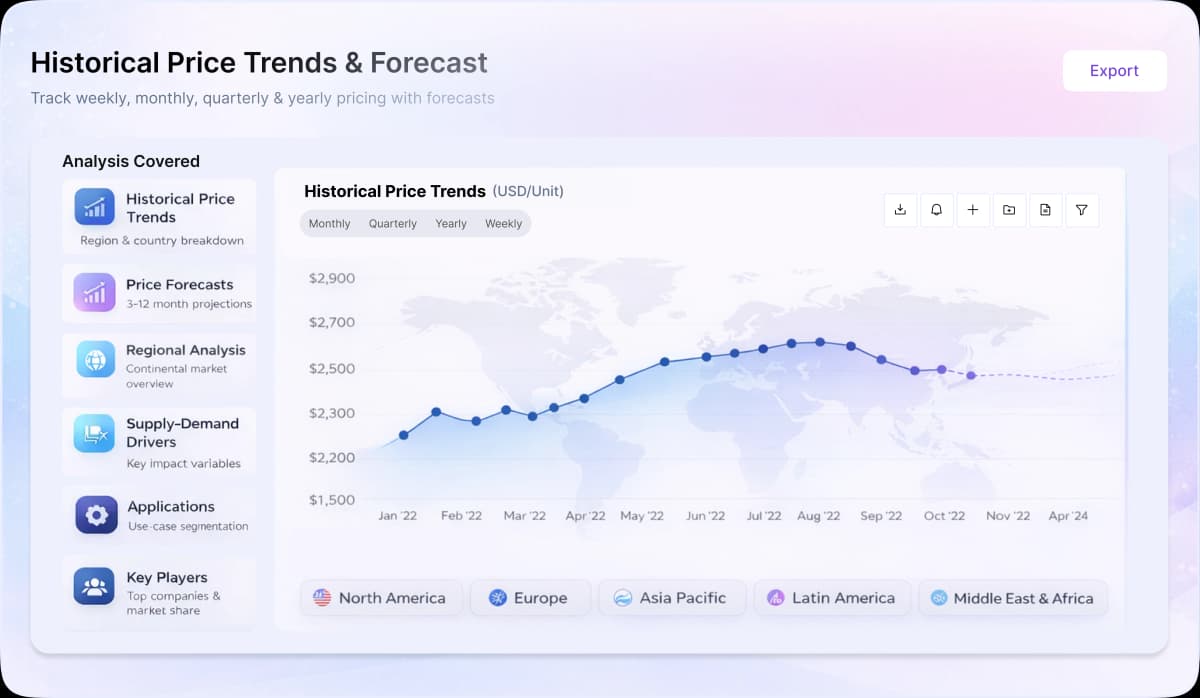
Price Trend Dashboard - What's Included
Price trends across a diverse portfolio of categories and products, spanning board to niche chemicals
Coverage extendable to grade-specific chemicals based on procurement requirements
Regular price tracking supported by robust historical datasets
News, policy updates, and key market drivers impacting price movements
Short-term and long-term price outlooks and forecasts
Supply-demand dynamics and capacity-driven market analysis