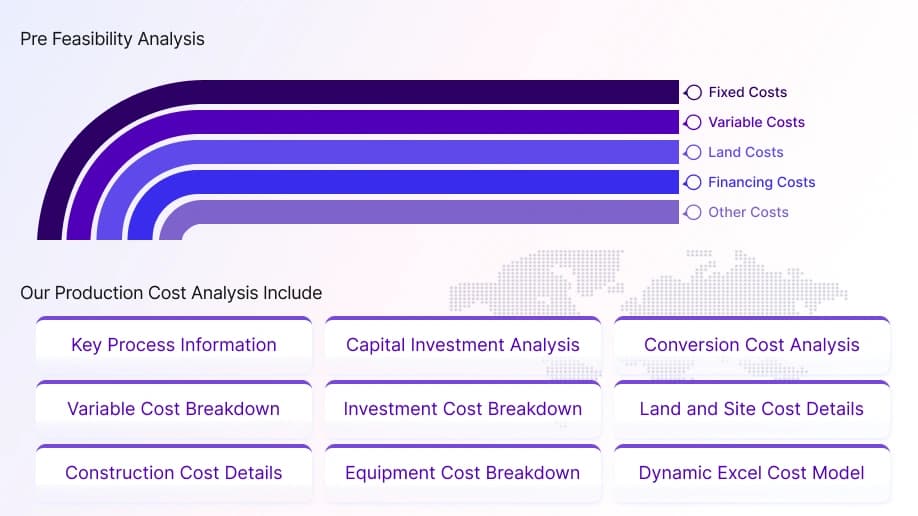
The report provides a detailed analysis essential for establishing an Acetic Acid production plant. It encompasses all critical aspects necessary for Acetic Acid production, including the cost of Acetic Acid production, Acetic Acid plant cost, Acetic Acid production costs, and the overall Acetic Acid production plant cost. Additionally, the study covers specific expenditures associated with setting up and operating an Acetic Acid production plant. These encompass production processes, raw material requirements, utility requirements, infrastructure needs, machinery and technology requirements, manpower requirements, packaging requirements, transportation requirements, and more.
Acetic Acid is an organic compound used as an important chemical reagent and industrial chemical used to produce products like plastic soft drink bottles, polyvinyl acetate for wood glue, photographic film, and many synthetic fibres and fabrics. It can also be used as a cleaning agent in its diluted form. In the food sector, it can be used to regulate acidity, as well as in vinegar, which is used to prepare many food items. It also finds use as a weed killer in gardening. In its 99.5 percent concentration, acetic acid is referred to as glacial acetic acid, which has various uses as a raw material in the production of other chemical products like vinyl acetate, acetic anhydride, and acetate esters. Other products that employ the acid include adhesives, paints, and textile finishes. It is also used to manufacture cellulose acetate fibers and plastics for clothing, photographic film, and coatings, as a hydrophilic solvent for reducing metal corrosion and scale build-up in oil and gas well applications, and for producing vitamins, antibiotics, hormones, and other products.
The market for Acetic Acid is majorly driven by its application as a food preservative and flavoring agent, mainly in the form of vinegar, to preserve meat and other food products, coupled with the shift in consumer preferences towards processed and preserved foods. Its utilization as an important precursor to produce various chemicals, such as vinyl acetate monomer (VAM), acetic anhydride, and acetate esters, that are essential in production paints, coatings, adhesives, and synthetic fibers, fuels its demand in the chemical industry.
Its usage in the production of synthetic fibers and plastics, such as polyethylene terephthalate (PET) and polyvinyl acetate (PVA), coupled with the expansion of the textile industry, mainly in emerging economies, also promotes the need for Acetic Acid. Also, its application in the pharmaceutical industry to synthesize various drugs and active pharmaceutical ingredients (APIs), as well as the global rise in healthcare needs, further impact industrial Acetic Acid procurement.
Raw Material for Acetic Acid Production
According to the Acetic Acid production plant project report, the key raw materials used in the production of Acetic Acid include methanol; ethanol; butane; acetaldehyde.
Production Process of Acetic Acid
The extensive Acetic Acid production cost report consists of the following major industrial production processes:
- Production from methanol: The production process of Acetic Acid occurs via carbonylation of methanol using carbon monoxide as a source of carbonyl group, in the presence of catalysts such as rhodium (Monsanto process) or iridium (Cativa process). The process utilizes a catalytic amount of water.
- Production via fermentation: The production process of Acetic Acid occurs via the submerged fermentation process. In this process, the ethanol in beverages such as spirits, wine, or cider undergoes oxidation to form Acetic Acid by the action of acetic acid bacteria such as Gluconacetobacter and Acetobacter.
- Production from butane: The production process of Acetic Acid occurs via the catalytic oxidation of butane by using air as an oxygen source, in the presence of metal catalysts such as cobalt acetate, at a temperature of 110–120 °C and a pressure of 60 atm. The process forms peroxides in the beginning, which are further decomposed to produce Acetic Acid.
- Production from acetaldehyde: The production process of Acetic Acid occurs via the oxidation of acetaldehyde in the presence of metal catalyst, such as the naphthenate salts of manganese, cobalt, and chromium, and by using air as an oxygen source. The product further undergoes distillation to separate the by-products, such as ethyl acetate, formic acid, and formaldehyde.
Acetic Acid with the chemical formula (CH3COOH), also known as ethanoic acid, is among the most vital and simplest carboxylic acids. It is a by-product of fermentation, resulting in an odor that is similar to that of vinegar (its concentration in vinegar is usually around 4-8%). Acetic acid has various properties, such as being antibacterial and antifungal. It is very corrosive, with a pungent smell and a sour taste. It has the role of a protic solvent, a food acidity regulator, an antimicrobial food preservative, and a Daphnia magna metabolite. Its molecular weight is 60.052 g/mol, and its density is 1.05 g/cm³. Its boiling and melting points are 118 °C and 16.6 °C, respectively.