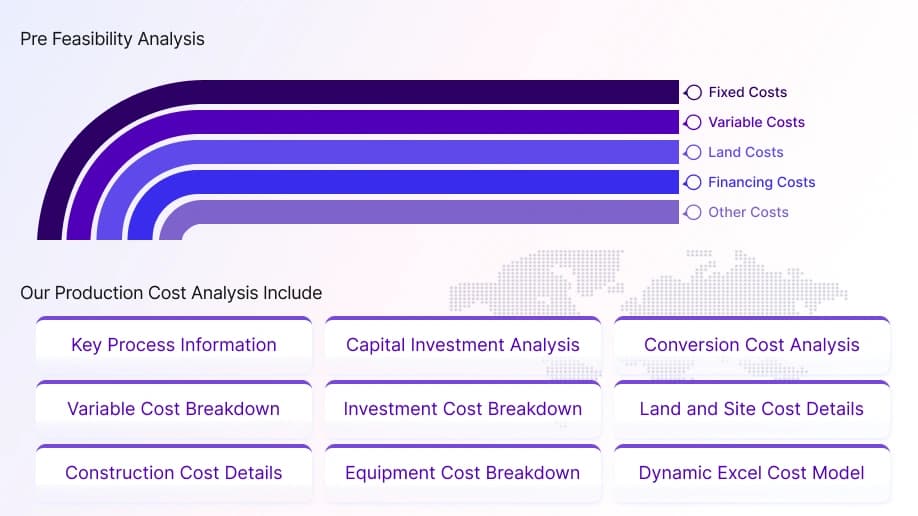
The report provides a detailed analysis essential for establishing an Alum production plant. It encompasses all critical aspects necessary for Alum production, including the cost of Alum production, Alum plant cost, Alum production costs, and the overall Alum production plant cost. Additionally, the study covers specific expenditures associated with setting up and operating an Alum production plant. These encompass production processes, raw material requirements, utility requirements, infrastructure needs, machinery and technology requirements, manpower requirements, packaging requirements, transportation requirements, and more.
Alum is an inorganic chemical substance used as an astringent for shrinking tissues, stopping bleeding, as well as to boost the immune response to a vaccine. It also finds use in the food industry in the baking and pickling process, as an acidulating agent in cooking, and as an acidic component of baking powder. It is also used in leather tanning and as a mordant in a textile company. It is also extensively employed in the coagulation and flocculation process of water treatment. Other products that employ Alum as a raw material are a toothpaste, deodorant, flame retardant, some homemade and commercial modeling clay, some depilatory (hair removal) waxes, and skin whiteners.
The market for Alum is driven by its usage in water purification processes due to its effectiveness as a coagulant. Its utilization as a food additive for pickling and as a firming agent in canned goods elevates its demand in the food industry. Its usage as a component in concrete and as a fire retardant amplifies its demand in the construction industry. The chemical's ability to be utilized in the paper production process, textile dyeing, and as a mordant in the dyeing process boosts its demand even more. Overall, industrial Alum procurement is influenced by its application in various industries such as water purification, food, construction, pharmaceutical, paper, textile, and dyeing industries, the availability of its raw materials (aluminium sulfate and alunite), the cost of its raw materials, and sustainability trends.
Raw Material for Alum Production
According to the Alum production plant project report, the key raw materials used in the production of Alum include aluminium sulfate; alunite.
Production Process of Alum
The extensive Alum production cost report consists of the following major industrial production processes:
- Production via precipitation: The production process of Alum occurs via the precipitation process. In this process, aluminium sulfate and a sulphate of the singly charged cation (e.g., potassium sulphate) are dissolved in water. The aqueous solution is precipitated by evaporation to produce Alum crystals.
- Production from alunite: The production process starts with calcination, where alunite is heated to a high temperature. Then, the alunite is hydrated or exposed to air to convert it into a powder. The calcined alunite is then lixiviated (leached) by the treatment with sulfuric acid and hot water to produce Alum crystals.
Alum is an inorganic chemical substance that includes aluminium sulfate and another chemical, typically potassium sulfate. It comprises water molecules, aluminium or other metals, and sulfates. Alum crystals are chemical compounds usually sold as white fitkari, red fitkari or white alum stones and red alum stones. They are odorless, have an astringent and sweet acid taste, and appear to be colorless. They usually come in a white crystalline powder form. It is highly soluble in water (particularly in hot water) as the alum crystals are liquified when heat is applied. It has the property of being an anti-inflammatory agent and can lower teeth gum inflammation and pain. Its boiling and melting points are around 200 degrees Celsius and 92.5 degrees Celsius, respectively. It has a density of 1.725 g/cm3.