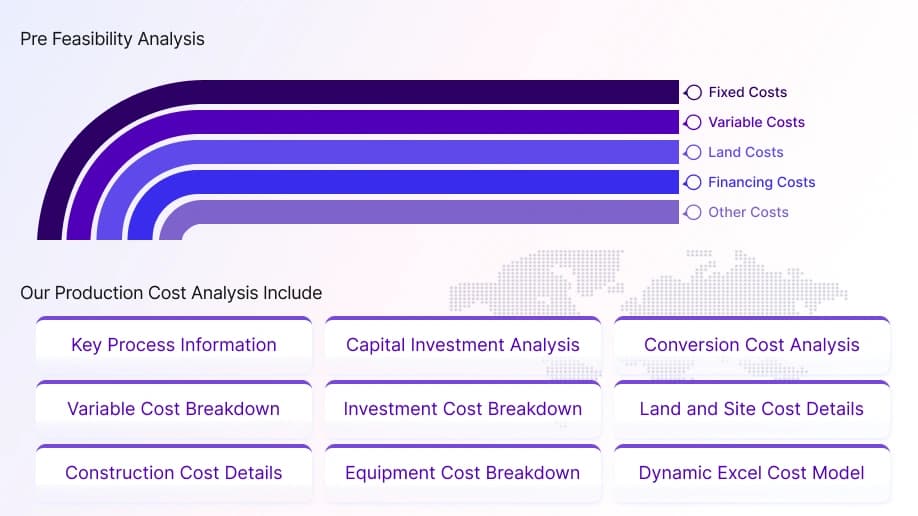
The report provides a detailed analysis essential for establishing an amylase production plant. It encompasses all critical aspects necessary for amylase production, including the cost of amylase production, amylase plant cost, amylase production costs, and the overall amylase production plant cost. Additionally, the study covers specific expenditures associated with setting up and operating an amylase production plant. These encompass production processes, raw material requirements, utility requirements, infrastructure needs, machinery and technology requirements, manpower requirements, packaging requirements, transportation requirements, and more.
Amylase is a digestive enzyme that helps digest starch into smaller molecules. It is primarily used in hydrolyzing starch molecules or their oligosaccharides' glycosidic bonds and turning them into simple sugars from complex carbohydrates. Furthermore, it is used in a wide array of industrial end-users, such as in downstream food, fermentation, brewery, and pharmaceutical industries. Furthermore, amylase, a starch-converting enzyme, also has applications for producing glucose, maltodextrin, fructose syrups, and modified starches. Also, it is used for making digestive tonics that have applications in the medical sector. In addition, amylase derived from apple showcased high efficiency in removing stains with commercial detergent.
The market for amylase is majorly driven by its applications in the production of glucose, fructose syrups, maltodextrin, and other modified starches, which increases its demand in the starch conversion industry. It is also utilized in the baking industry as an antistaling agent and flavor enhancement to improve bread quality, accelerate yeast fermentation, and production of fermentable wort, which further substantiates its demand in the food and brewing industries.
Moreover, amylase is also employed in the detergent, textile, and pharmaceutical industries to remove stains, starch desizing, and production of digestive tonics, which contributes to its market expansion. Additionally, several factors influence an industrial amylase procurement, such as the availability and cost of production of amylase’s feedstock (bacillus species), amylase market prices, distribution (including trading and shipping), logistics, environmental regulations, safety standards, etc.
Raw Material for Amylase Production
According to the Amylase production plant project report, the major raw material for Amylase production includes Bacillus Species.
Production Process of Amylase
The extensive Amylase production cost report consists of the following industrial production process:
- Production from Bacillus species: This method of producing amylase involves Bacillus species, as producers. In this process, slants of nutritional agar are used to keep the Bacillus species isolated from their surroundings followed by the addition of sterile distilled water to form the inoculum and is incubated. After incubation, the fermented medium is centrifuged, and amylase is separated.
Amylase is a digestive enzyme found in little amounts in other tissues, which is primarily secreted by the pancreas and salivary glands. It is categorised into three main types, including Alpha-, beta-, and gamma-amylase, with every single one functioning on distinct carbohydrate molecule parts.
Alpha-amylase is present in microbes, animals, plants, and humans; Beta-amylase is present in plants, yeast, bacteria, moulds, and microbes; and Gamma-amylase is present in plants and animals. Alpha-amylase is found in all living organisms. In the digestive systems of humans and many other mammals, ptyalin, an alpha-amylase, is produced by the salivary glands.
At the same time, pancreatic amylase is secreted by the pancreas into the small intestine. The optimum alpha-amylase pH is 6.7–7.0.; Beta-amylase optimum pH of 4.0–5.0, and the optimum pH of gamma-amylase is 3.0. The optimum temperature for maximal Amylase activity was found to be 30–35 degree C.