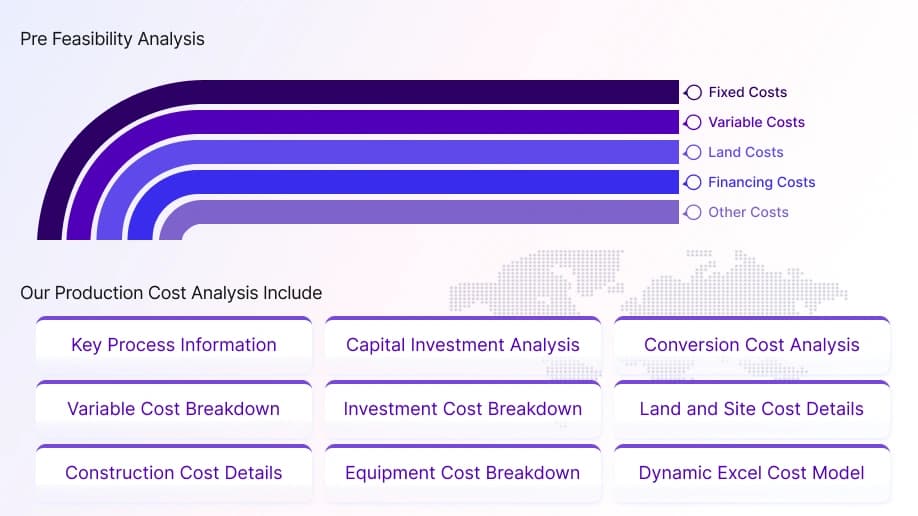
The report provides a detailed analysis essential for establishing a Apramycin Sulphate production plant. It encompasses all critical aspects necessary for Apramycin Sulphate production, including the cost of Apramycin Sulphate production, Apramycin Sulphate plant cost, Apramycin Sulphate production costs, and the overall Apramycin Sulphate production plant cost. Additionally, the study covers specific expenditures associated with setting up and operating a Apramycin Sulphate production plant. These encompass production processes, raw material requirements, utility requirements, infrastructure needs, machinery and technology requirements, manpower requirements, packaging requirements, transportation requirements, and more.
Apramycin Sulphate is a semisynthetic antibiotic substance that is obtained from Streptomyces tenebrarius. The compound is an aminoglycoside antibiotic that is resistant to a variety of gram-negative bacteria like Escherichia coli. Therefore, it is widely used for the treatment of bacterial infections in animals. Moreover, it also finds applications in aquaculture to control bacterial infections in fish farms and aquatic environments. Additionally, it is also employed in the form of an injection and an oral medication to treat bacterial infections in cattle, pigs, and chickens.
The demand for Apramycin Sulphate is driven by its application as a broad-spectrum antibiotic that makes it versatile for different veterinary applications. Its utilization in oral and injectable forms in the treatment of bacterial infections in animals, including pigs, calves, poultry, and other farm animals, further accentuates its demand in the veterinary medicine industry. Additionally, several critical factors influence industrial Apramycin Sulphate procurement, including the availability and cost of raw materials like Streptomyces tenebrarius, adherence to regulatory and quality standards, and the effect of technological advancements. Moreover, supplier relationships, efficient distribution and logistics, and compliance with safety protocols also contribute to creating procurement strategies.
Raw Material for Apramycin Sulphate
According to the Apramycin Sulphate production plant project report, the major raw material for Apramycin Sulphate production includes Streptomyces tenebrarius.
Production Process of Apramycin Sulphate
The extensive Apramycin Sulphate production cost report consists of the following industrial production process:
- Production via Fermentation: This method of production uses Streptomyces tenebrarius to produce Apramycin Sulphate as the final product. The process is initiated by the fermentation of Streptomyces tenebrarius in a rich-nutrient medium, which results in the synthesis of apramycin sulfate as the final product. This method produces apramycin sulfate with a purity of at least 85%.
Apramycin Sulphate is a complex that contains nine different water-soluble aminoglucoside antibiotics. It is an aminoglycoside antibiotic that is resistant to a variety of gram-negative bacteria. These antibiotics are extracted from the actinomycete Streptomyces tenebrarius through fermentation. The molecular formula of the compound is C21H43N5O15S, and its molecular weight is 637.66 g/mol. Moreover, the compound is also known as Apramycin Sulphate, and its flash point is 528.2°C. Additionally, the compound appears as a slightly yellow powder with a boiling point of 949.8°C at 760 mmHg. The compound is hygroscopic and gets easily dissolved in water. The compound is stored between 2-8oC.