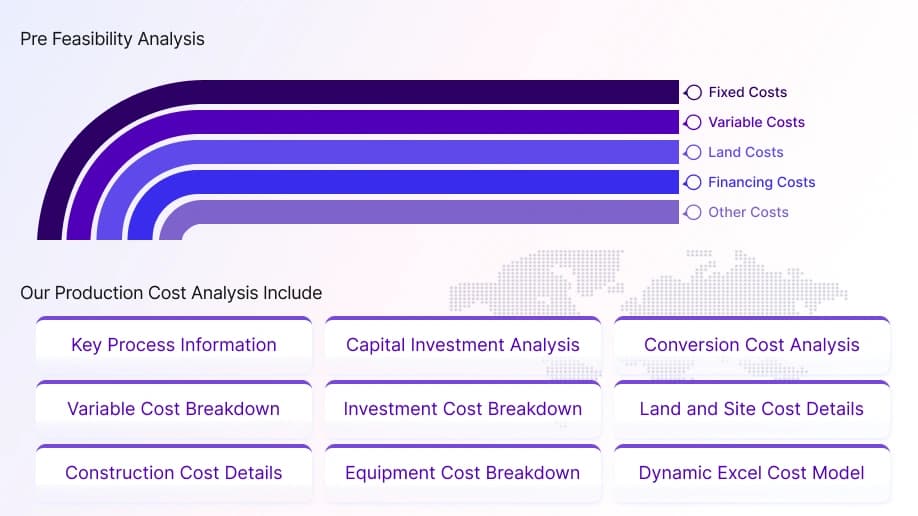
The report provides a detailed analysis essential for establishing an asphalt production plant. It encompasses all critical aspects necessary for ASPHALT production, including the cost of asphalt production, asphalt plant cost, asphalt production costs, and the overall asphalt production plant cost. Additionally, the study covers specific expenditures associated with setting up and operating an asphalt production plant. These encompass production processes, raw material requirements, utility requirements, infrastructure needs, machinery and technology requirements, manpower requirements, packaging requirements, transportation requirements, and more.
Asphalt is a chemical mixture, majorly considered as a binder or filler, and is associated with the construction sector. Asphalt is made up of binder, aggregates, and filler; it can be used in the construction industry for the development and maintenance of roads, railway tracks, bicycle lanes, parking areas, ports, airport runways, sidewalks, as well as sports areas.
Furthermore, the commodity is mainly employed in end-uses like road surfacing, which takes place by using Light oil "dust layer" treatments or by adding a granular aggregate to an asphalt coat. Also, it is used in many other applications, such as making the lining of canals and reservoirs, dam facings, and also other sea and harbour works. Apart from that, it can also be employed in applications such as coatings, roofs, soundproofing, floor tilings, waterproofing, and other construction activities.
The demand for asphalt serves as the prime factor that drives its market growth. The compound is used as a binder and filler in cement mixture. Its usage across construction activities strengthens its demand in the market. Its application in the preparation of cement and concrete mixtures for the construction of concrete structures drives its demand in the global market.
Industrial asphalt procurement is governed by various factors, including its demand as a filler and binder in concrete mixtures, along with its prices and logistics, etc. hence, the variation in its demand as a binder and filler, specifically in the construction industries, along with the changes in its prices and supply directly influences its procurement across the borders.
Raw Material for Asphalt Production
According to the asphalt production plant project report, the key raw material for asphalt production includes crude oil.
Production Process of Asphalt
The extensive asphalt production cost report consists of the major industrial production process:
- From Crude Oil Distillation: The production process of asphalt begins with the fractional distillation of crude oil. The crude content is heated, and after vaporization, asphalt is obtained as the end product.
Asphalt, also known as bitumen, is an extremely viscous liquid which is the glassy semi-solid form of petroleum. The commodity is present on the earth naturally and is available in deposits which can be further refined and classified as a pitch. There are many types of grades of asphalt, which include natural, residual, mastic, asphalt cement, cutback asphalt and asphalt emulsion.
The liquid appears to be brown or black in colour and has a sticky consistency. The commodity comprises a binder, filler, and aggregates which makes it an ideal choice for the construction industry. The commodity's main components are sulphur, carbon, oxygen, hydrogen, and nitrogen, and in tiny amounts, nickel, iron, and vanadium as well. Other properties of the commodity include being waterproof, having viscosity, plasticity as well as temperature sensitivity.