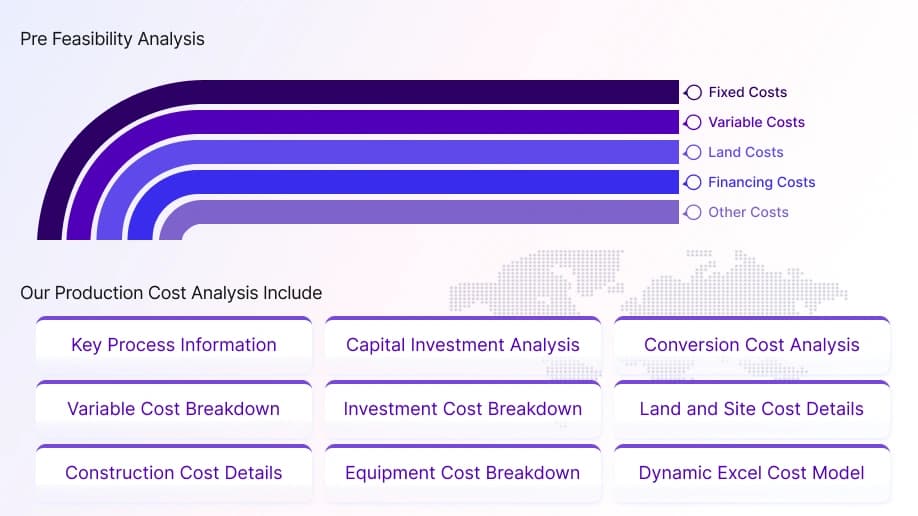
The report provides a detailed analysis essential for establishing an ATMP production plant. It encompasses all critical aspects necessary for ATMP production, including the cost of ATMP production, ATMP plant cost, ATMP production costs, and the overall ATMP production plant cost. Additionally, the study covers specific expenditures associated with setting up and operating an ATMP production plant. These encompass production processes, raw material requirements, utility requirements, infrastructure needs, machinery and technology requirements, manpower requirements, packaging requirements, transportation requirements, and more.
ATMP or Amino trimethylene phosphonic acid is an organic phosphonic acid compound that is widely used in water treatment applications. ATMP is an adequate scale inhibitor that is employed in several industrial applications, like water treatment on an industrial scale, cooling water systems, and detergents.
Due to its properties, like having good corrosion inhibition along with zinc and other such phosphates which makes it is an ideal chelating/sequestering agent in the textile industry. It is also used as a corrosion inhibitor for steel in the treatment of the metal surface. It also has use as a stabilizer in H2O2 solutions. Other end-uses of the product include its use in oilfields (injection water system), petrochemicals, paper & pulp industry, power plants, metal treatment, refineries, electroplating, inks & construction chemicals.
The market for ATMP is majorly driven by its applications in the treatment of industrial water and recirculated cooling water systems, which increases its demand in the water and waste-water treatment industries. It is also utilized as a chelating agent in textile industries and for its scale and corrosion-inhibiting properties for detergent and metal surfaces, which further accentuates its demand in the detergent and metal industry. Moreover, ATMP is often utilized in oilfields, petrochemicals, power plants, and refineries, which significantly enhances its demand in the petroleum, petrochemical, energy & utility, and oil & gas industries. Additionally, several factors influence an industrial ATMP procurement, such as the availability and cost of production of ATMP’s feedstock (phosphoric acid, ammonium chloride), ATMP market prices, distribution (including trading and shipping), logistics, environmental regulations, safety standards, etc.
Raw Material for ATMP Production
According to the ATMP production plant project report, the major raw materials for ATMP production include Phosphorous Acid-Ammonium Chloride.
Manufacturing Process of ATMP
The extensive ATMP production cost report consists of the following industrial production process:
- Production from Phosphorous Acid: This method involves the reaction of phosphorous acid with an aqueous solution of ammonium chloride, subsequently adding formaldehyde to the reaction vessel in a controlled temperature state. Further, after extracting the unreacted ammonium and HCl separately, a clear, pale-yellow liquid is produced.
Amino tris (methylene phosphonic acid) is a white, solid crystalline powder which is hygroscopic. It can be dissociated into six negative and positive ions in the water, forming a stable chelate with various metal ions like zinc, magnesium, copper, iron, aluminium, and calcium etc.
Amino tris (Methylene Phosphonic Acid) (ATMP) appears to be a clear aqueous solution which is either colourless or pale yellow and has a physical liquid state. It has excellent chelation, low threshold inhibition and lattice distortion. It has great scale inhibition below 200, good thermal stability, and low toxicity. The chemical has a melting and boiling point of ~215 °C (dec.) and 746.2±70.0 °C(Predicted). It is slightly water-soluble and has a water solubility of 500g/L at 20°C. Its density is 1.3 g/mL at 25 °C, with a PH of 0.46.