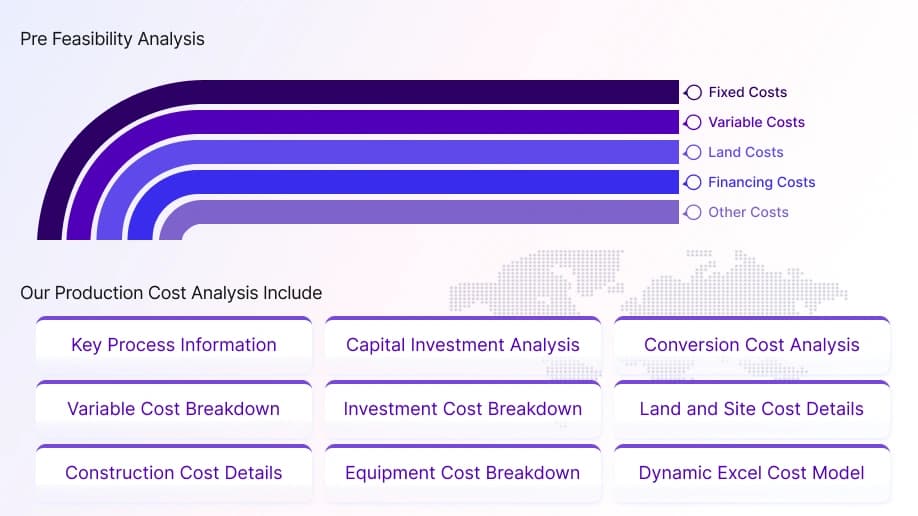
The report provides a detailed analysis essential for establishing an Azathioprine production plant. It encompasses all critical aspects necessary for Azathioprine production, including the cost of Azathioprine production, Azathioprine plant cost, Azathioprine production costs, and the overall Azathioprine production plant cost. Additionally, the study covers specific expenditures associated with setting up and operating an Azathioprine production plant. These encompass production processes, raw material requirements, utility requirements, infrastructure needs, machinery and technology requirements, manpower requirements, packaging requirements, transportation requirements, and more.
Azathioprine is a chemical compound that finds its primarily known for its immunosuppressive properties. The compound is widely used as an immunosuppressant to prevent organ rejection in patients who undergo transplants, including kidney, liver, and heart transplants. It also finds its application in the treatment and alleviation of pain associated with active rheumatoid arthritis. Additionally, it is also employed in combination with other immunosuppressive therapy to treat a wide range of autoimmune diseases, such as Crohn's disease, ulcerative colitis, multiple sclerosis, systemic lupus erythematosus (SLE), and others.
The market for Azathioprine is primarily led by its role as an immunosuppressive agent used alone or in combination with corticosteroids to inhibit rejection of organ transplants, which significantly increases its demand in the pharmaceutical industry. Moreover, its usage as a drug in the management of various autoimmune disorders, most commonly rheumatoid arthritis, further boost its demand in the medical and healthcare industries. Additionally, its employment as a combination drug to enhances overall therapeutic effectiveness effectively promotes its market growth. Overall, the availability of raw materials (6-mercaptopurine, etc.), cost and pricing, compliance with medical regulations, adherence to quality standards, distribution (including trading and shipping), logistics, safety standards, etc., are some of the major factors that influence industrial Azathioprine procurement to a great extent.
Raw Material for Azathioprine Production
According to the Azathioprine production plant project report, the major raw materials for Azathioprine production include 6-Mercaptopurine-5-Chloro-1-Methyl-4-nitroimidazol.
Production Process of Azathioprine
The extensive Azathioprine production cost report consists of the following industrial production process:
- Production via Heteroarylation: This method of production involves the process of heteroarylation of the sulfhydrile group of 6-mercaptopurine, which, upon further reactions, produces Azathioprine as the product. This method is initiated by the heteroarylation of the sulfhydrile group of 6-mercaptopurine, along with 5-chloro-1-methyl-4-nitroimidazol in the presence of sodium acetate (acts as a weak base) to obtain Azathioprine as the final product.
Azathioprine exists in the form of a pale-yellow crystalline powder that belong to the class of imidazoles and an aryl sulfide. The compound serves as a Nucleic Acid Synthesis Inhibitor. The molecular formula of the compound is C9H7N7O2S, and its molecular weight is 277.27 g/mol. Moreover, the compound is used as a drug that is largely marketed under the trade name Imuran. The compound is usually consumed as an oral tablet. Additionally, the melting point of the compound is 243-244°C, and its boiling point is 521.0°C. The density of the compound is 1.5379 gm/cm3, and its solubility in water is <0.1 g/100 mL at 23 ºC. The compound is not compatible with strong oxidizing agents and strong bases, and its pka value is 8.2(at 25).