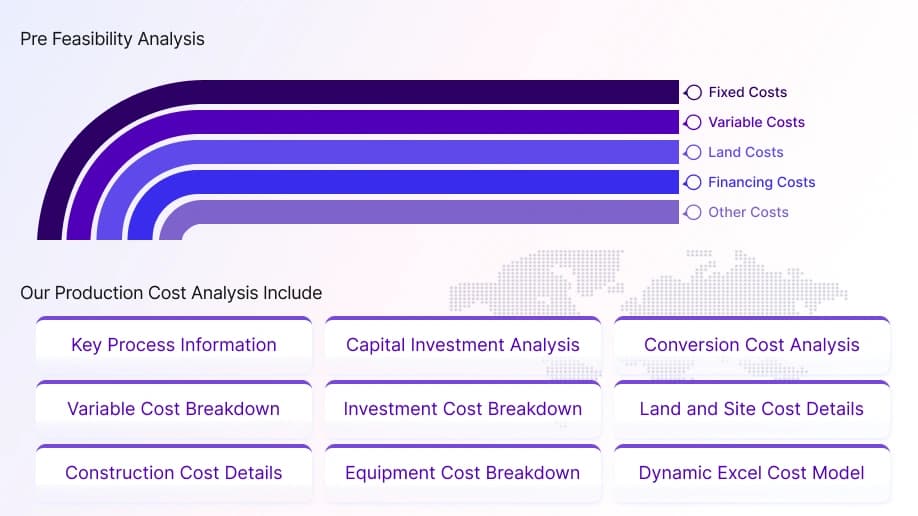
The report provides a detailed analysis essential for establishing a boric acid production plant. It encompasses all critical aspects necessary for boric acid production, including the cost of boric acid production, boric acid plant cost, boric acid production costs, and the overall boric acid production plant cost. Additionally, the study covers specific expenditures associated with setting up and operating a boric acid production plant. These encompass production processes, raw material requirements, utility requirements, infrastructure needs, machinery and technology requirements, manpower requirements, packaging requirements, transportation requirements, and more.
Boric acid is an acidic compound that is in high demand in a variety of end-use industries, including ceramics, glass, agriculture, and pharmaceuticals. Boric acid is increasingly being used as an insecticide and pesticide in agriculture and horticulture to protect crops and plants against pests and insects. Moreover, it is used as a flame retardant in a variety of applications, including textiles, polymers, and plastics. It serves as a preservative and antiseptic compound in medicines. It can be used to produce LCD glass panels that are further used in electronic devices such as cell phones, laptop computers, and televisions.
The market for boric acid is driven by its demand as a boron-based acidic compound in ceramics, glass, chemical, electronic, pharmaceutical, and agrochemical industries. Its usage in the production of boron-based insecticides and pesticides drives its demand in the agrochemical and agricultural sectors. Similarly, its involvement in ceramic and glass production, along with LED screen production, fuels its demand and contributes to its market growth. Additionally, its applications covering healthcare sectors for the preparation of medications boost its demand in the global market.
Industrial boric acid procurement is largely governed by various factors, including its production cost, market prices, logistics, demand as a boron-based acid, supply, etc. Hence, the shifts in these factors, majorly its prices, supply, and demand in the agrochemical, pharmaceutical, ceramic, glass, and electronic industries, have a prominent impact on its procurement across various regions.
Raw Material for Boric Acid Production
According to the boric acid production plant project report, the key raw material for boric acid production includes borates.
Production Process of Boric Acid
The extensive boric acid production cost report consists of the major industrial production process:
- From Borates: The production process of boric acid is initiated by the chemical reaction between borates and sulfuric acid. The reaction leads to the acidification of the borates and gives boric acid as the final product.
Boric acid is a Lewis acid that is weak and monobasic. It is a white crystalline solid that can be found as colourless crystals or as a fine powder. It is a moderately acidic weak acid that is widely utilised in industrial and home applications. It is made up of atoms of boron, oxygen, and hydrogen. It can be made from borax (sodium borate) or other borate minerals via an acidification process.
The melting point of boric acid is 170.9 °C and its boiling point is 300 °C. The density of boric acid is 1.435 g/cm³. It is soluble in water and glycerol, but insoluble in alcohol and ether. It is a weak acid with a pH of around 5.1. It has a low viscosity. The crystals of boric acid are transparent and have a refractive index of 1.34.