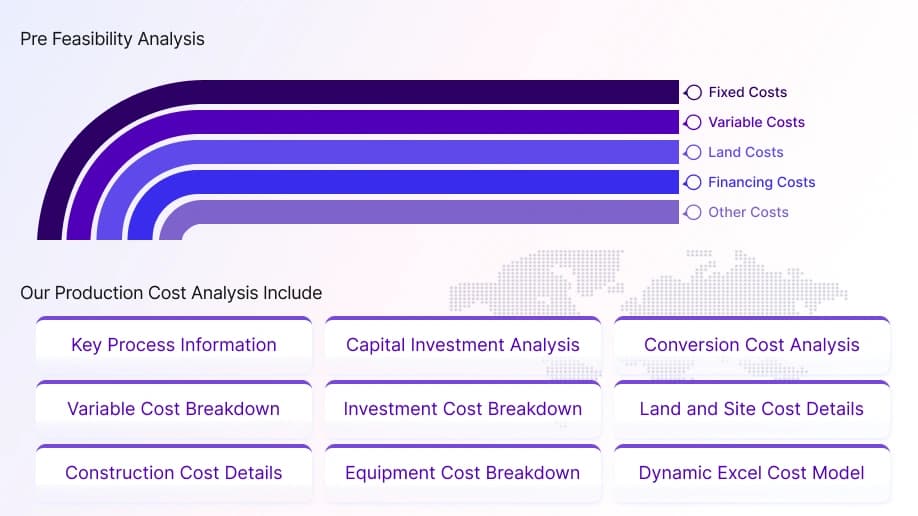
The report provides a detailed analysis essential for establishing a Bupivacaine production plant. It encompasses all critical aspects necessary for Bupivacaine production, including the cost of Bupivacaine production, Bupivacaine plant cost, Bupivacaine production costs, and the overall Bupivacaine production plant cost. Additionally, the study covers specific expenditures associated with setting up and operating a Bupivacaine production plant. These encompass production processes, raw material requirements, utility requirements, infrastructure needs, machinery and technology requirements, manpower requirements, packaging requirements, transportation requirements, and more.
Bupivacaine is an anesthetic agent used locally to block sensing in a particular region. It blocks the signals that the nerves send to the brain, thus allowing surgeons to operate, or treat a disease without causing pain to the patient. Bupivacaine is recommended for several uses, such as single-dose infiltration for local analgesia in patients six years of age and above and postsurgical analgesia for up to twenty-four hours following open inguinal hernia surgery in adults. It provides analgesia for up to 72 hours after several orthopedic and soft tissue operations when taken with meloxicam. Furthermore, Bupivacaine can be used for local or regional anesthetic in a variety of surgical, dental, diagnostic, and obstetric procedures, either by itself or in combination with epinephrine.
The procurement of Bupivacaine is influenced by its application in the pharmaceutical and medical industries as an anesthetic agent. Bupivacaine is a potent amide local anesthetic, effective as a postoperative analgesic, and is applied in the treatment of chronic pain disorders. The increasing cases of musculoskeletal disorders combined with the elderly population increases the need for Bupivacaine-based pain management.
The rising number of surgeries such as orthopedic, obstetric, and dental surgeries demand the usage of local anesthesia such as Bupivacaine, as it helps to discourage pain hence faster healing from the surgery, thereby amplifying its market appeal. Minimally invasive surgeries and the usage of ambulatory surgical centres are on the rise, which is driving the demand for Bupivacaine. Overall, industrial Bupivacaine procurement is influenced by its application in the pharmaceutical and medical industries as an anesthetic agent, rising cases of chronic pain disorders, rising number of surgeries, faster onset of action, and regulatory approvals.
Raw Material for Bupivacaine Production
According to the Bupivacaine production plant project report, the key raw materials used in the production of Bupivacaine include α-picolin-2,6-xylidide; piperidine-2-carboxylic acid chloride.
Production Process of Bupivacaine
The extensive Bupivacaine production cost report consists of the following major industrial production processes:
- Production from α-picolin-2,6-xylidide: The production process of Bupivacaine starts with the alkylation of α-picolin-2,6-xylidide with butyl bromide to form the corresponding pyridine salt. Finally, the salt undergoes reduction by hydrogen using platinum oxide as a catalyst to produce Bupivacaine.
Production from piperidine-2-carboxylic acid chloride: The production process of Bupivacaine starts with the reaction of the starting compound with 2,6-dimethylaniline to form an amide intermediate. Finally, the amide undergoes alkylation with butyl bromide to produce Bupivacaine.
Bupivacaine, commercially known as Exparel, is a white to off-white crystalline powder having the molecular formula C18H28N2O and a molecular weight of 288.4 g/mol. It has a melting point in the range of 107-108 °C. It has a water solubility of around 2400mg/L (at 25 °C). It has an estimated water solubility of 0.0977 mg/mL. It is soluble to some extent in acetone, chloroform, and ether. It has a log P value of 3.41. The value of its dissociation constant, pKa, is 8.1.