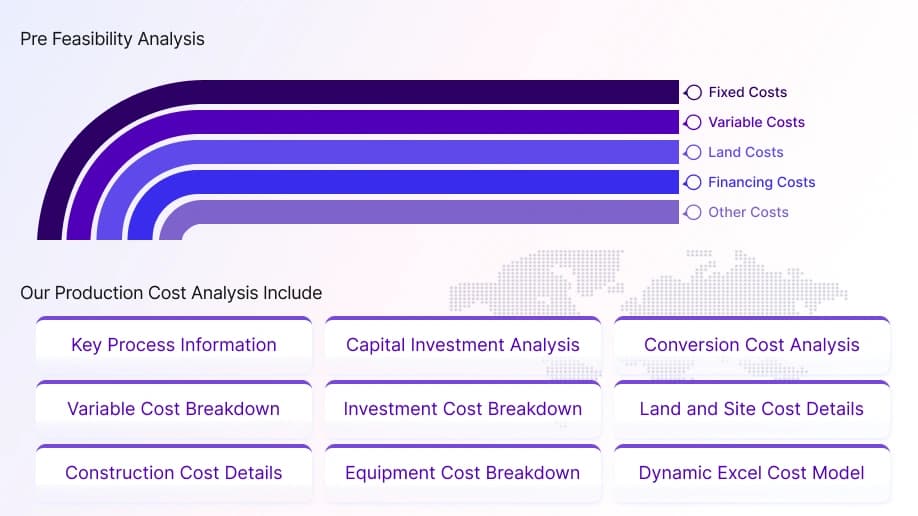
The report provides a detailed analysis essential for establishing a Calcium Carbide production plant. It encompasses all critical aspects necessary for Calcium Carbide production, including the cost of Calcium Carbide production, Calcium Carbide plant cost, Calcium Carbide production costs, and the overall Calcium Carbide production plant cost. Additionally, the study covers specific expenditures associated with setting up and operating a Calcium Carbide production plant. These encompass production processes, raw material requirements, utility requirements, infrastructure needs, machinery and technology requirements, manpower requirements, packaging requirements, transportation requirements, and more.
Calcium Carbide is a chemical compound mainly used to produce calcium cyanamide or nitrolime, calcium hydroxide and acetylene (which is a calcium carbide derivative) that is further used to produce PVC. It carries out sulfur removal in iron and from any material, which is called desulphurization. In addition, it is used as a deoxidizer that helps oxygen removal in steel production, as carbide lamps in lamps, and as headlights for automobiles. Moreover, it finds application in the production of chemicals for fertilizers and the steel industry for making and hardening steel. It is also employed with calcium phosphide in floating, self-igniting solar flares. Also, it is used in bamboo cannons as well as big-bang cannons.
The market for Calcium Carbide is driven by its usage as a reducing agent in metallurgical processes, which elevates its demand in steel production. Its usage to produce acetylene gas used in welding, cutting, and as a precursor for various chemical syntheses, fuels its market even further. Its function to produce various chemical compounds such as calcium cyanamide or nitrolime, calcium hydroxide and acetylene amplifies its market appeal. Its utilization as a ripening agent for fruits and as a precursor for calcium cyanamide, an important nitrogen fertilizer, boosts its demand in the agriculture industry. Overall, industrial Calcium Carbide procurement is influenced by its application in various industries such as steel, chemical, organic, and agricultural industries, the availability of its raw materials (lime and coke), the cost of its raw materials, regional growth, and technological advancements.
Raw Material for Calcium Carbide Production
According to the Calcium Carbide production plant project report, the key raw materials used in the production of Calcium Carbide include lime and coke.
Production Process of Calcium Carbide
The extensive Calcium Carbide production cost report consists of the following major industrial production process:
- Production from lime and coke: The production process of Calcium Carbide occurs in the electric arc furnace with lime and coke as the starting materials. The process starts with the reaction of lime and coke in an electric arc furnace at 2,200 °C (3,990 °F) to produce Calcium Carbide as the final product.
Calcium Carbide, with the chemical formula CaC2, is a chemical compound that in its pure form appears to be a colorless and odorless solid, while on the contrary, commercial Calcium Carbide can be found in a series of colours, either brown or grey, based on the impurities present (like magnesium, calcium, and other oxides). At room temperature, it is a crystalline solid and has a rock-like structure. Its technical grade produces an unpleasant odour like that of garlic in the presence of moisture. It is harmful to human consumption. It has a molecular weight/ molar mass of 64.099 g/mol and a density of 2.22 g/cm3. Its respective melting and boiling points are 2160 °C and 2300 °C.