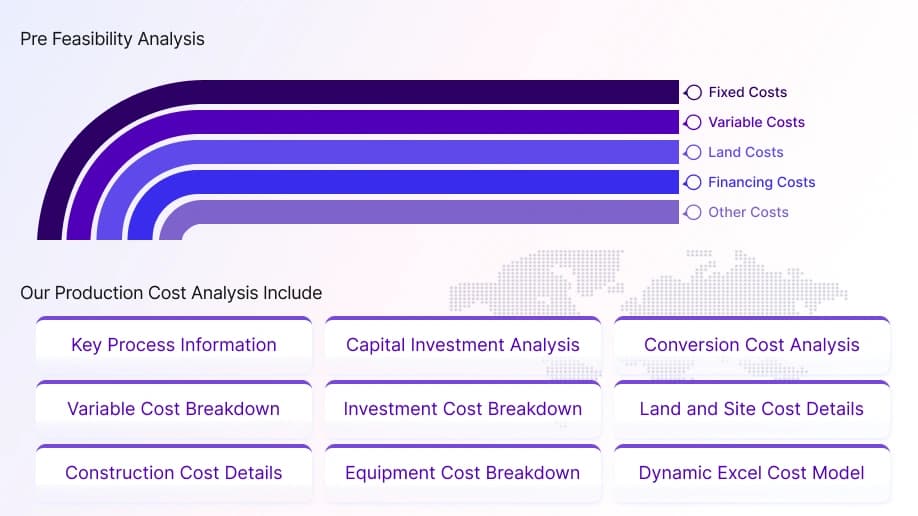
The report provides a detailed analysis essential for establishing a Calcium Carbonate production plant. It encompasses all critical aspects necessary for Calcium Carbonate production, including the cost of Calcium Carbonate production, Calcium Carbonate plant cost, Calcium Carbonate production costs, and the overall Calcium Carbonate production plant cost. Additionally, the study covers specific expenditures associated with setting up and operating a Calcium Carbonate production plant. These encompass production processes, raw material requirements, utility requirements, infrastructure needs, machinery and technology requirements, manpower requirements, packaging requirements, transportation requirements, and more.
Calcium Carbonate is a chemical compound that has several industrial applications. In the construction industry, it has been used as a natural raw material to produce cement as it makes high-quality, durable binders. It is employed in wine to lower acidity, and in food items, it works like an additive used in pastries, chewing gums, crisps, and cookies. In the beauty sector, it is used to manufacture face powders, baby powders, and eye shadows. It is added as a fertilizer to enrich impoverished soil and pH stabilization. Also, it is used widely as a pigment and filler in the paper and pulp industries. It can also be used to reduce water hardness in some water treatment processes and is also used in sewer treatment plants to get rid of impurities and acidity.
The market for Calcium Carbonate is driven by its usage as a filler material in cement, ceramics, and building materials, which elevates its demand in the construction industry. Its utilization as a filler in papers to enhance the quality and reduce costs of paper products amplifies its market in the paper and packaging industries. Its usage in plastic products boosts its demand even more in various sectors. Its role in dietary supplements and food fortification fuels its demand in the health and nutrition industries.
Its function to reduce water hardness contributes to its demand in water-treatment. Overall, industrial Calcium Carbonate procurement is influenced by its application in various industries such as construction, paper and packaging, plastics, healthcare and nutrition, and water treatment industries, the availability of its raw materials (soda lime and quick lime), the cost of its raw materials, and regulatory approvals.
Raw Material for Calcium Carbonate Production
According to the Calcium Carbonate production plant project report, the key raw materials used in the production of Calcium Carbonate include soda lime; quick lime.
Production Process of Calcium Carbonate
The extensive Calcium Carbonate production cost report consists of the following major industrial production processes:
- Production from soda lime: The production process of Calcium Carbonate involves soda lime as the raw material. The process starts with the reaction of carbon dioxide and water present in the soda lime to form carbonic acid. The carbonic acid is reacted with sodium hydroxide to give sodium carbonate and water. In the final step, sodium carbonate reacts with slaked lime (Ca(OH)2) to produce Calcium Carbonate.
- Production from quick lime: The production process of Calcium Carbonate starts with the addition of water to quick lime (calcium oxide) to form calcium hydroxide, followed by passing carbon dioxide to calcium hydroxide to precipitate out Calcium Carbonate as the final product.
Calcium Carbonate (CaCO3) is a white powder/colorless crystal that occurs in rocks in the earth's crust worldwide. It appears to be a white and odorless inorganic substance that is insoluble in water. It decomposes when heated (up to 825°C/1098 K) and reacts with acids. It is non-toxic and is usually referred to as fluffy powder. Its molecular weight is 100.0869 g/mol. It has a density of 2.8 g/cm³. Its pH value is in the range of 8 to 9.